Clear Sky Science · en
Unifying attoclock and Larmor measurements through position-resolved weak values
Why this ultra-fast question matters
When a quantum particle crosses an energy barrier it should not cross, it is said to "tunnel" through—a counterintuitive process at the heart of modern electronics, chemistry, and even nuclear physics. For decades, physicists have argued about a deceptively simple question: how long does tunneling actually take? Two of the most sophisticated "clocks" for timing this motion, called the attoclock and the Larmor clock, have given seemingly contradictory answers. This paper shows that both clocks can be described within a single framework, revealing why they disagree and what each really measures about the hidden journey of an electron. 
Two clocks, one puzzling tunnel
The controversy began when experiments using the attoclock appeared to show that an electron leaves an atom through tunneling with essentially no delay, at least for the simplest case of hydrogen. In contrast, experiments using the Larmor clock—where a magnetic field makes the particle’s internal spin rotate only while it is inside the barrier—found a clear, non-zero time spent in the forbidden region. At first glance, these results seemed irreconcilable, fueling debates about whether tunneling is instantaneous or takes a finite time. The authors take a different route: instead of favoring one clock over the other, they ask whether both can be recast in common quantum-mechanical language and, if so, whether they are truly timing the same thing.
Timing tunneling with gentle questions
The key concept used to unify the clocks is that of a “weak value” from quantum measurement theory. A weak measurement interacts only very gently with a system, and by repeating it many times and sorting the outcomes according to a chosen final state, one can extract a complex number whose real and imaginary parts describe subtle properties of the underlying process. Earlier work had already shown that the Larmor clock’s reading can be understood as a weak value of how long the particle’s wavefunction occupies the barrier region. In this study, the authors express the attoclock in the same language, but now as the weak value of a temporal delay encoded in how the electron’s wave reaches a distant detector. This allows a clean, apples-to-apples comparison: each clock is a weak value of a different quantity, with a different kind of post-selection.
Following the electron from barrier to detector
To make the comparison precise, the authors analyze a simple but realistic one-dimensional model of strong-field ionization, where an electron bound in a short-range potential is pulled free by a static electric field. In this setting, the barrier, its exit, and the electron’s classical escape path are all clearly defined. They compute how the Larmor time—the time accumulated locally inside the barrier—grows with position and saturates at the tunnel exit. At the same time, they recast the attoclock observable as a time delay tied to the ionization amplitude, and then relate the final measured momentum to positions along the electron’s path outside the barrier. This yields a “position-resolved” attoclock time that can be directly compared with the Larmor time along the same trajectory. 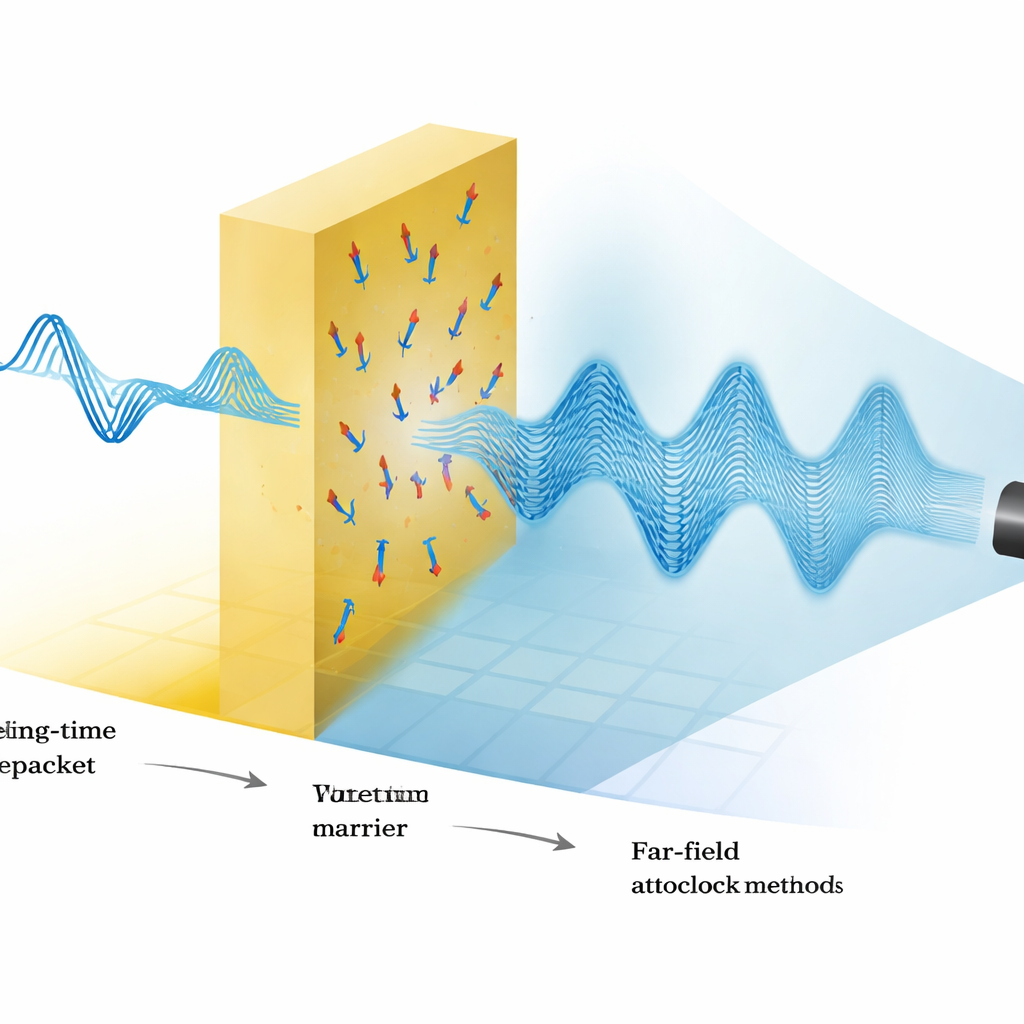
Why one time survives and the other fades
The comparison reveals a striking pattern. Near the tunnel exit, the attoclock time is indeed non-zero: there is a genuine quantum delay associated with the electron’s emergence into the classically allowed region. However, as the electron propagates further away and its motion becomes more classical, the attoclock time steadily diminishes and eventually vanishes by the time the electron reaches the far-field detectors used in real experiments. In contrast, the Larmor time, defined as a local time spent inside the barrier, remains fixed once the electron has left the forbidden region. Mathematically, both clocks are weak values, but of different operators; physically, one is a local clock sensitive to where the particle dwells, while the other is a non-local clock that reads out an overall phase-like delay imprinted in the outgoing wave.
What this means for the tunneling-time debate
The authors conclude that the attoclock does not, in fact, measure the same tunneling time as the Larmor clock and cannot be expected to reproduce its non-zero value, even in idealized conditions. Instead, the attoclock accesses a more global “delay” encoded in the ionization amplitude, closely related to phase-time concepts, which fades during the electron’s journey to the detector. The Larmor time, by contrast, is a genuinely local measure of how long the particle lingers within the barrier. In practical terms, this means that standard attoclock setups—where only the final electron momentum is recorded—cannot recover the full, position-dependent tunneling time. To access that information, one would need experiments capable of probing the electron’s spatial phase right at the barrier exit, similar in spirit to recent tunneling measurements with ultra-cold atoms.
Citation: Maier, P.M., Patchkovskii, S., Ivanov, M.Y. et al. Unifying attoclock and Larmor measurements through position-resolved weak values. Commun Phys 9, 135 (2026). https://doi.org/10.1038/s42005-026-02615-6
Keywords: quantum tunneling time, attoclock, Larmor clock, weak measurements, strong-field ionization