Clear Sky Science · en
Topology made visible through standing waves in a spinning fluid
Ripples That Reveal Hidden Order
Imagine dropping a stone in a pond and seeing not just simple ripples, but patterns that quietly encode ideas from quantum physics. This study shows that something as familiar as water waves swirling around a drain can imitate a famous quantum effect and make its hidden “topological” structure visible across the whole system. In other words, the researchers use a spinning pool of water to turn an abstract concept from modern physics into a striking, camera-ready pattern of lines and ripples.
A Quantum Idea Brought to the Water Tank
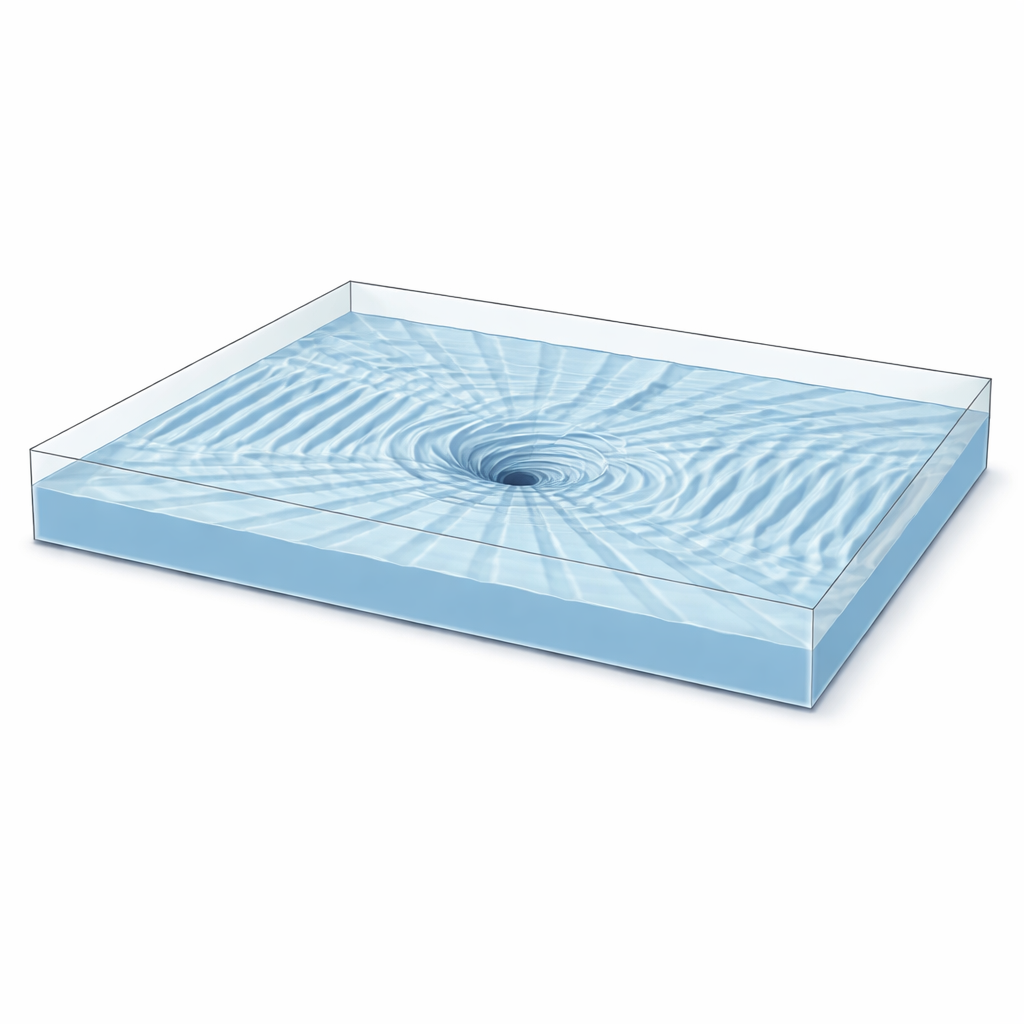
At the heart of the work is the Aharonov–Bohm effect, a counterintuitive quantum phenomenon where charged particles are influenced by a magnetic field even when they never pass through it directly. Traditionally this lives in the world of electrons and magnetic coils, far from everyday experience. Here, the authors recreate a close analogue using surface waves in a shallow water tank. They generate a controlled whirlpool—a vortex—by draining water at a constant rate, and then send waves across the surface from two opposite sides so that they meet and form a standing pattern. By carefully choosing the water depth, flow speed, and wave properties, they ensure that the equations for these water waves closely mirror those that describe quantum particles in the Aharonov–Bohm setup.
A Surprising Network of Silent Lines
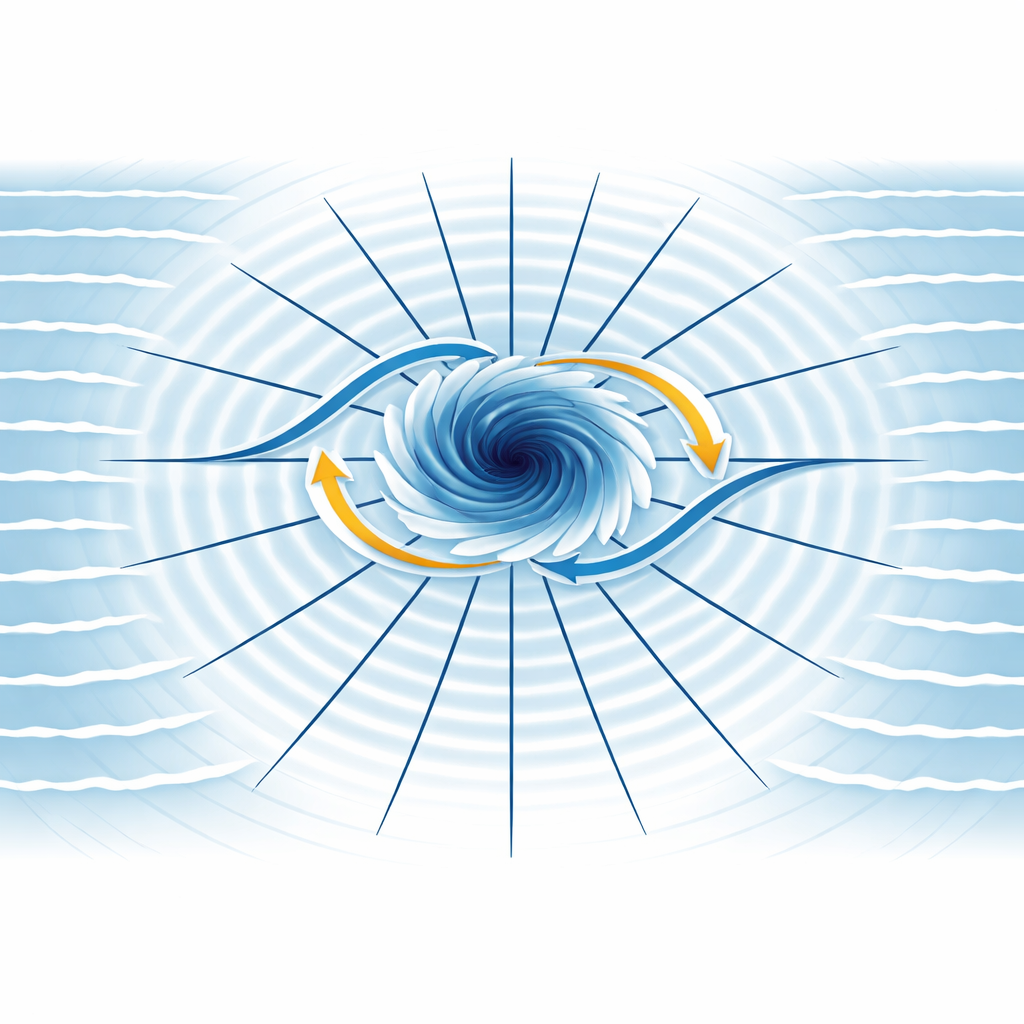
The researchers expected that when two sets of waves met around the vortex, any small disturbances in their crests might cancel or simply remain confined near the spinning core. Instead, they observed something startling: thin lines of zero wave motion—called nodal lines—radiating outward from the center and stretching across the entire observable region. Along these lines, the water surface barely moves, even while waves pass on either side. High-speed imaging and a clever lighting method, which converts tiny surface bumps into bright and dark caustic patterns on a screen, reveal these nodal lines as dark, almost motionless streaks cutting through the shimmering ripples.
Counting and Timing the Hidden Structure
These nodal lines are not random. Their number is “quantized”: for each value of a dimensionless parameter that measures the strength of the vortex relative to the waves, only certain counts of nodal lines are allowed. When that parameter takes an integer value, the number of lines matches its magnitude; when it lies between integers, the number of lines oscillates between the nearest whole numbers as time passes. The lines also slowly rotate around the vortex at a well-defined rate, with direction set by the sign of the circulation. On crossing one of these lines, the wave pattern flips its phase—crests become troughs and vice versa—signalling a sharp shift in how the waves interfere. Detailed theory, based on rewriting the shallow-water equations in a form that mimics the Schrödinger equation of quantum mechanics, predicts exactly these rotating, system-spanning nodal structures, and the experiments closely match the calculations without adjustable fitting tricks.
A Playground for Exotic Wave Effects
Because the pattern of nodal lines depends only on the large-scale swirling flow and not on the fine details near the vortex core, the effect is robust and truly global. This makes the spinning-water system a powerful testbed for exploring exotic wave behaviors that, in quantum systems, are notoriously hard to control and observe directly. The authors point to future possibilities such as mimicking “Aharonov–Bohm caging,” in which waves become trapped in place purely through destructive interference, and designing fluid analogues of metamaterials that steer light, sound, or even particles using engineered patterns of vortices. By tuning the vortex strength and shaping the incoming waves, researchers may probe how such interference-driven localization and topological organization emerge.
What This Means Beyond the Lab
In everyday language, this work shows that a spinning pool of water can act like a magnifying glass for some of the most elusive ideas in quantum physics. Instead of invisible phases and abstract fields, the influence of a central “hidden” source—the vortex—shows up as long, rotating lines where waves cancel out. These visible standing-wave patterns provide a clear window into how waves and topology intertwine, and suggest that table-top fluid experiments can help guide the design of new photonic, acoustic, and quantum materials that rely on interference and geometric structure rather than ordinary forces. The ripples on water thus become a tangible proxy for the strange, non-local influences that shape quantum behavior.
Citation: Singh, A., Rønning, J., Liu, CC. et al. Topology made visible through standing waves in a spinning fluid. Commun Phys 9, 123 (2026). https://doi.org/10.1038/s42005-026-02603-w
Keywords: Aharonov–Bohm effect, water waves, vortices, topological interference, metamaterials