Clear Sky Science · en
Direct evidence of non-acoustic collective modes in dynamics of molten Carbon
Why hot liquid carbon matters
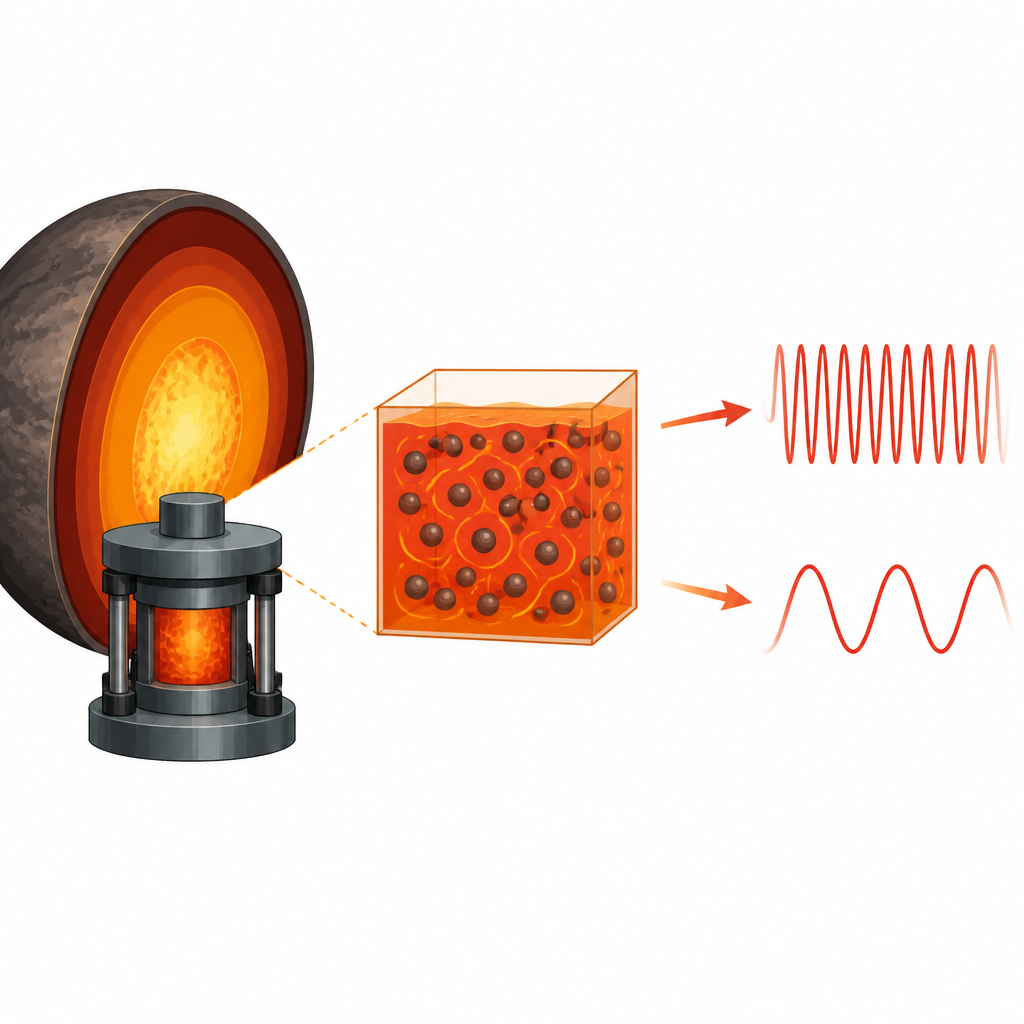
Carbon is the backbone of life on Earth, but under the crushing pressures and blistering temperatures inside planets or fusion devices it turns into a dense, fiery liquid. Understanding how this molten carbon behaves is important for modeling the deep interiors of carbon rich worlds, designing advanced materials, and planning extreme industrial processes. This study looks beyond the usual picture of sound waves in liquids and uncovers a hidden type of collective motion inside liquid carbon that had never been clearly seen in a simple one component liquid before.
Looking for hidden waves in a strange liquid
On large scales, liquids behave like smooth continua where familiar sound waves carry pressure disturbances. At microscopic scales, however, atoms jostle one another in far more complex ways. The authors focus on molten carbon at about 5500 kelvin and pressures between 10 and 40 gigapascals, conditions similar to those deep inside giant planets or produced in powerful lasers. Earlier experiments had already shown that liquid carbon forms a dense, four coordinated network with short lived bonds, but how groups of atoms move together under these conditions was still poorly understood.
Simulations that watch atoms in real time
To track these motions, the team used two kinds of computer simulations. First, they ran ab initio molecular dynamics, which follow the motion of 600 carbon atoms using quantum mechanical calculations of the forces between them. Second, they trained a machine learning potential on those results and simulated more than 16000 atoms, extending the size and time scales they could explore. From these simulated trajectories, they computed how currents of atoms fluctuate over time and converted these fluctuations into spectra that reveal which collective vibrations are present at different length scales.
A surprising second wave appears
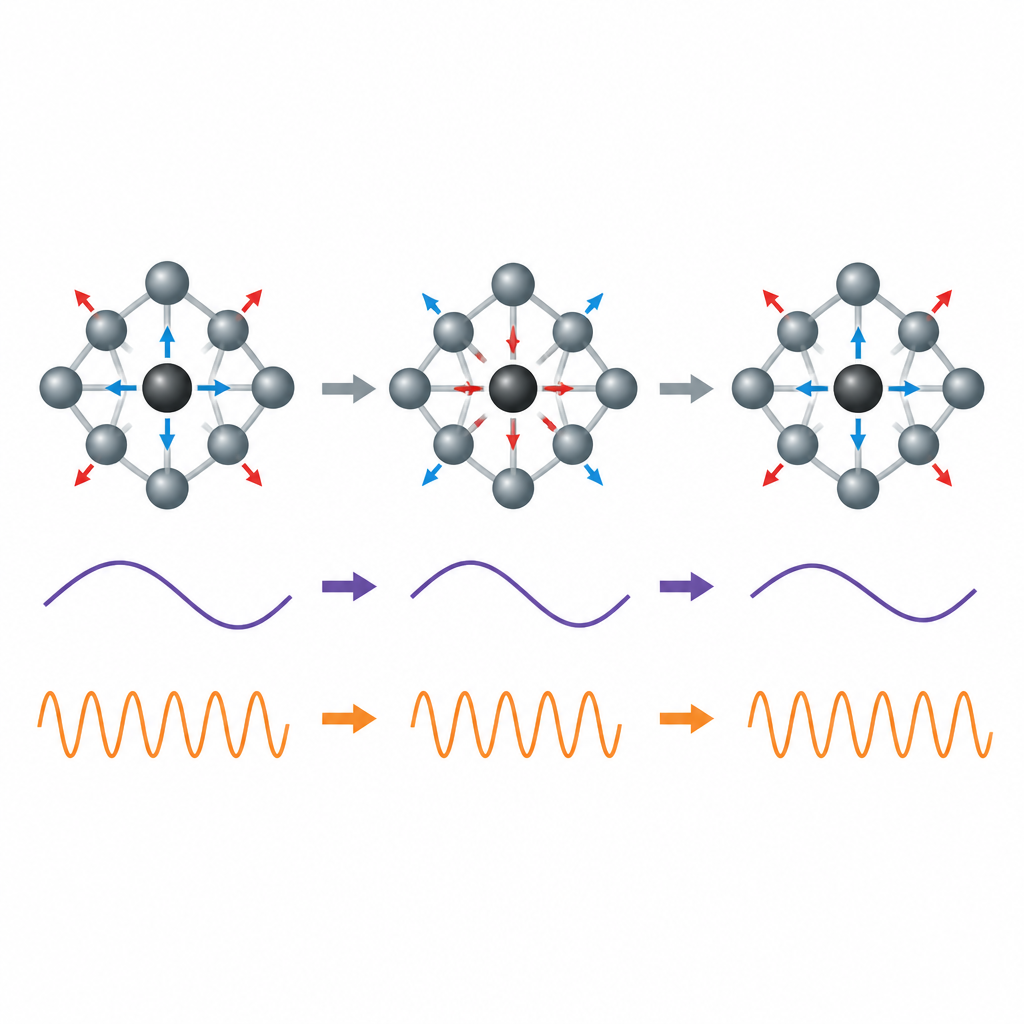
In a normal simple liquid, the spectrum of longitudinal motion, similar to sound, shows a single peak at each wavelength corresponding to one propagating mode. In molten carbon the authors found something strikingly different. For wavelengths shorter than about six angstroms, the longitudinal spectrum splits into two distinct peaks, signaling two separate propagating branches: a high frequency branch that behaves like an ordinary acoustic wave, and a lower frequency branch that cannot be explained by standard hydrodynamics. At the same time, transverse shear waves remain single peaked, and the two longitudinal branches do not merge with the shear branch, ruling out a simple mixing of directions as the cause.
Out of step atoms and their moving cages
To uncover the origin of the extra branch, the researchers introduced a new way of looking at motion in the liquid. Instead of tracking the total current of all atoms, they defined a mutual current for each atom that measures how it moves relative to the cage of its nearest neighbors. This quantity is constructed so that it is independent of the ordinary flow. When they calculated spectra of this out of phase motion, they found a single peak whose position matched the lower frequency branch of the longitudinal spectrum across a range of wavelengths and pressures. In other words, the extra mode corresponds to atoms rattling against their temporary cages within the medium range structure of the liquid, not to simple compression waves.
What this reveals about liquid carbon
The study shows that molten carbon, even though it is made of only one type of atom, supports an additional non acoustic collective mode that travels through the liquid alongside normal sound. This mode arises from coordinated, out of step motion between atoms and their neighbors and is linked to the medium range order in the dense liquid network. By combining quantum based simulations, machine learning, and a generalized theory of collective modes, the authors provide direct evidence for this hidden branch of excitations. For non specialists, the key message is that under extreme conditions even a seemingly simple fluid can host richer, cage like vibrations that may influence how heat, sound, and momentum move through planetary interiors and advanced materials.
Citation: Bryk, T., Ruocco, G., Wax, JF. et al. Direct evidence of non-acoustic collective modes in dynamics of molten Carbon. Commun Phys 9, 187 (2026). https://doi.org/10.1038/s42005-026-02602-x
Keywords: molten carbon, collective modes, liquid structure, molecular dynamics, planetary interiors