Clear Sky Science · en
Path-optimized fast quasi-adiabatic driving in coupled elastic waveguides
Guiding waves along the shortest safe route
Modern technologies from quantum computers to tiny sensors often need to move energy or information from one place to another without losing it along the way. A familiar rule says that if you change a system slowly enough, it will quietly follow along without jumping into unwanted states. But slow usually means bulky devices and wasted time. This research asks a simple question with far-reaching consequences: can we carefully plan a faster route that still keeps the system on track?
Why slow change usually keeps systems calm
Physicists rely on a principle that says a system will stay in its preferred pattern of motion if you adjust its surroundings gently. In quantum devices this preferred pattern is a quantum state, while in more everyday materials it can be a special way that waves move. When changes are rushed, the system can "slip" into other patterns, wasting energy or scrambling signals. These slips, called unwanted transitions, become especially common near gaps in the system’s allowed behaviors, where even tiny jolts can throw it off course.
Building a tabletop model of a tricky quantum problem
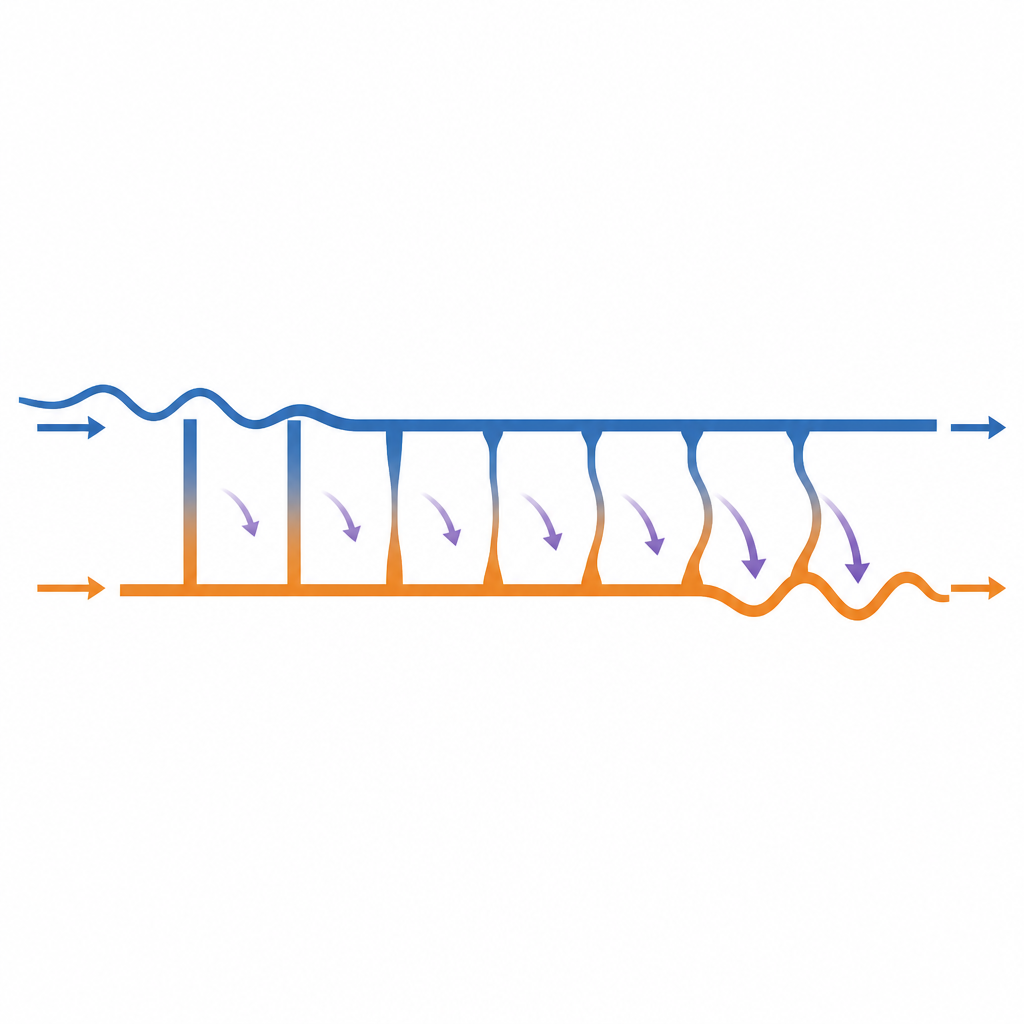
To explore how to avoid such slips while speeding things up, the authors build a tangible mechanical model. They use two long, thin beams that guide bending vibrations, linked by many tiny bridges. By changing the thickness of each beam and the shape of the bridges along the length, they can steer how vibrating energy moves between the two guides. This setup acts as a stand-in for more abstract quantum systems but is easy to measure directly with laser instruments that map how the beams shake in space.
Finding not just the speed but the right path
Earlier tricks for making slow-like behavior fast focused mostly on how quickly a single control knob was turned. In this work, two knobs matter at once: how strongly the beams are linked and how different they are from each other. Together these form a landscape of possibilities. Instead of marching straight across this landscape, the team uses a mathematical search to find a gentler path that bends around the most dangerous zones where slips are likely. Once that path is chosen, they then adjust how quickly they move along each part so the system feels a nearly constant level of "gentle push" everywhere, never too large and never wasted.
Watching energy follow the designed route
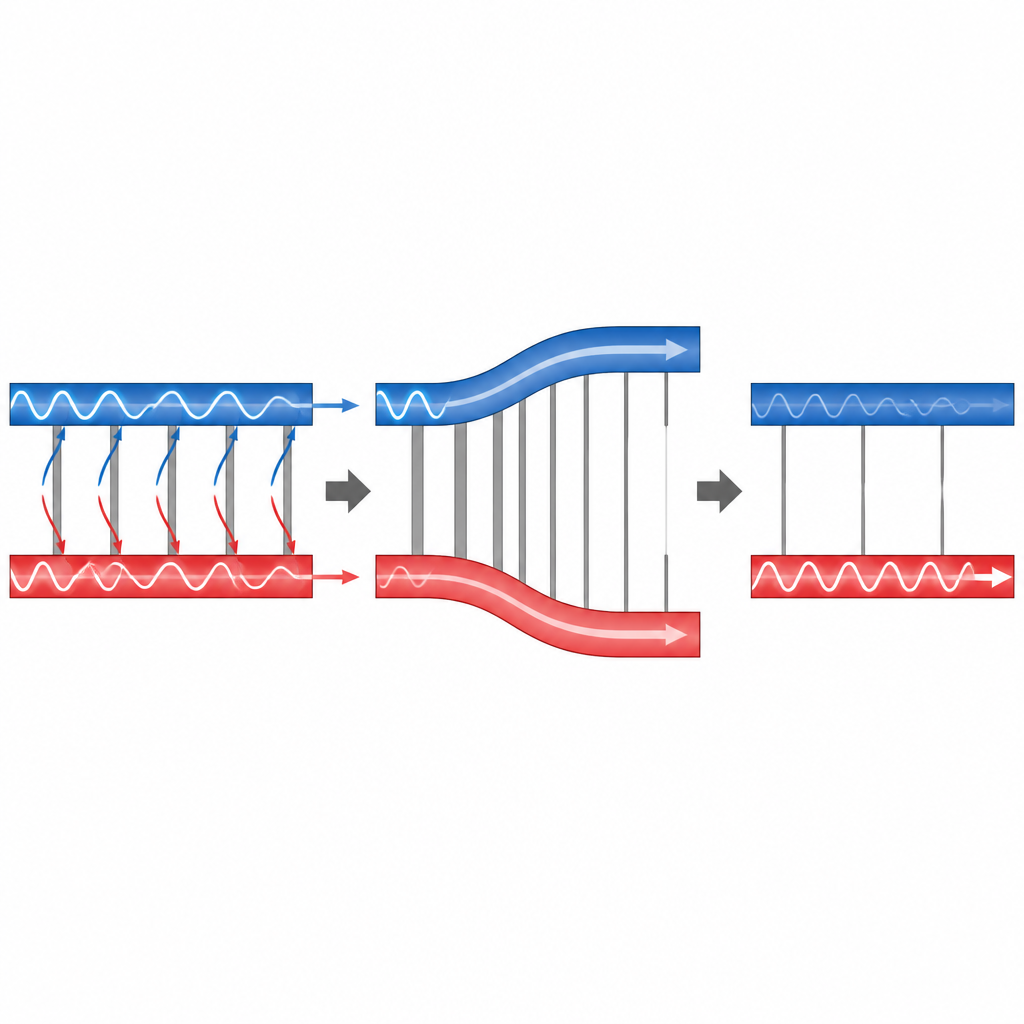
The researchers test two designs that start with vibrations in the upper beam and aim to end with vibrations in the lower beam. In the first design, they simply vary one property in a straight line along the structure. In the second, they follow the carefully optimized path and speed profile. Using computer simulations and laser measurements of real printed samples, they track where the energy travels. In the straight-line design, a short device fails to complete the transfer: energy ends up split between both beams, showing that slips have occurred. In the optimized design with the same length, energy smoothly leaves the upper beam and arrives almost entirely in the lower one, as if the system had evolved very slowly.
A faster route that still feels gentle
To a non-specialist, the key message is that the authors show how to plan both the route and the pace of change in a complex system so it behaves as if it had all the time in the world, even when it does not. By combining a smart path through the design space with a carefully chosen speed along that path, they restore calm, adiabatic behavior in a region where rough changes would normally cause trouble. Their tabletop elastic device provides a clear window into the process and hints that similar ideas could help design compact, efficient components for guiding waves or signals in many different technologies.
Citation: Liu, D., Hao, Y., Luo, L. et al. Path-optimized fast quasi-adiabatic driving in coupled elastic waveguides. Commun Phys 9, 175 (2026). https://doi.org/10.1038/s42005-026-02599-3
Keywords: adiabatic control, elastic waveguides, shortcuts to adiabaticity, metamaterials, wave energy transfer