Clear Sky Science · en
Magneto-optical observation of electrically generated orbital polarization in pristine Cu and oxidized Cu
Why tiny twists of electrons matter
Electrons do more than carry charge; they also possess a tiny built-in motion that can take the form of spin or orbital motion around atoms. While spin has already powered technologies such as magnetic memories and sensors, scientists are now exploring how to harness the orbital motion as well. This study shows how ordinary copper, both clean and slightly rusted, can convert electrical current into ordered orbital motion of electrons, revealing new ways to store and manipulate information in everyday metals.
From spin electronics to orbital electronics
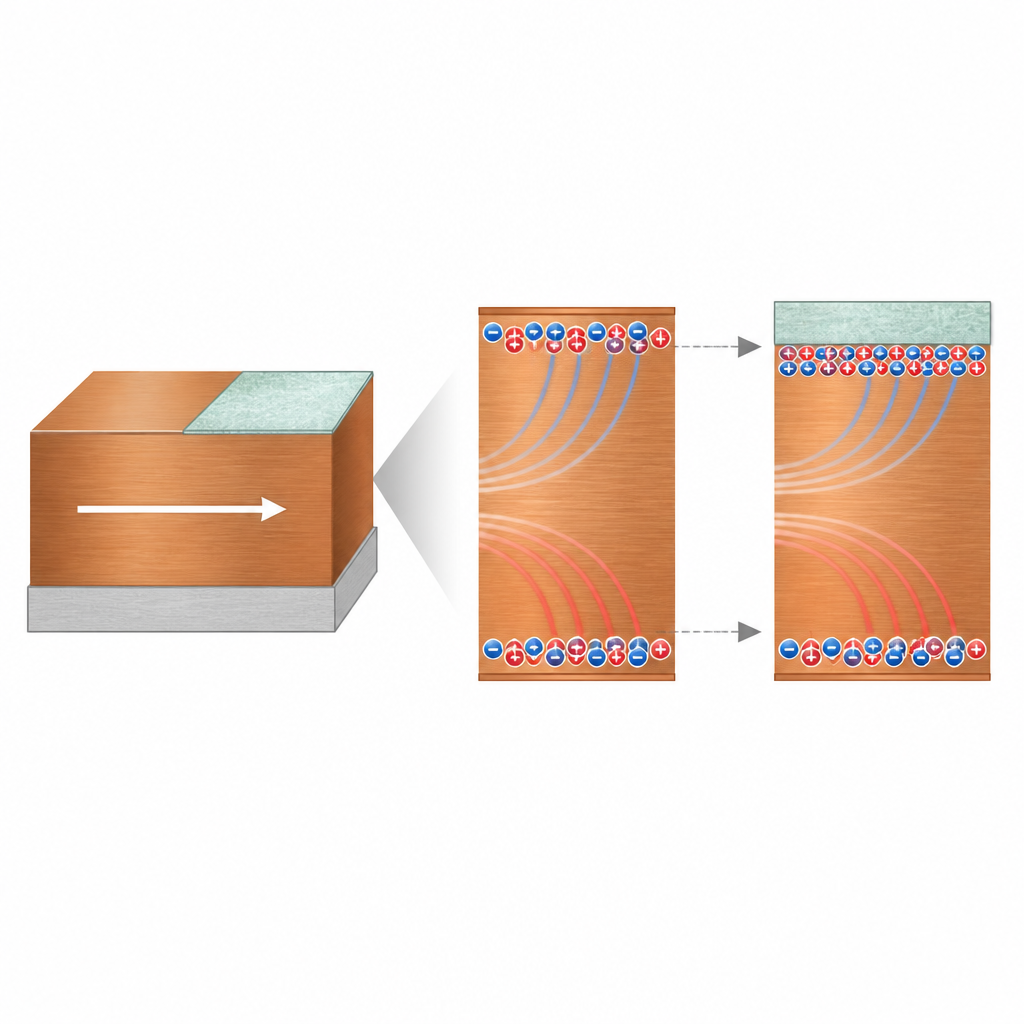
Much of modern research in nanoelectronics has focused on spintronics, which uses the spin of electrons to process information. Recently, theorists predicted that the orbital motion of electrons could also be generated and guided by electric currents, giving rise to the emerging field of orbitronics. Two key processes are involved. In a perfectly symmetric metal, a sideways flow of orbital motion can appear when current runs through the material, piling up opposite orbital states at opposite edges. In a material where symmetry is broken at a surface, current can instead create orbital motion directly at that boundary. Copper, a common wiring metal with weak spin effects, was proposed as a promising platform for such orbital effects, especially when its surface is oxidized.
Watching orbital motion with light
Previous hints of orbital behavior in oxidized copper came indirectly from measurements involving extra magnetic layers, which made it hard to tell orbital and spin effects apart. Here, the researchers took a more direct approach. They fabricated thin copper films of various thicknesses, either capped immediately to keep them pristine or briefly exposed to air to form a thin copper oxide layer on top. They then shone polarized light on the films while sending an electric current along them. The reflected light rotates slightly in the presence of magnetic or orbital moments, a phenomenon known as the magneto optical Kerr effect. Because copper responds much more strongly to orbital motion than to spin in this optical test, the technique acts as an orbital selective probe.
How pure copper moves orbital motion
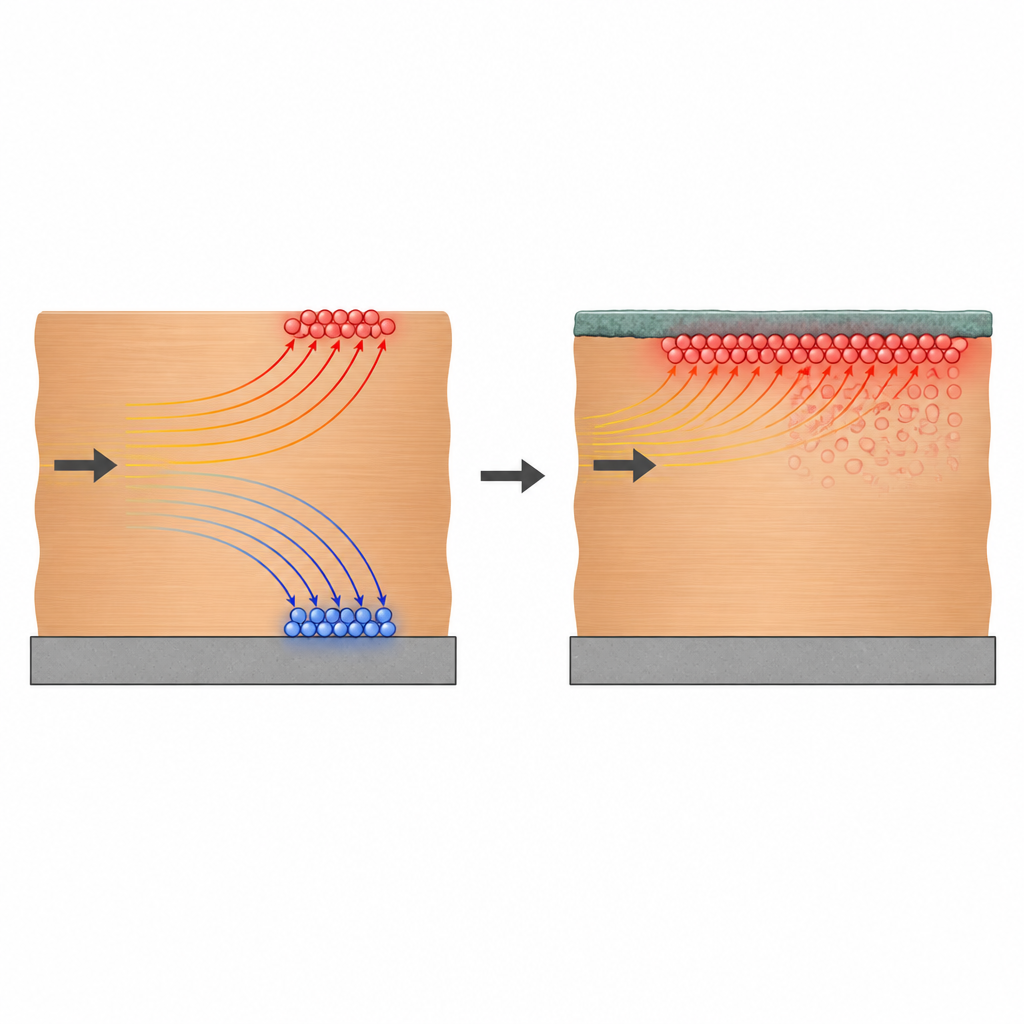
In pristine copper, the team detected a measurable rotation of the reflected light that grew with film thickness and eventually saturated. By modeling how orbital motion builds up and relaxes across the film, and comparing the data with detailed calculations of copper’s response, they concluded that the effect comes from a sideways flow of orbital motion inside the bulk of the metal. This bulk process is the orbital analogue of the well known sideways deflection of spins in the spin Hall effect. The analysis revealed that orbital motion in copper loses its memory over only about 8 nanometers, far shorter than the roughly 400 nanometers over which spin remains coherent in the same metal. At the same time, the orbital response to current is strong, indicating that copper is unexpectedly effective at generating orbital motion in its interior.
What oxidation does at the surface
When the copper surface was allowed to oxidize naturally, forming a copper oxide cap only a couple of nanometers thick, the behavior changed in a striking way. Thin oxidized films, where bulk effects should be weak, showed a much larger light rotation than their pristine counterparts, and this signal barely changed as the copper layer was made thicker. Such thickness independence is the hallmark of a process confined to an interface. The authors attributed it to an orbital counterpart of a well known surface effect, where broken symmetry at the copper–oxide boundary lets current generate orbital motion right at that junction. The orbital moments created at the surface then seep a short distance into the underlying copper, consistent with the same short relaxation length found in the bulk.
How orbital motion flows and fades
From their measurements, the researchers could estimate how quickly orbital motion spreads and how fast it dies out. They found that orbital motion diffuses much more slowly than electric charge and also more slowly than spin in many materials. This suggests that the crystal environment in copper strongly ties orbital motion to the lattice, making it easier for orbitals to lose their direction even while charge carriers continue to flow freely. The stark contrast between orbital and spin behavior means that traditional pictures borrowed from spin transport cannot simply be reused for orbitronics. Instead, orbital motion demands its own transport rules.
New routes for orbitronic devices
In simple terms, this work shows that running a current through ordinary copper can line up the tiny orbital loops of electrons, both inside the metal and at its oxidized surface, and that light can directly see this alignment. The measurements provide clear evidence that bulk and surface processes both contribute to orbital generation in copper, each with its own characteristic length scale. By separating orbital effects from spin and quantifying how orbital motion moves and relaxes, the study lays groundwork for future devices that use orbital currents to control magnetism or carry information, potentially adding a new degree of freedom to electronic technology.
Citation: Ko, KH., Jo, D., Oppeneer, P.M. et al. Magneto-optical observation of electrically generated orbital polarization in pristine Cu and oxidized Cu. Commun Phys 9, 174 (2026). https://doi.org/10.1038/s42005-026-02595-7
Keywords: orbitronics, copper thin films, orbital Hall effect, magneto optical Kerr effect, orbital transport