Clear Sky Science · en
Collective dynamics of polar nanoregions enhance electrical properties via solid-solution-induced entropy increase in KBT relaxors
Why tiny regions in crystals matter
Electronics in cars, medical scanners, and even tiny sensors depend on special ceramics that bend when hit with electricity and store electrical energy. This study explores how invisible clusters inside one such ceramic can be rearranged by clever chemistry so that the material stretches more and stores energy better, all without using toxic lead.
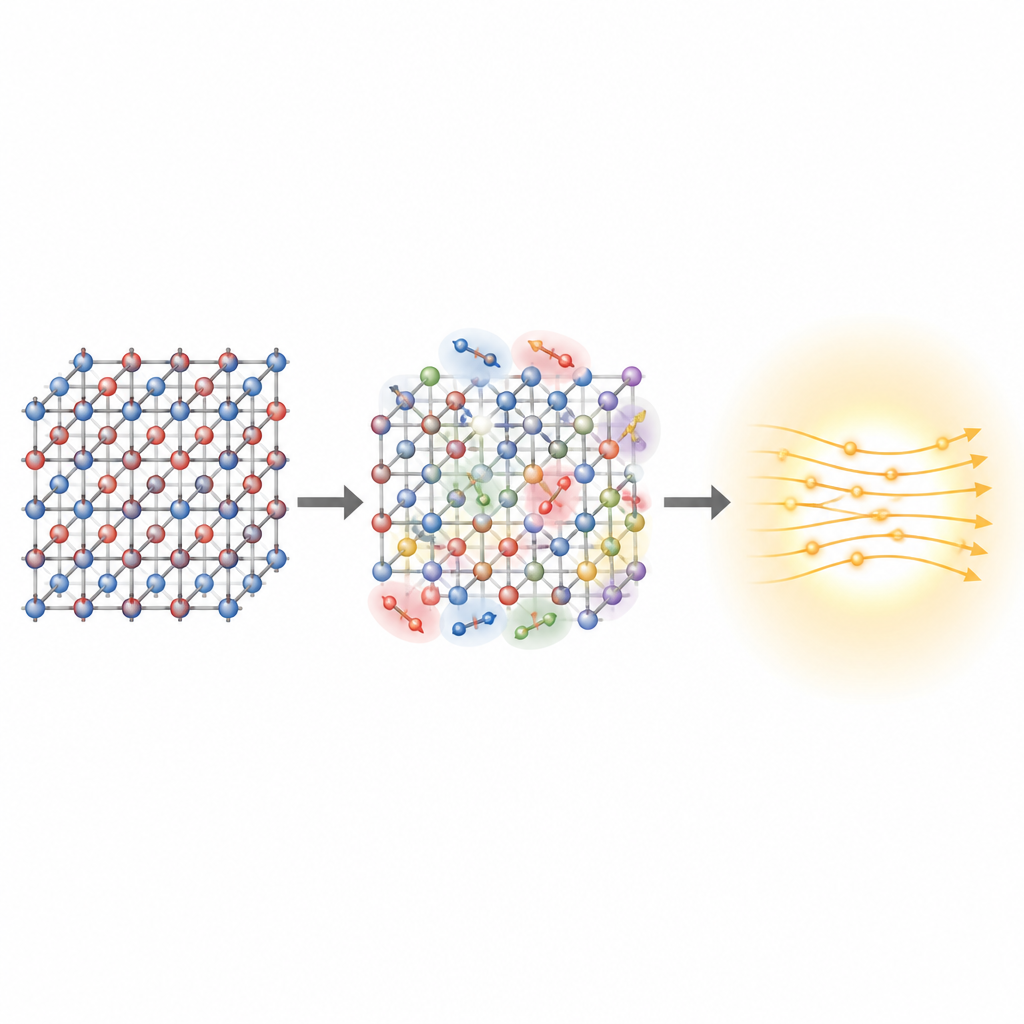
From neat order to useful disorder
The researchers focus on a relaxor ferroelectric ceramic based on potassium, bismuth, and titanium. In its pure form, this material has regions where electric dipoles line up over long distances, like soldiers on parade. By mixing in a second compound containing nickel and zirconium, they deliberately increase the chemical “messiness” inside the crystal. This added disorder breaks up the long-range alignment into many tiny polar nanoregions, small clusters only a few billionths of a meter across whose dipoles point in different directions.
Shaping grains and crystal phases
Microscope and X-ray studies show that the added ingredients do more than just shuffle atoms. They change the size of the ceramic grains and shift the crystal between two shapes: a tetragonal form and a nearly cubic form. At certain mixing levels, both shapes coexist in about equal amounts. This balanced state, called a morphotropic phase boundary, is known to make it easier for dipoles to rotate when an electric field is applied. At the same time, grain sizes first shrink and then grow again as the chemical recipe changes, reflecting a competition between processes that block and promote grain growth.
How tiny polar clusters team up
Electron microscopy reveals that the polar nanoregions do not stay isolated. As their number increases and size shrinks to about 2–4 nanometers, they begin to self-assemble into larger patterns that run from about 10 up to 1000 nanometers across. These appear as spots, stripes, and lamellar bands embedded in a nonpolar background. The authors model this behavior with a mathematical framework known as a reaction–diffusion model, specifically the Gray–Scott model. In this picture, small mobile polar clusters aggregate into larger, more sluggish ones, while competing interactions and local fields cause the clusters to organize into stable patterns reminiscent of Turing patterns seen in chemistry and biology.
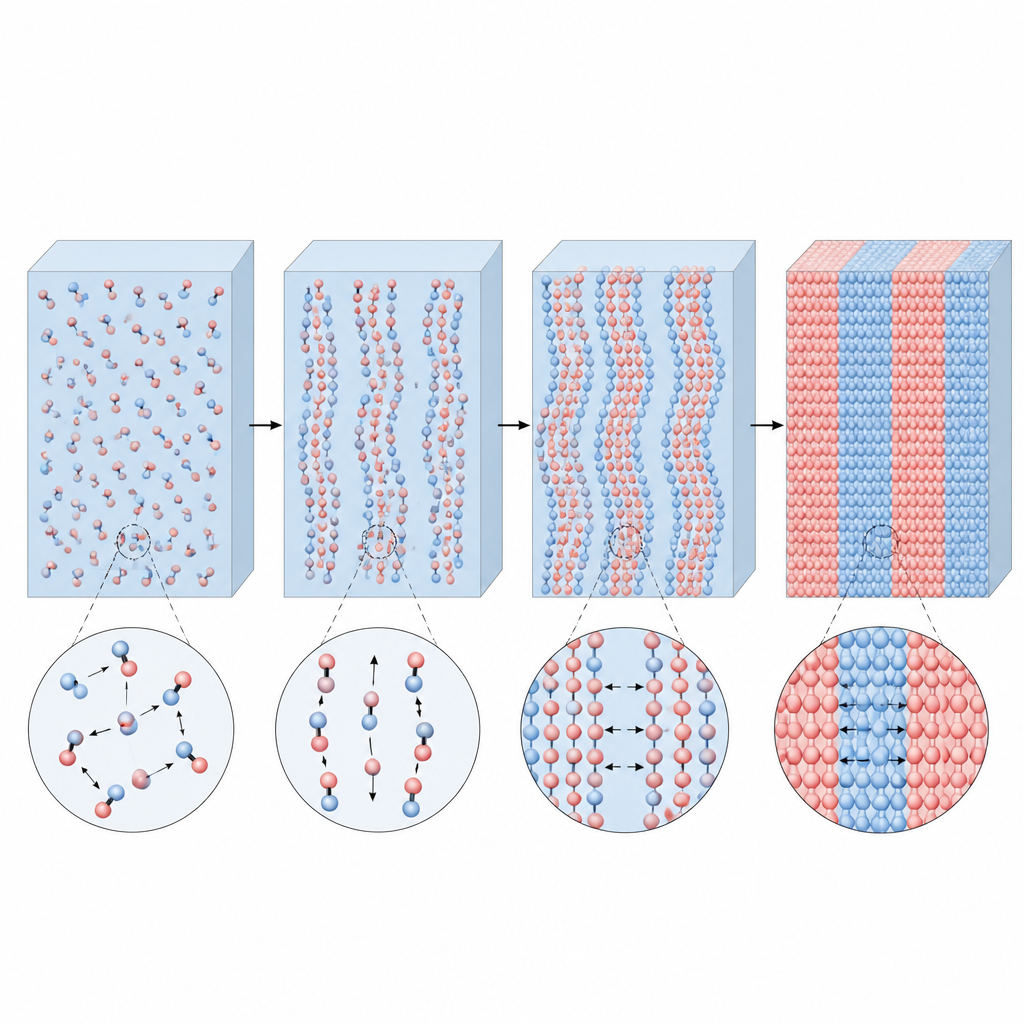
From collective motion to better performance
When an electric field is applied, the many small polar nanoregions can flip and reorient more easily than a rigid, uniformly polarized crystal. Their collective patterns act like a jammed network that helps transfer and dissipate energy, similar to force chains in a pile of grains. Measurements show that, with optimized mixing, the ceramic can reach about three times the original strain under an electric field and roughly double the electrostrain coefficient, comparable to widely used lead-based relaxor ceramics. The energy it can store per unit volume and the efficiency of charging and discharging also rise significantly, before dropping again when excessive defects hinder motion.
What this means for future devices
In simple terms, the study shows that carefully tuned disorder and the self-organization of tiny polar regions can make a lead-free ceramic stretch more and store more electrical energy. By linking the way these nanoregions move and jam together to the overall performance, the work offers design rules for next-generation capacitors, actuators, and sensors. The same ideas about pattern formation and collective dynamics may also guide the design of other advanced materials where many small building blocks must act together to deliver useful behavior.
Citation: Guo, J., Zhao, K., An, Y. et al. Collective dynamics of polar nanoregions enhance electrical properties via solid-solution-induced entropy increase in KBT relaxors. Commun Phys 9, 167 (2026). https://doi.org/10.1038/s42005-026-02594-8
Keywords: relaxor ferroelectrics, polar nanoregions, lead-free ceramics, energy storage, electrostrain