Clear Sky Science · en
Relativistic 56Ni decay lines in GRB 221009A
A cosmic flash that broke records
In October 2022, telescopes across Earth witnessed the brightest gamma ray burst ever seen, a flash of high-energy light from a distant dying star called GRB 221009A. This event was so intense that it briefly overwhelmed several space observatories. The new study explains how a faint but telling pattern hidden in that glare reveals, for the first time, the radioactive ashes of the star being shot out at nearly the speed of light, directly tying the burst to a powerful stellar explosion.
From monster star to cosmic lighthouse
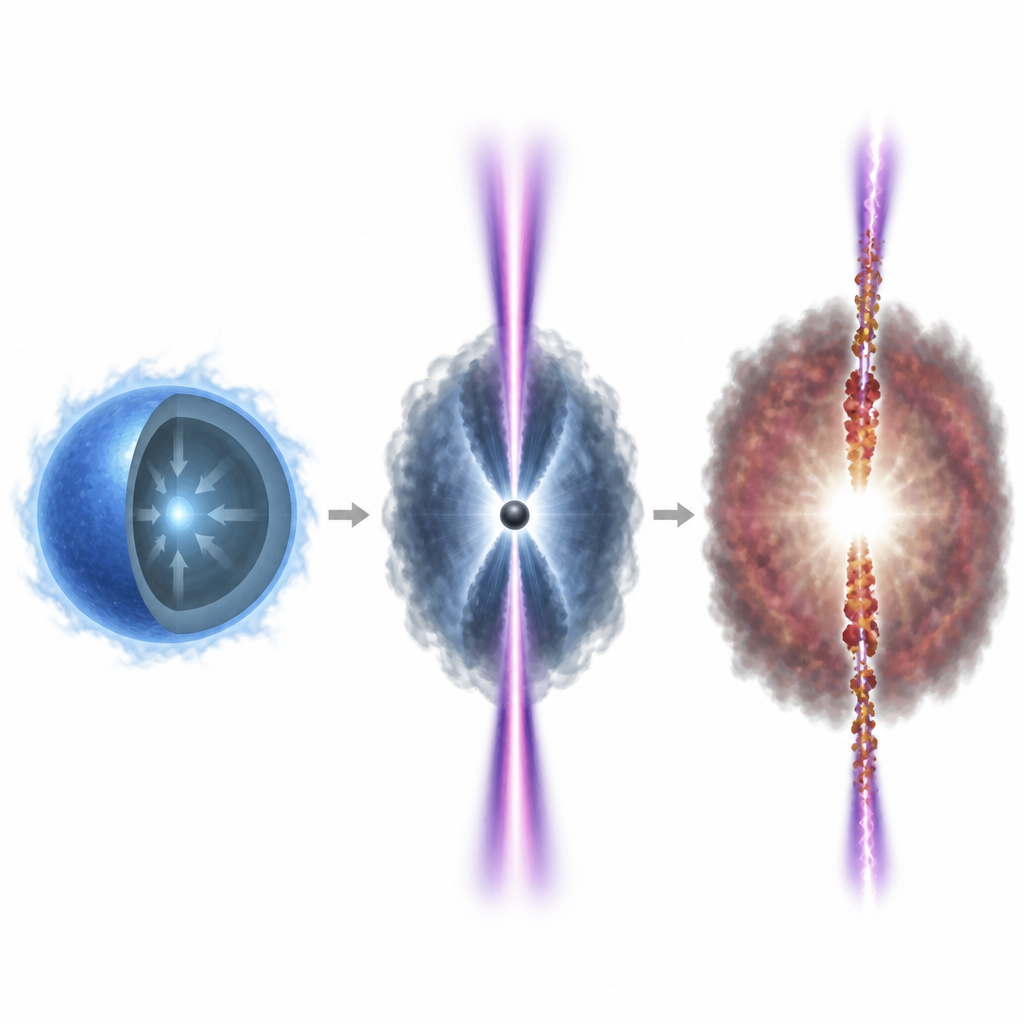
Long gamma ray bursts are thought to mark the deaths of very massive stars whose cores collapse into black holes or neutron stars. In many cases, this collapse also powers a broad-lined Type Ic supernova, a bright explosion that lacks hydrogen and helium and shows very fast-moving debris. Theory predicts that such blasts forge large amounts of the radioactive element nickel-56, whose decay later lights up the supernova in visible and infrared light. For GRB 221009A, the James Webb Space Telescope has already revealed a supernova with a typical amount of nickel-56 in its slower moving debris, confirming this broad picture.
Hidden lines in the brightest burst
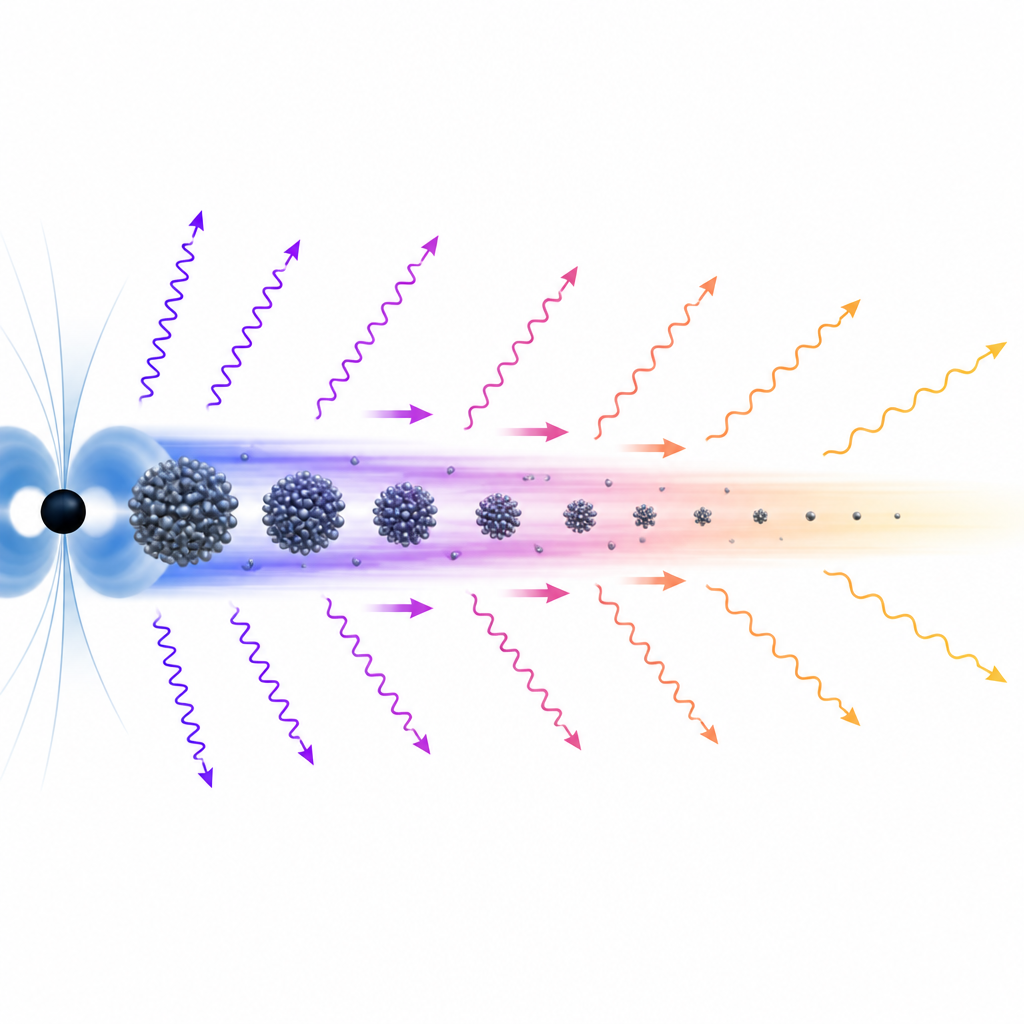
During the first few hundred seconds after the burst, detectors aboard the Fermi and GECAM space missions picked up a narrow bump in the gamma ray spectrum at energies of tens of millions of electron volts. This feature slid steadily in energy from about 37 million to 6 million electron volts while its brightness faded in a smooth way. The authors show that such a drifting line fits naturally if it comes from a well known nickel-56 decay gamma ray at 158 thousand electron volts that has been boosted by the extreme speed of material in the jet. As the jet slows and its geometry changes, the Doppler boost lessens, so the observed line energy drops with time.
Radioactive nickel riding the jet
In the scenario explored here, nickel-56 is forged in the hot, dense disk of matter swirling into the newborn black hole and is then mixed into the jet that pierces the dying star. Clumps of nickel coast outward at relativistic speeds and decay, emitting gamma ray photons. The team models how much nickel is needed, how the jet slows, and how the beaming of light toward Earth changes. They find that the observed line brightness and its time evolution can be matched with a plausible jet opening angle, total jet mass, and energy consistent with other studies of this exceptional burst. The analysis also examines whether nuclei would be destroyed by collisions or intense radiation and concludes that the nickel can survive long enough to emit the observed gamma rays.
A second hint and what it might mean
Besides the main line, the researchers uncover a weaker excess of emission near 24 million electron volts during a short ten second interval. Its energy is close to what would be expected from another nickel-56 decay line at 270 thousand electron volts, again Doppler boosted by the jet’s motion. Statistical tests show that including this second line improves the fit to the data and is about ten times more likely than a single line model, though the evidence is still only moderate. The study also explains why other, higher energy decay lines are not seen: they would be strongly absorbed by interactions with the burst’s own intense X ray and gamma ray field or fall outside the energy range where the instruments are most sensitive.
Why these clues matter
By tying a specific radioactive fingerprint to the prompt flash of a gamma ray burst, the work provides direct spectroscopic evidence that the same explosion both launches an ultra fast jet and forges heavy elements. The nickel-56 seen in the jet is distinct from, yet complementary to, the nickel that powers the later supernova glow, so together they trace how matter is distributed from the compact central engine out to the expanding debris. Although some details, such as the amount of nickel in the jet and the exact jet structure, remain uncertain and depend on future high quality data, the study opens a new way to probe how extreme stellar deaths shape the chemical makeup and high energy activity of the universe.
Citation: Moradi, R., Yorgancioglu, E.S., Xiong, SL. et al. Relativistic 56Ni decay lines in GRB 221009A. Commun Phys 9, 172 (2026). https://doi.org/10.1038/s42005-026-02593-9
Keywords: gamma ray burst, supernova, nickel 56, relativistic jet, high energy astronomy