Clear Sky Science · en
Spatially-resolved atmospheric turbulence sensing with two-dimensional orbital angular momentum spectroscopy
Why the air can scramble our light signals
Any time a beam of light crosses a long stretch of air it is quietly jostled by pockets of warm and cool air. For technologies that send data or images through the sky using light instead of radio, these invisible ripples can blur, dim, or twist the signal. This study explores a new way to read those ripples in fine detail, using carefully shaped beams of light and modern pattern-recognition tools to turn the air itself into a measurable object.
Light with a built in twist
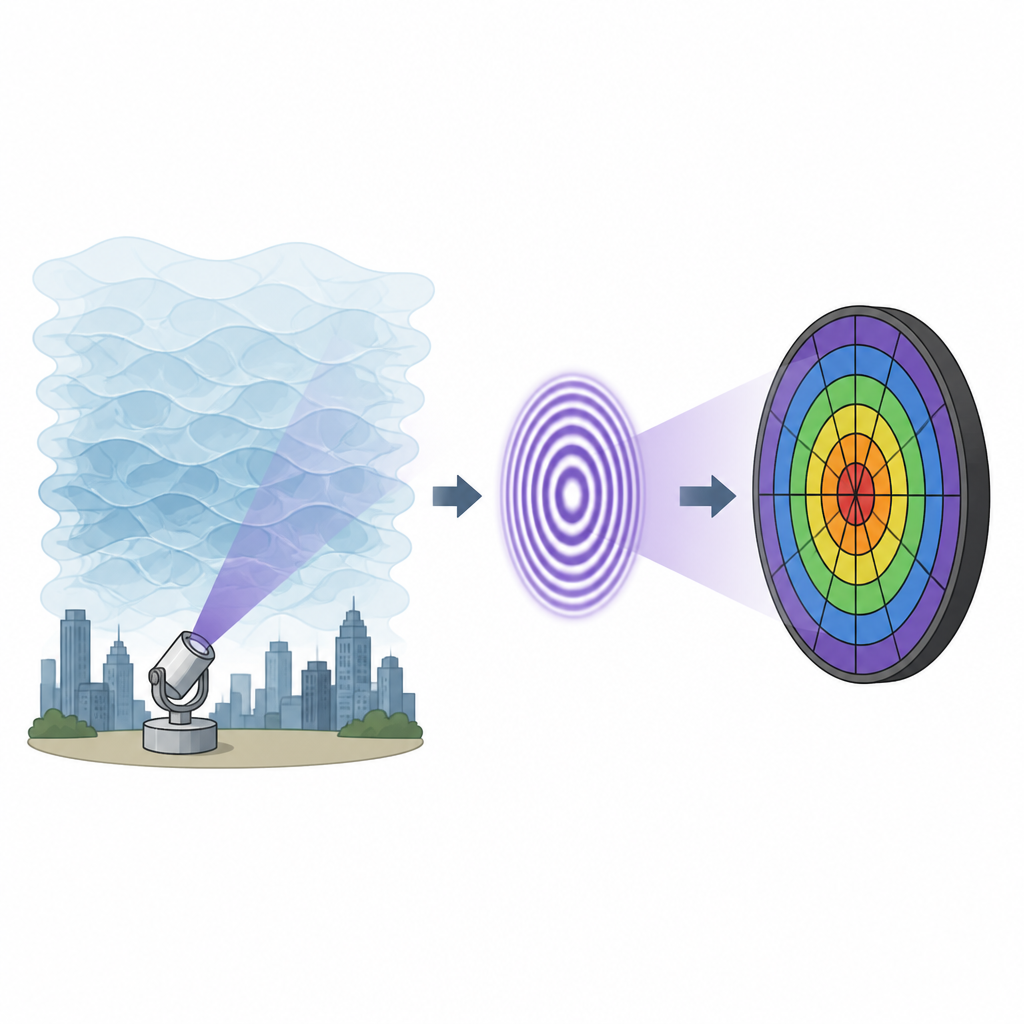
Instead of using simple flashlight-like beams, the researchers focus on so-called vortex beams, whose light waves spiral around like a corkscrew. They give these beams an additional ringed structure, similar to ripples on a pond, by using a type of beam called Bessel–Gaussian. Each ring is sensitive to a different range of swirling air sizes along the path. When this twisted, ringed beam travels through turbulent air, the air’s random structure pushes parts of the light into new spiral patterns. The way energy spreads among these spirals contains a hidden record of the air it passed through.
From a single number line to a full picture
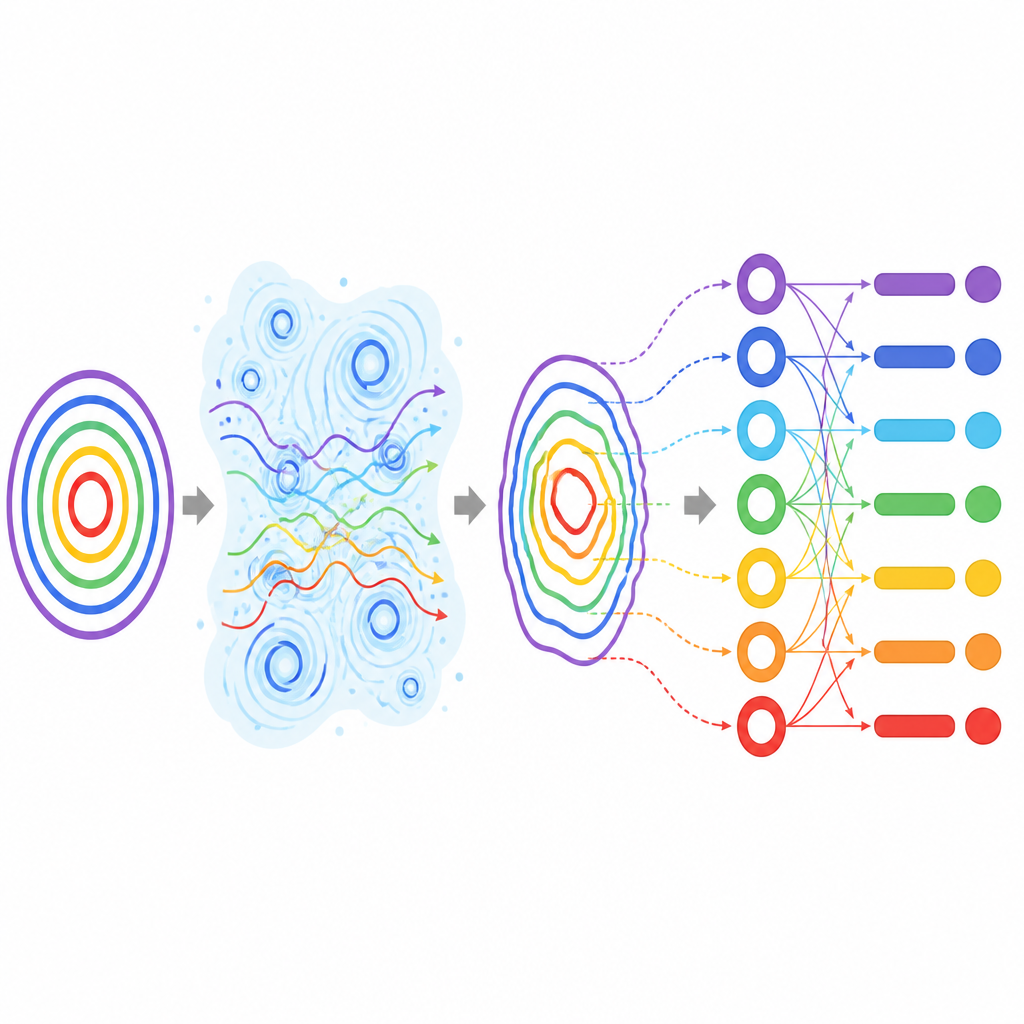
Earlier methods squeezed all of this behavior into a one-dimensional spectrum: a single list that summed up how much light ended up in each spiral pattern overall. While this is compact and easy to compute, it throws away where in the beam cross-section that scrambling happened. The new approach keeps track of both the spiral pattern and how far from the center it occurred. The beam is sliced into a set of thin rings, and for each ring the team measures how the light has been shuffled among spiral patterns. The result is a two-dimensional map that shows how the core and outer rings of the beam respond differently to the same patch of air.
Letting machines read the air
This richer map is then handed to a support vector machine, a common type of machine learning algorithm that learns to tell different situations apart. In thousands of simulated flights through choppy air, the team varied two key ingredients of turbulence: how strong it was and how many small swirls it contained. Each simulated journey produced a two-dimensional map of the scrambled beam, and the algorithm learned to link these maps to the underlying air conditions. Compared with the older one-dimensional method, the new two-dimensional view allowed the algorithm to distinguish between 25 different turbulence cases with a typical success rate of about 86 percent, improving accuracy by roughly a quarter.
Tuning rings for the clearest readout
The study also asks how to get the most useful information for the least effort. Adding more rings around the beam and looking at a wider range of spiral patterns both tend to improve performance, but only up to a point. The inner rings carry most of the meaningful signal, while the faint outskirts are easily swamped by noise. By selectively ignoring the noisiest outer rings, the team maintains high accuracy even when the receiving camera is larger than the beam or when image resolution is reduced. They find that just a handful of rings and a moderate spread of spiral patterns are enough to capture most of the benefit, pointing the way toward practical systems that can run quickly.
What this means for real world systems
In simple terms, the work shows that looking at how a patterned beam of light is disturbed in space as well as in its twisting pattern allows us to “feel” the structure of turbulent air with much greater clarity. Instead of treating the atmosphere as one blurry obstacle, this method teases out how different parts of the beam are affected and lets an algorithm translate that into meaningful measures of turbulence strength and scale. While the results come from computer experiments, they fit naturally with existing optical setups that can record both brightness and wave shape. In the long run, such detailed sensing could help future free space communication links, telescopes, and remote sensing systems adapt in real time to a restless sky, keeping their signals sharper and more reliable.
Citation: Jiang, W., Cheng, M., Guo, L. et al. Spatially-resolved atmospheric turbulence sensing with two-dimensional orbital angular momentum spectroscopy. Commun Phys 9, 159 (2026). https://doi.org/10.1038/s42005-026-02587-7
Keywords: atmospheric turbulence, structured light, orbital angular momentum, free space optics, machine learning sensing