Clear Sky Science · en
Real-time simulation of jet energy loss and entropy production in high-energy scattering with matter
Watching Particles Plow Through Matter
When high‑energy particles slam into atomic nuclei inside giant colliders, they briefly create extreme forms of matter similar to the early universe. Yet we still do not fully understand what happens to a fast particle “jet” as it bores through this hot, dense material and comes out the other side—or fails to. This paper uses a simplified but powerful model to watch that process unfold step by step on a computer, revealing how jets lose energy, how the surrounding matter is stirred up, and how both become quantum‑mechanically intertwined.
A Simple Playground for Violent Collisions
Instead of tackling the full complexity of quantum chromodynamics, the theory of quarks and gluons, the authors work with a well‑known toy model called the Schwinger model. It lives in one space dimension plus time and describes charged particles interacting through an electric field. Despite its apparent simplicity, this model captures key phenomena such as particle–antiparticle creation and confinement, making it a favorite testing ground for ideas in high‑energy physics. Here, it serves as a stripped‑down analogue of a jet—represented by a localized packet of energy—colliding with a block of dense matter represented by a region filled with a strong electric field.
Designing a Collision on a Quantum Lattice
The team reformulates the Schwinger model on a one‑dimensional lattice, where each site can host matter and pieces of electric field. They first prepare a “vacuum” ground state and then build two ingredients. One is a tightly bound meson‑like packet that will act as the incoming jet. The other is a compact region whose electric field is boosted by external charges, mimicking a lump of dense nuclear matter. After this setup, they abruptly switch off the external charges so that the medium evolves on its own, and then let the jet propagate toward it. Using advanced tensor‑network algorithms—numerical tools that excel at tracking quantum systems in real time—they follow how local energy, electric field strength, and quantum entanglement change across the lattice throughout the collision.
Three Ways a Jet Can Cross a Medium
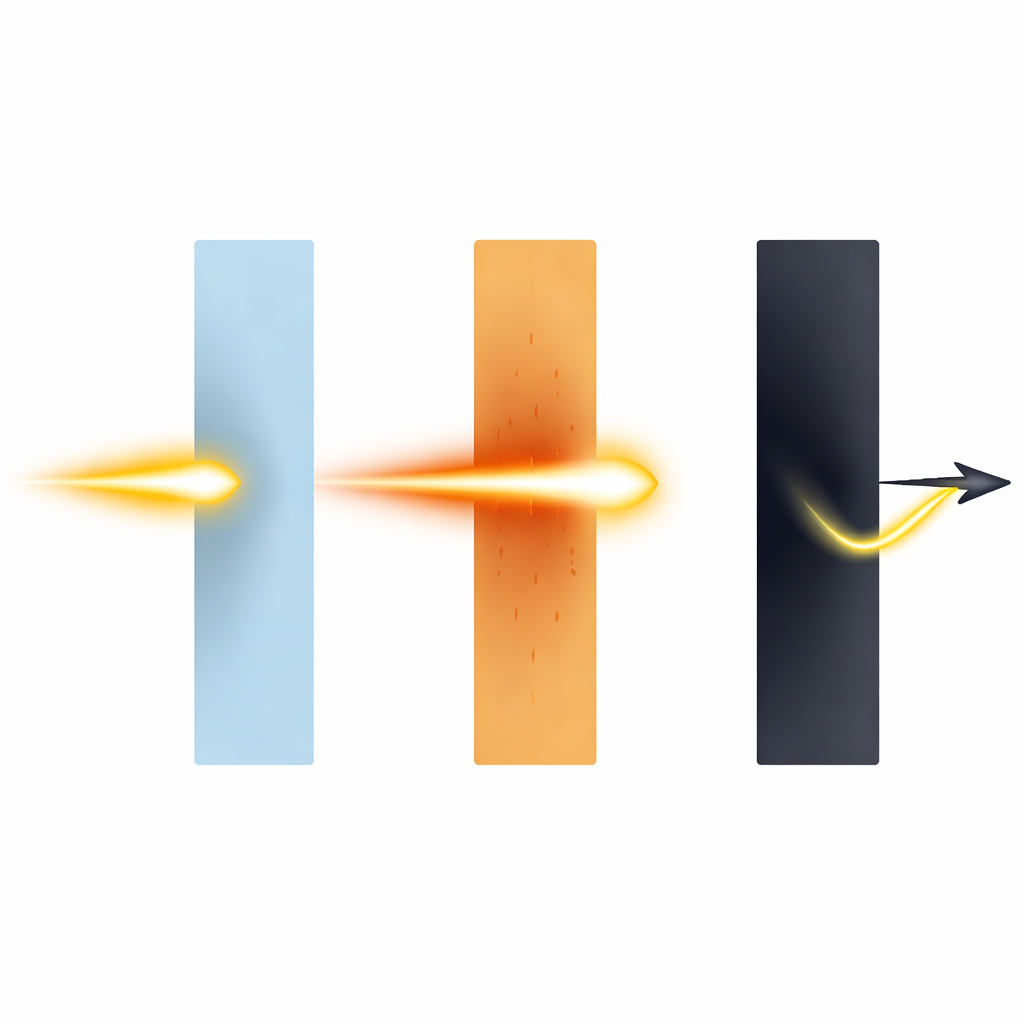
By gradually increasing the strength of the initial electric field in the target region, the authors uncover three distinct behavioral regimes. For a weak or “dilute” medium, the jet glides almost ballistically, barely disturbed, leaving only a modest trail of excitations behind it. At intermediate strengths, the jet still punches through but clearly deposits energy along its path, exciting the medium and emerging weakened and broadened. For the strongest fields, the picture changes dramatically: the target behaves like an almost opaque wall. Most of the jet’s energy is reflected back rather than transmitted, an analogue of the “black disk” limit in collider physics where the inner structure of the target cannot be resolved by the probe.

Measuring Energy Loss and Quantum Mixing
To make these pictures quantitative, the authors define a jet “energy budget” by summing the local energy in the region where the jet resides and tracking how it changes over time. Even in empty space the jet loses some energy, as it naturally sheds excitations into its wake. When the medium is present, an additional loss appears: energy is drained from the jet and ends up stored inside the target. The rate of this medium‑induced energy loss grows with the distance traveled, and over the range studied it scales roughly linearly with the path length, echoing expectations from more realistic jet‑quenching theories. At the same time, the researchers compute a local measure of entanglement entropy, which tracks how strongly different parts of the system are quantum‑mechanically linked. As the jet crosses the medium, this entropy rises in the region of overlap, signaling that the outgoing jet and the excited matter can no longer be cleanly separated into independent subsystems.
Steps Toward Quantum Simulations of Colliders
Beyond its immediate physical insights, the work points toward future experiments on quantum‑computing and quantum‑simulation platforms. The authors outline how a closely related “quantum link” version of their model, which replaces the continuous electric field with a finite‑dimensional spin system, could be realized using qubits and qutrits in engineered devices. Such implementations would allow researchers to recreate jet‑like probes, dense targets, and their real‑time collisions in the laboratory, moving closer to table‑top analogues of nuclear scattering experiments.
What This Means for Understanding Extreme Matter
In everyday terms, the study shows how a fast, focused blast of energy behaves when it tries to tunnel through material that ranges from fluffy to brick‑like. In the soft case the blast passes through; in the middle case it slows and shares some of its punch; in the hardest case it mostly bounces back, and in the process the blast and the wall become deeply entangled at the quantum level. Although the model is deliberately pared down compared with the full theory of quarks and gluons, it reproduces key trends—such as path‑length‑dependent energy loss and the merging of jet and medium into a single complex state—that are central to interpreting collider data. As more powerful quantum simulators come online, similar approaches in higher‑dimensional models may offer an unprecedented window into the microscopic life of jets inside the hottest matter ever created in the lab.
Citation: Barata, J., Rico, E. Real-time simulation of jet energy loss and entropy production in high-energy scattering with matter. Commun Phys 9, 155 (2026). https://doi.org/10.1038/s42005-026-02586-8
Keywords: jet quenching, quark gluon plasma, quantum simulation, Schwinger model, entanglement entropy