Clear Sky Science · en
Injection locking of Rydberg dissipative time crystals
Clocks Made of Light and Atoms
Most clocks tick because something swings, vibrates, or oscillates in a steady rhythm. This paper shows how a cloud of ordinary atoms at room temperature can develop its own internal rhythm and then be gently steered and stabilized by a faint radio signal. The work reveals a new way to tame a recently discovered state of matter called a "time crystal" and points toward future sensors and timing devices that run on quantum effects but operate in everyday conditions.
A Rhythmic State of Matter
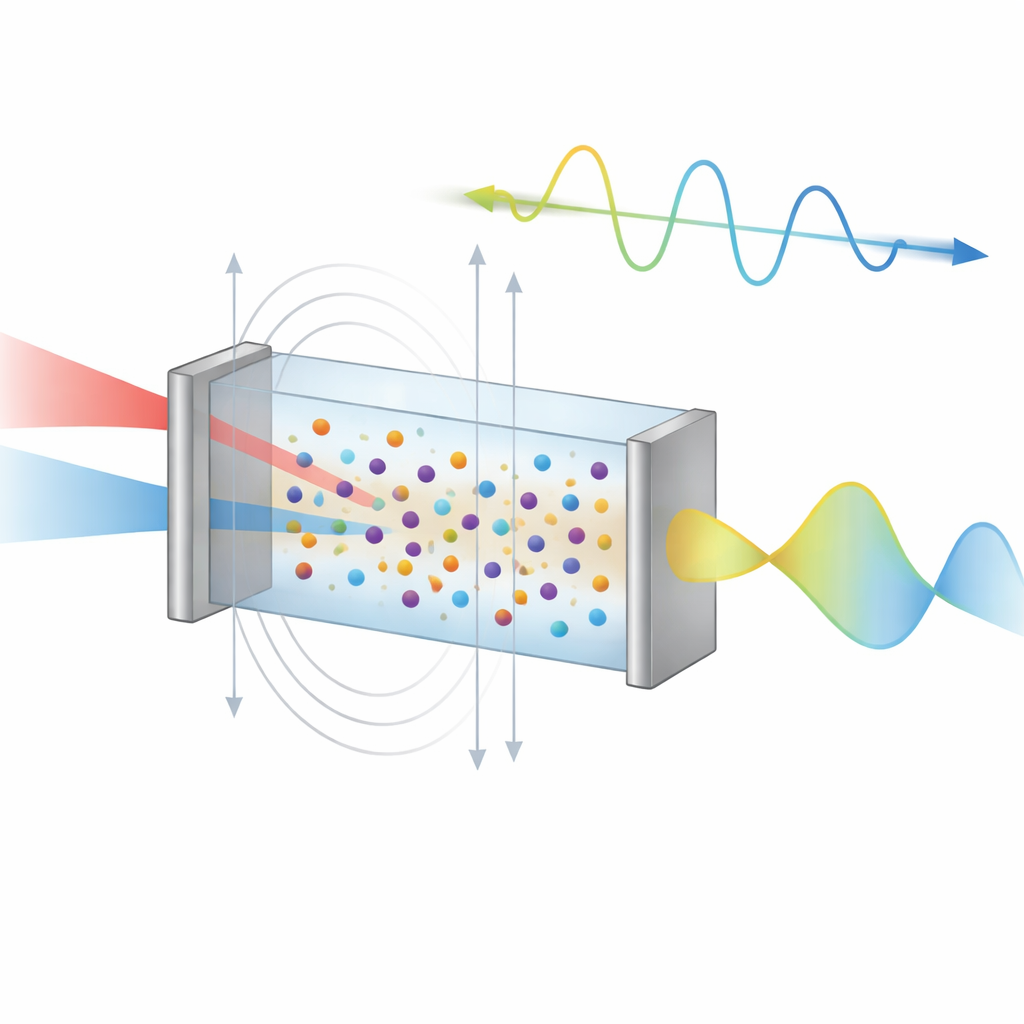
In the experiment, cesium atoms in a glass cell are illuminated by two laser beams and exposed to a weak magnetic field. Under these conditions, some atoms are pushed into highly excited "Rydberg" states, where their outer electrons sit far from the nucleus and interact strongly with one another. Instead of settling into a quiet steady state, the whole cloud begins to pulse: the amount of light that passes through the cell naturally rises and falls at a well-defined audio-frequency rate of about ten thousand cycles per second. This repeating pattern is an example of a "dissipative time crystal"—a system that keeps oscillating in time, all on its own, while energy is continuously supplied and lost.
Gently Steering a Self-Made Rhythm
The author then adds a very weak radio-frequency electric field across the vapor cell, tuned close to the crystal’s natural pulsing rate. At low strength, this extra signal barely disturbs the atoms: their oscillation frequency hardly shifts, and the system keeps its own beat. As the radio field is made slightly stronger, the crystal’s rhythm begins to drift toward the drive frequency, a behavior known as "frequency pulling." Once the field crosses a critical strength, the time crystal suddenly snaps into step with the external signal. From that point on, its oscillations are locked to the radio wave, just as a choir can fall into perfect harmony with a lead singer.
How Locking Shows Up in Practice
To see this transition, the experiment tracks the spectrum of the transmitted light—the different frequencies at which the crystal is oscillating. When the radio frequency is swept across the natural oscillation, the strongest peak in the spectrum first bends toward the drive and then merges with it when locking occurs. By repeating this process at different field strengths, the study maps out a "locking bandwidth": the range of drive frequencies over which the time crystal will stay synchronized. This locking range grows in direct proportion to the radio field’s strength, matching the classic behavior of many familiar oscillators, from electronic circuits to mechanical pendulums.
Reining In Complex Motion
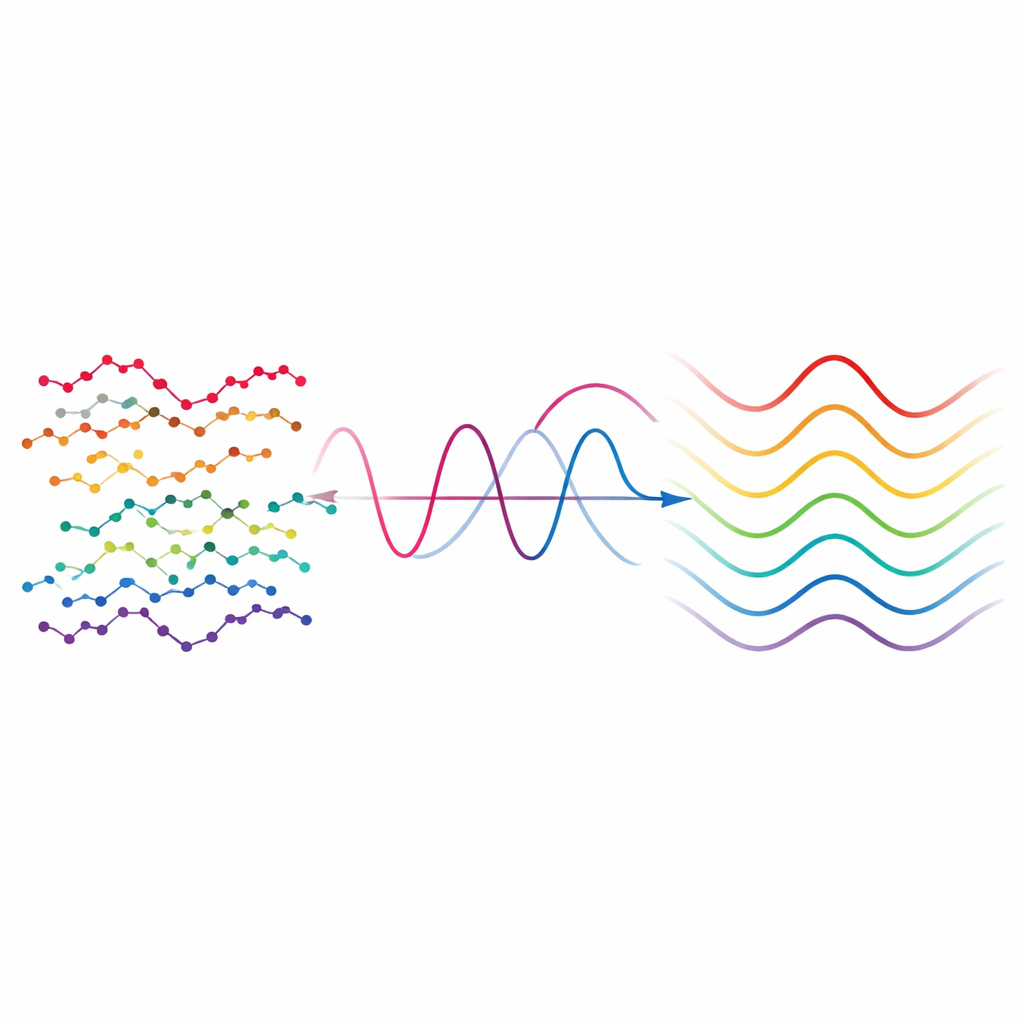
The time crystal does not only oscillate at a single frequency; it also produces higher overtones, or harmonics, much like the richer tones of a musical instrument. When the radio field is tuned and strengthened, these harmonics are pulled along with the main beat and become synchronized as well. Numerical simulations using a simplified model of the atoms reproduce this behavior and connect it to a well-known equation from the theory of synchronization. The model shows that the radio field effectively couples two excited atomic states, nudging the entire many-atom system so that its internal motion falls into line with the external rhythm.
From Quantum Rhythm to Useful Tools
By demonstrating controlled locking of a time crystal made from strongly interacting atoms, this work establishes a new knob for stabilizing and tuning quantum rhythms. The ability to narrow the oscillation’s spread in frequency and reduce its drift suggests that such systems could serve as sensitive detectors of tiny electric fields, or as compact, room-temperature references for timing and measurement. More broadly, it shows that ideas from everyday synchronization—like musicians keeping time together—carry over into exotic quantum phases of matter, opening doors to new technologies based on managing the flow of time itself in quantum materials.
Citation: Arumugam, D. Injection locking of Rydberg dissipative time crystals. Commun Phys 9, 156 (2026). https://doi.org/10.1038/s42005-026-02585-9
Keywords: time crystals, Rydberg atoms, synchronization, injection locking, quantum sensing