Clear Sky Science · en
A finite sufficient set of conditions for catalytic majorization
How hidden helpers can unlock forbidden changes
Many physical processes seem to be blocked by basic rules of nature, yet can suddenly become possible when an extra system quietly joins in and leaves unchanged. This paper explores these hidden helpers, called catalysts, and shows how to check in a practical way when they can unlock otherwise impossible transformations in quantum systems and tiny thermal machines.
From simple ordering rules to subtle quantum changes
Physicists often describe whether one state of a system can turn into another using a mathematical ordering called majorization. Roughly speaking, it compares how uneven or spread out different probability patterns are. This ordering plays a central role in areas such as quantum information and thermodynamics, where it helps decide if one quantum state can be converted into another using only restricted operations, like local moves and classical communication between distant labs, or thermodynamic operations that respect energy and temperature.
When an extra system makes the impossible possible
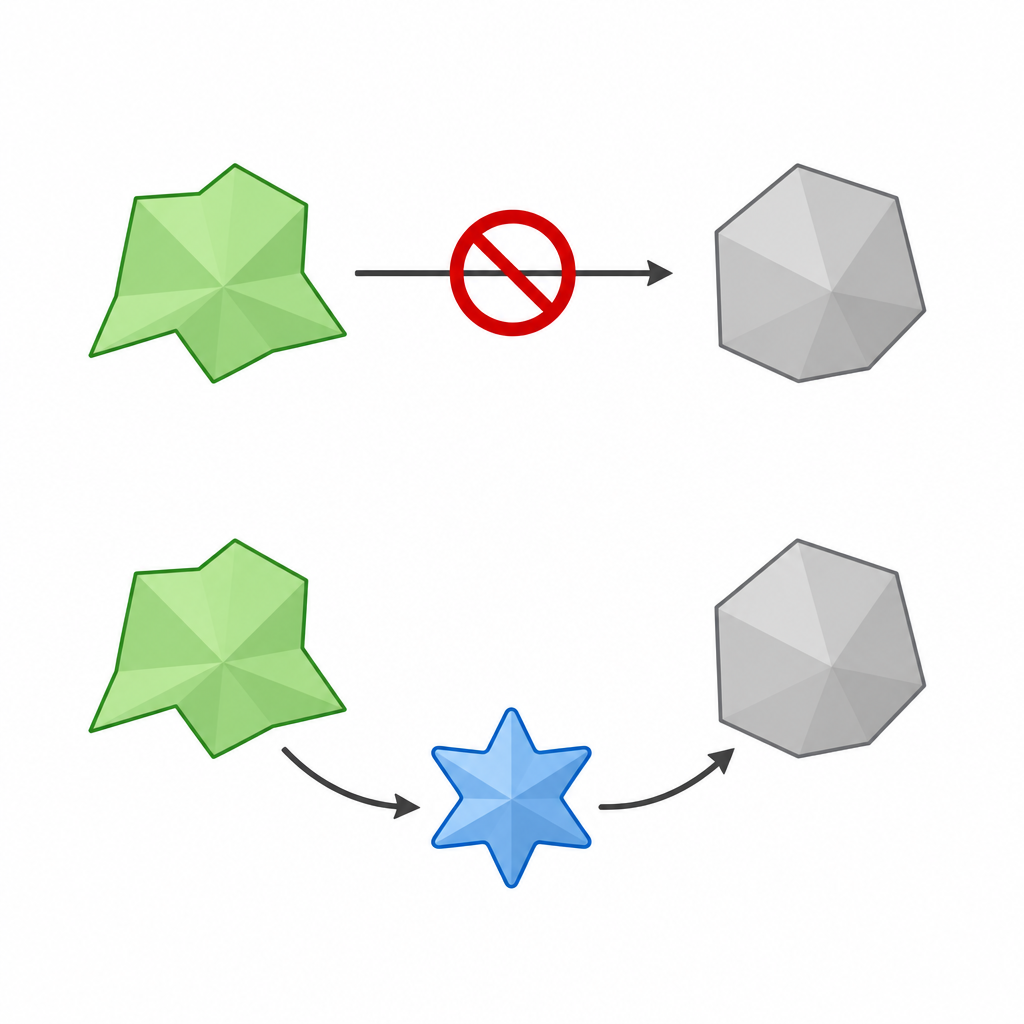
Majorization rules are powerful but not complete. There are pairs of states that fail these rules, so a direct transformation appears impossible, yet can still be achieved if an additional system is brought in as a catalyst. This catalyst participates in the process but must be returned exactly as it started. The resulting situation is called catalytic majorization or trumping. Earlier work gave precise conditions for when trumping is possible, but these conditions required checking an infinite family of inequalities based on generalized entropies, making them essentially impossible to verify in practice.
Turning infinite tests into a finite checklist
The authors solve this practicality problem by replacing the infinite list of checks with a carefully chosen finite collection of inequalities. Their approach relies on a special family of symmetric polynomials that are linked to familiar mathematical quantities called ℓp norms and to Rényi entropies. By showing how comparisons between these polynomials guarantee the right ordering of norms for whole ranges of parameters, they prove that satisfying a finite set of inequalities is enough to ensure that a catalyst exists for a desired state change under local quantum operations.
Applying the method to tiny heat engines and coherent states
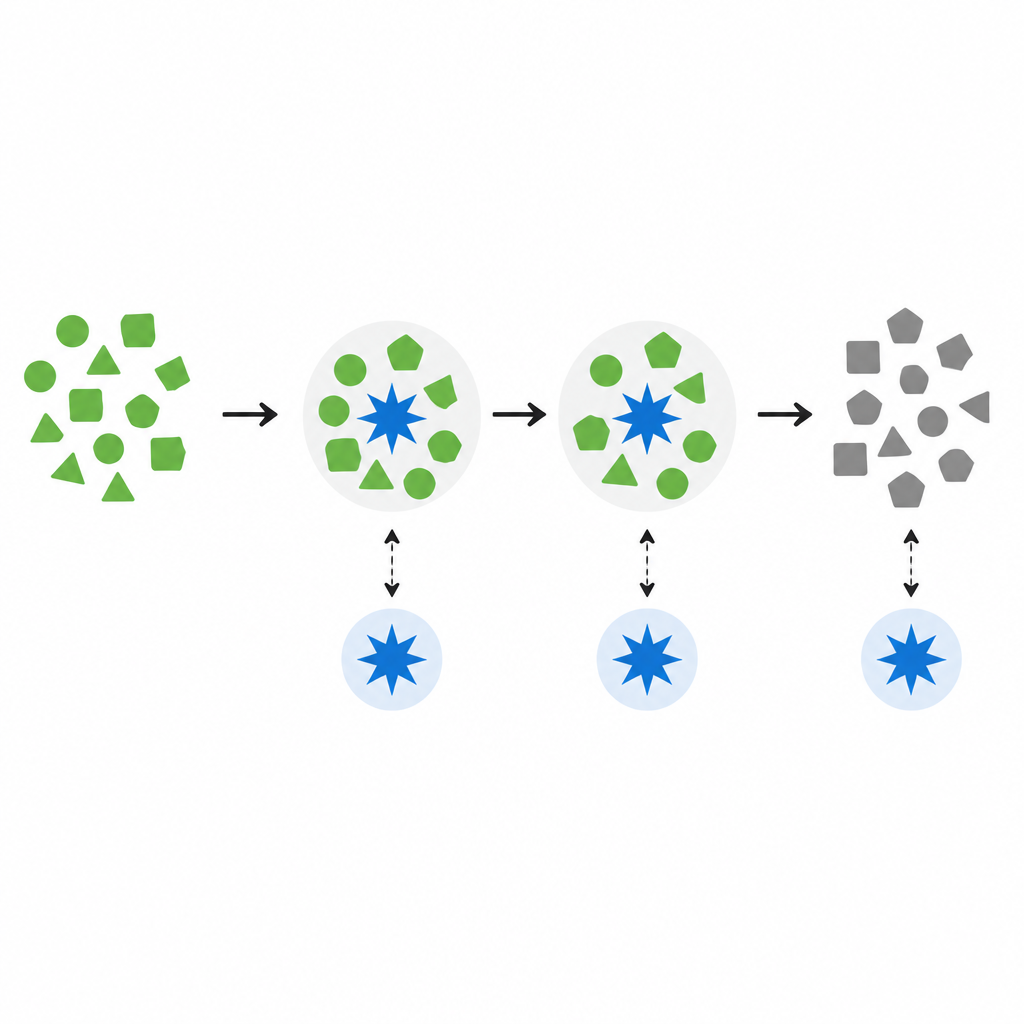
The same strategy is carried over to thermodynamics, where the focus is on systems interacting with a heat bath at fixed temperature. In that setting, allowed operations are thermal operations that conserve energy, and the key quantities are generalized free energies, one for each Rényi divergence between a state and its thermal equilibrium. Previously, confirming a catalytic thermal transformation required comparing these free energies for all real parameter values, again an infinite task. The authors show how to turn this into a finite checklist, even when the underlying thermal state has irrational probabilities, by approximating it with a rational one and controlling the resulting errors.
Examples, software tools, and what remains open
To demonstrate their conditions in action, the authors present explicit examples where a direct conversion between two states is forbidden by majorization or thermo majorization, yet becomes possible with a suitable catalyst. They also show how their finite criteria apply to states that carry quantum coherence, not just those that are diagonal in an energy basis. To help other researchers use these ideas, they provide an open source software toolbox that implements the new inequalities and tests for the existence of catalytic transformations in concrete cases.
Why this matters for understanding change
In plain terms, this work provides a practical way to decide when hidden helpers can enable state changes that would otherwise seem ruled out by standard thermodynamic or quantum constraints. Instead of facing an unmanageable infinity of checks, scientists can now work with a finite, computable set of tests that still guarantee the presence of a catalytic route. This advances our ability to map which transformations are truly impossible and which simply require the right helping system, sharpening our understanding of irreversibility and resource use from quantum information to tiny thermal devices.
Citation: Elkouss, D., Maity, A.G., Nema, A. et al. A finite sufficient set of conditions for catalytic majorization. Commun Phys 9, 164 (2026). https://doi.org/10.1038/s42005-026-02583-x
Keywords: catalytic majorization, quantum thermodynamics, entanglement catalysis, state transformations, resource theories