Clear Sky Science · en
Accelerating atomic fine structure determination with graph reinforcement learning
Why this research matters
When scientists look at the light from stars, fusion plasmas, or industrial lamps, they see thousands of sharp colored lines. Each line hides information about how atoms are built, but working out that hidden structure by hand can take experts many years. This study shows how modern artificial intelligence can shoulder much of that burden, turning months or even decades of human effort into work that can be done in hours, while still reaching the accuracy needed for real scientific use.
Reading the fingerprints of atoms
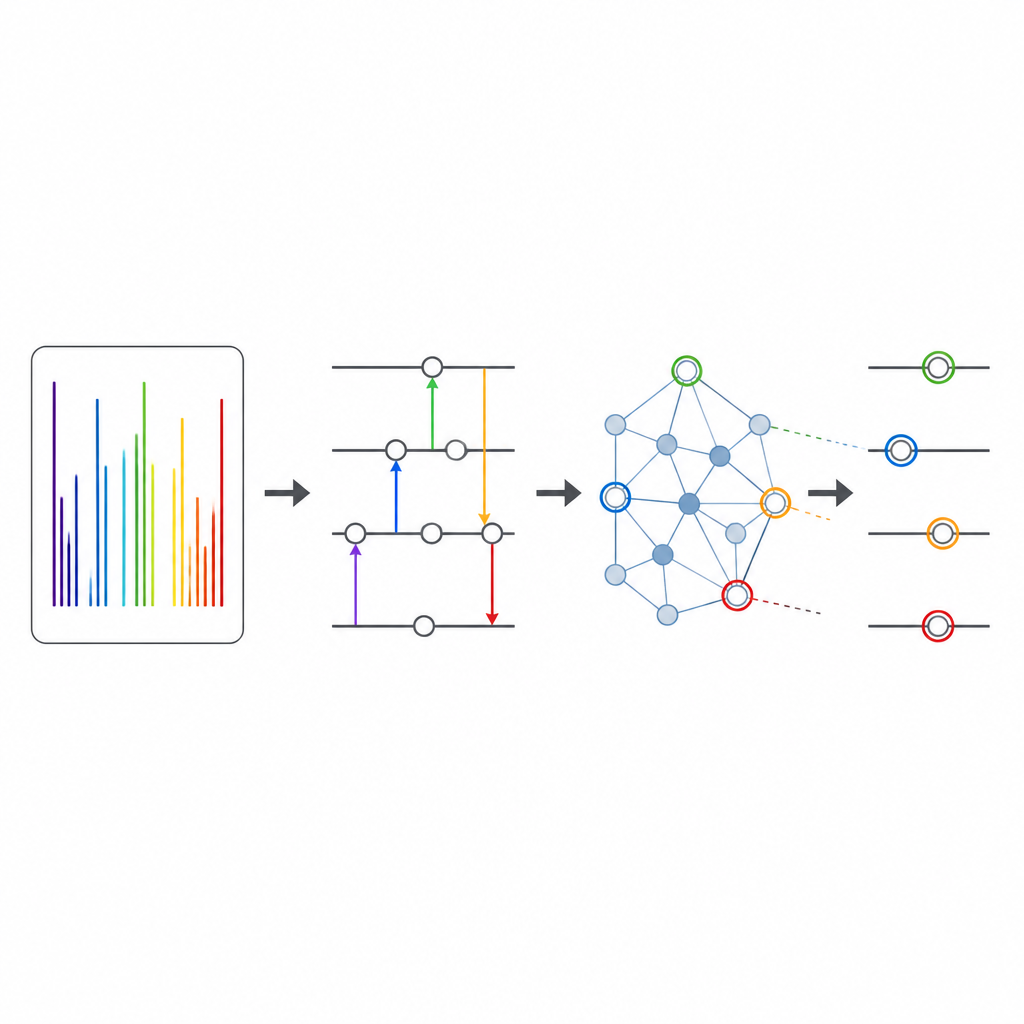
Every chemical element gives off a unique pattern of spectral lines, a bit like a barcode. Behind each line is a jump between two energy levels inside an atom. For heavy elements, especially those with more complex electron arrangements, there can be thousands of such levels. Carefully working out their energies and related properties is called term analysis, and it is crucial for fields ranging from the design of lighting and metal processing to nuclear research, medical isotope production, fusion energy, and astronomy. In particular, astronomers rely on precise atomic data to understand what elements are present in stars and in exotic events such as neutron star mergers.
The bottleneck in atomic data
Modern instruments can record tens of thousands of spectral lines for a single element within weeks, and theory can predict level patterns fairly quickly. The slow step is turning all those measurements into a consistent set of precise energy levels. Experts must decide which observed lines belong to which theoretical transitions, then refine the level energies until they agree with the data. For some ions of cobalt and neodymium that the authors consider, this has historically meant years of detailed work per element. Despite decades of effort, many levels for heavier elements remain unknown, and purely theoretical calculations are not yet accurate enough on their own for high precision applications.
Teaching an AI to do term analysis
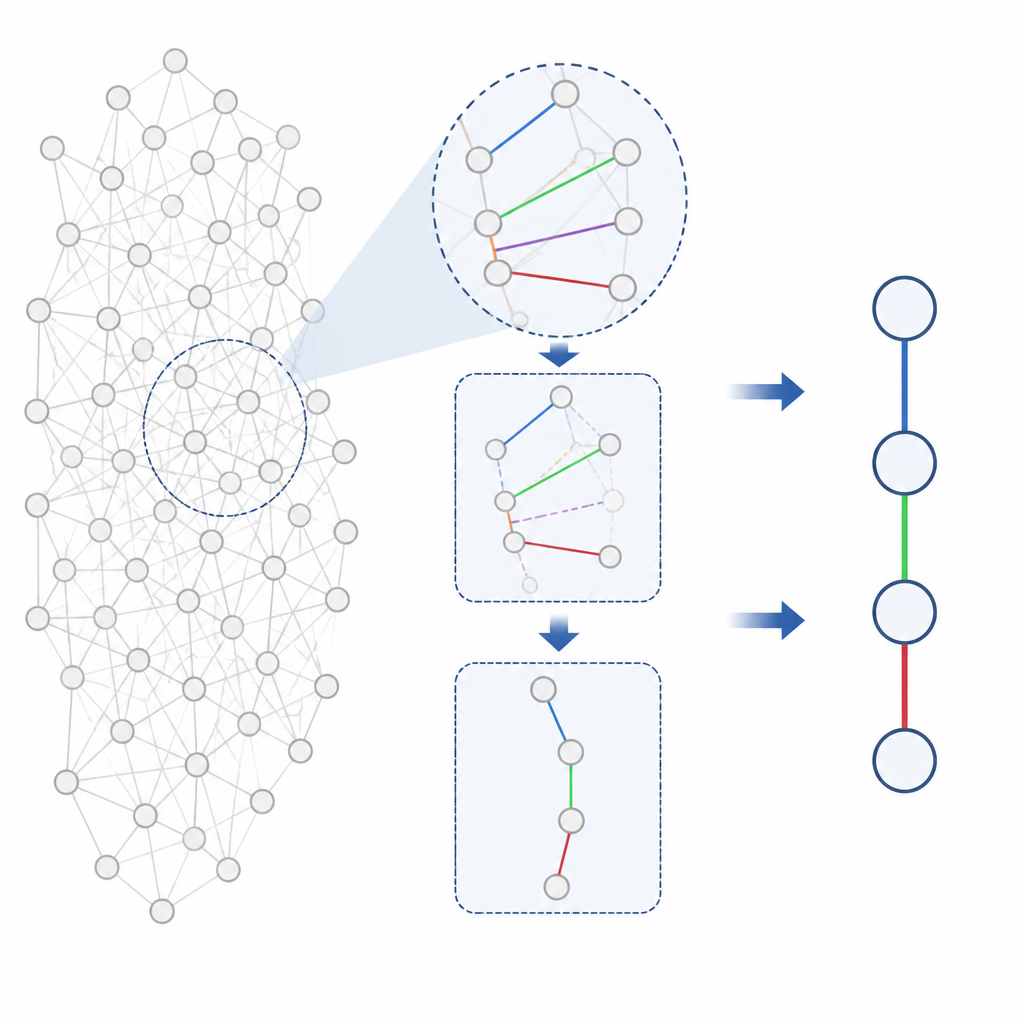
The authors recast term analysis as a step by step decision problem that a computer can learn to solve. They represent all known and predicted energy levels as points in a graph, with lines between them standing for allowed light emitting transitions. The state of the system includes both experimentally confirmed information and theoretical guesses. At each step, an artificial agent must first choose an unknown level to focus on, then pick a combination of observed spectral lines that most consistently fixes that level’s energy. This two stage move gradually expands the set of trusted levels. The agent learns a strategy through reinforcement learning, where good decisions are rewarded and poor ones discouraged, using a graph based neural network to understand the web of possible connections.
Learning from human choices
To guide the AI toward decisions that mirror expert judgment, the researchers also train part of its reward system on past human analyses. They extract examples of how experienced spectroscopists chose among competing line matches, and use a separate neural network to imitate those preferences. This learned reward measures how convincing a new level appears, based on factors such as how well line strengths and energies agree with expectations, and how many independent lines support the same energy value. The reinforcement learning agent then searches for sequences of choices that maximise this confidence, effectively exploring many trial analyses far faster than a person could.
What the AI achieved
The team tested their method on three sample ions: singly ionised cobalt and two states of ionised neodymium, using real high resolution spectra and realistic theoretical inputs. For each case, they simulated the situation partway through a human analysis and asked the AI to extend it. Their system, called TAG DQN, determined hundreds of additional energy levels within hours. For cobalt, its results agreed with published values about 95 percent of the time, and for the two neodymium cases the agreement ranged between just over half and nearly ninety percent, depending on how accurate the starting theory was. In head to head comparisons with more traditional search strategies, the learning based agent generally matched or outperformed them in how many correct levels it found.
Implications for future science
For researchers who depend on accurate atomic data, this work suggests that much of the most tedious part of term analysis can be handed to machines, while humans concentrate on checking tricky cases and refining the underlying physics. The method does not replace expert judgment, and it still leans on theoretical calculations, but it can quickly generate high quality candidate level schemes that would otherwise take months or years to assemble. As similar tools are extended and improved, they could help keep atomic databases in step with growing observational demands, and they offer a broader example of how artificial intelligence can assist in other complex, data heavy areas of science.
Citation: Ding, M., Darvariu, VA., Ryabtsev, A.N. et al. Accelerating atomic fine structure determination with graph reinforcement learning. Commun Phys 9, 158 (2026). https://doi.org/10.1038/s42005-026-02582-y
Keywords: atomic spectra, energy levels, reinforcement learning, graph neural networks, plasma diagnostics