Clear Sky Science · en
Single-shot spatiotemporal characterization of ultrashort lasers based on spectral interferometry with fiber array
Why Powerful Laser Pulses Need Careful Checking
Modern super‑lasers can briefly outshine all the power used on Earth, and scientists use them to explore extreme physics, from creating particle beams to simulating conditions in stars. But these ultrashort, ultra‑intense pulses are useful only if their light is perfectly shaped in both space and time. Even tiny distortions can dramatically weaken the focus and mislead experiments. This paper introduces a new way to take a detailed “snapshot” of such laser pulses in a single shot, making it far easier to tune the world’s most powerful lasers.
A New Way to See a Laser Pulse
The authors present a technique called SIFAST, short for “spectral interferometry with fiber array for single‑shot spatiotemporal characterization.” In everyday terms, SIFAST lets researchers map out how a laser pulse is arranged both across its cross‑section and over its fleeting duration, all at once. Traditional cameras can only record two dimensions at a time, so older methods had to scan the beam point by point or repeat the measurement over many shots—impractical for huge petawatt laser systems that may fire only a few times per hour. SIFAST overcomes this limitation by rearranging the information in a clever way so that a single measurement captures the full three‑dimensional structure of the pulse.
How Fibers Turn a Beam into Data
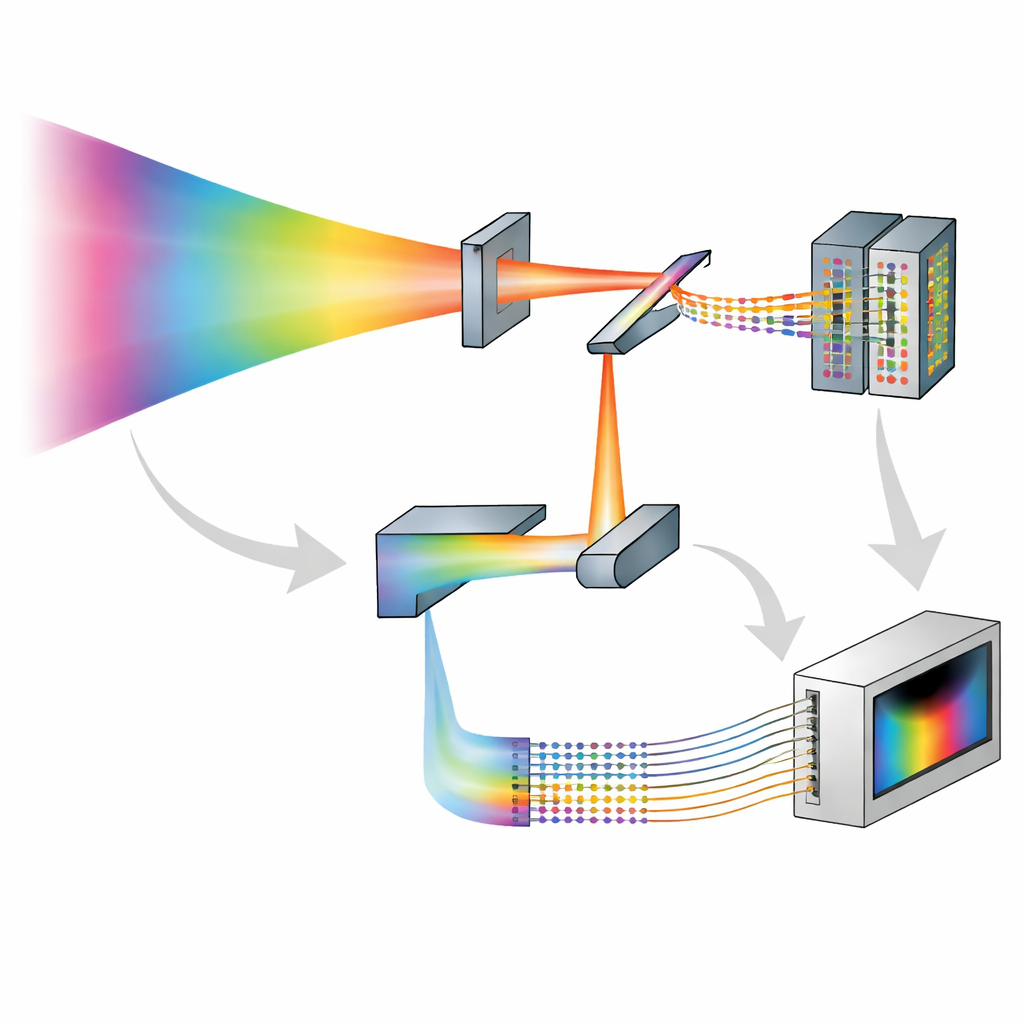
At the heart of SIFAST is a specially designed bundle of thin glass fibers. First, the incoming laser beam is split into two paths: a “test” beam, whose shape is unknown, and a “reference” beam created from a small, carefully cleaned‑up portion of the same light. These two beams overlap and interfere with each other, producing delicate patterns that encode how their waves differ in space and color. Instead of letting a camera struggle to record a complex pattern all at once, the fiber bundle samples the beam at many points arranged in a grid and then physically rearranges those points into a single line at its output. This line of fibers feeds an imaging spectrometer, which spreads the colors and records a neat array of interference patterns, one for each point on the original beam.
Rebuilding the Laser’s Shape in Space and Time
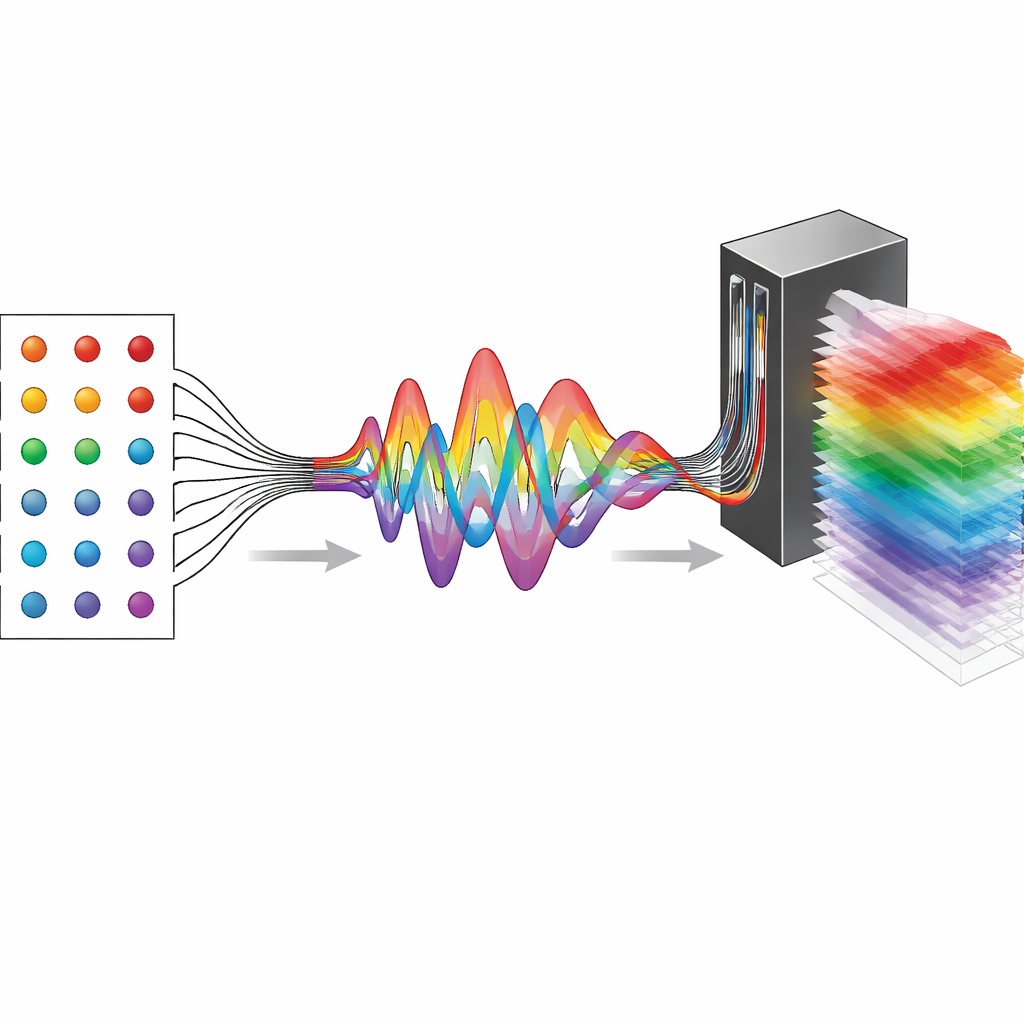
From these recorded patterns, the team uses straightforward mathematical tools—mainly Fourier transforms—to extract how the light wave evolves at each sampled point. Because the test and reference beams travel through the same fibers almost simultaneously, random disturbances that would normally scramble the wavefront cancel out, giving a clean picture. The method recovers both the intensity and the phase of the light, which together define the full electric field of the pulse. In practical terms, SIFAST can reconstruct the three‑dimensional structure of a pulse using nearly two hundred sampling points in about five seconds, fast enough for routine monitoring and feedback in large laser facilities.
Putting the Method to the Test
To demonstrate what SIFAST can do, the researchers examined several demanding kinds of laser beams. They first measured a well‑behaved Gaussian beam to calibrate the system, confirming that the pulse front—the surface where the pulse reaches its maximum—was extremely flat, as expected. Next, they looked at “vortex” beams, whose wavefronts twist like corkscrews and are used in advanced optical experiments. SIFAST successfully reproduced the helical patterns associated with different vortex strengths. They then introduced a controlled tilt in the pulse front using a glass prism, and SIFAST accurately measured both the tilt and the way the wavefront rotated with color. Finally, they applied the technique to a four‑grating compressor, a key component in many high‑power lasers, and showed that SIFAST could track how tiny angular adjustments to one grating altered the pulse front tilt, matching theoretical predictions.
Why This Matters for Extreme Light
The study shows that SIFAST offers a fast, reliable, and flexible way to monitor the full space‑and‑time structure of ultrashort laser pulses in a single shot. For giant petawatt facilities, where each pulse is precious and beam sizes are enormous, this kind of real‑time diagnostic tool is crucial. It enables operators to spot and correct subtle distortions that would otherwise slash the intensity at the focus, and it helps researchers interpret experimental results with greater confidence. In effect, SIFAST gives scientists a clear three‑dimensional picture of some of the most extreme flashes of light ever made, paving the way for more precise and powerful experiments in high‑field physics.
Citation: Xu, Y., Shen, X., Chen, R. et al. Single-shot spatiotemporal characterization of ultrashort lasers based on spectral interferometry with fiber array. Commun Phys 9, 151 (2026). https://doi.org/10.1038/s42005-026-02581-z
Keywords: ultrashort lasers, petawatt laser diagnostics, spatiotemporal pulse characterization, spectral interferometry, fiber array techniques