Clear Sky Science · en
Efimov effect in long-range quantum spin chains
A strange quantum pattern in a simple chain
Imagine a row of tiny quantum magnets that can flip up or down, all talking to each other not just with their nearest neighbors, but over long distances. This paper shows that such a seemingly simple setup can host one of the strangest effects in quantum physics: an endless ladder of three-particle bound states known as Efimov states. What makes the result striking is that it appears in a one-dimensional chain that could be built with today’s trapped-ion quantum devices, offering a new and experimentally accessible window into exotic few-body quantum behavior.
When three make a crowd
Efimov physics was first discovered in the context of ordinary particles in three-dimensional space. When two particles are tuned to interact just strongly enough that a bound state is about to form, adding a third particle leads to a counterintuitive outcome: instead of a single three-body molecule, theory predicts an infinite tower of three-particle bound states. Their energies follow a simple geometric pattern, each one a fixed factor shallower than the previous. This “Efimov effect” has been seen in cold atomic gases and helium clusters, and is famous because it does not depend on microscopic details, only on broad features such as dimensionality and interaction strength.
Turning spins into particles
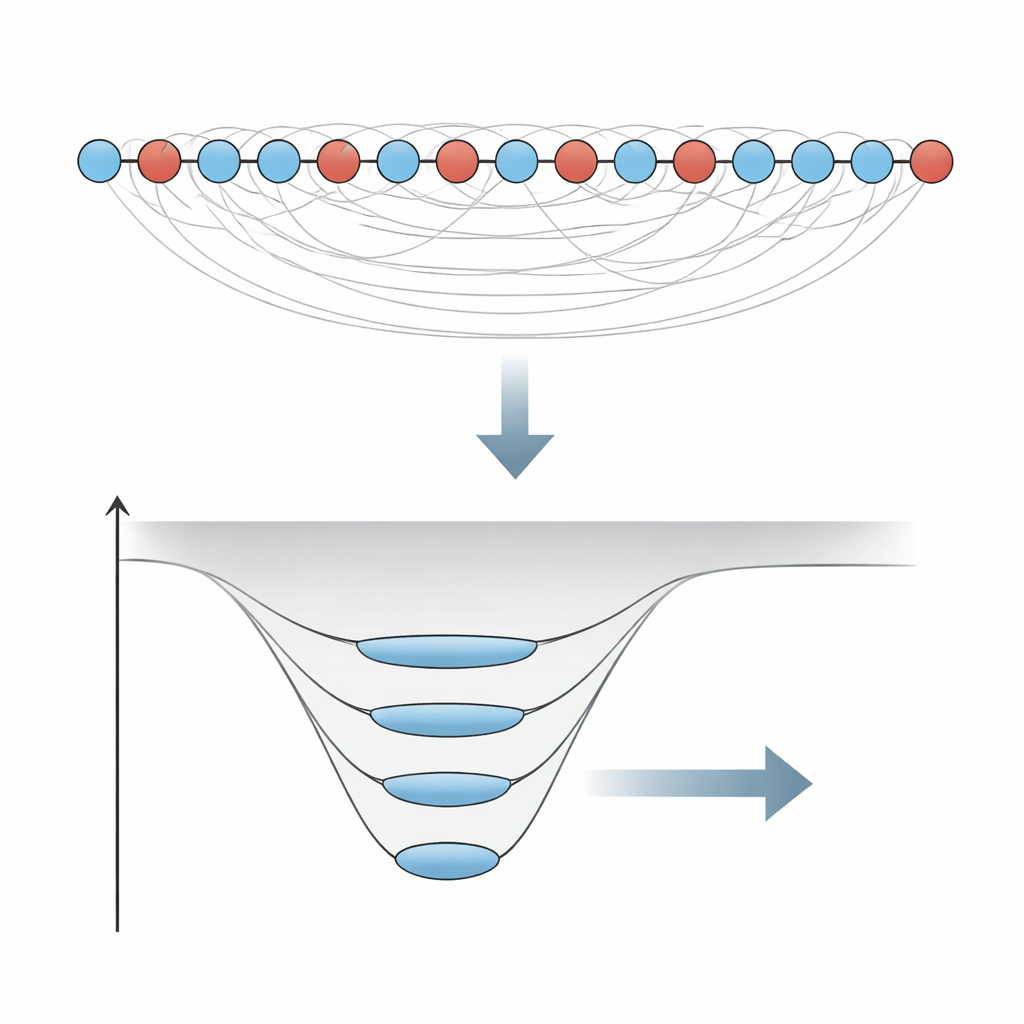
In the system studied here, the basic ingredients are spins in a chain, such as those realized by trapped ions, Rydberg atom arrays, or certain nuclear magnetic resonance setups. The authors treat the fully aligned chain as an empty background, and a flipped spin as a moving particle called a magnon. Because the spins are coupled over long distances with a strength that falls off as a power of their separation, these magnons do not behave like ordinary non-relativistic particles: their energy depends on momentum in a tunable, non-standard way. By adjusting how quickly the coupling decays along the chain, one effectively dials a new type of dynamical scaling that reshapes how pairs and triplets of magnons scatter and bind.
From smooth scaling to a quantum staircase
The authors first analyze how two magnons interact. They identify a range of coupling exponents where a pair of magnons can be tuned to a special “resonant” point: just shy of forming a bound state, but still strongly influencing each other at long distances. At this point, the two-magnon problem has a continuous scaling symmetry, meaning that its low-energy behavior looks self-similar at different length scales. The real surprise comes when a third magnon is added. Using an effective field theory and a standard three-body integral equation, the authors show that this continuous scaling is no longer fully respected. Instead, it fractures into a discrete scaling pattern, so that three-magnon bound states reappear over and over at energies related by a fixed geometric ratio—the hallmark of the Efimov effect.
Efimov states in new places
In one-dimensional long-range spin chains, this Efimov behavior does not occur for all parameters. The team finds that it appears only within a specific window of the coupling decay exponent, roughly when the interaction falls off a bit faster than the inverse square of distance but not as fast as short-range models. Within this window, they predict an infinite series of three-magnon bound states whose energy spacing can be significantly smaller than in traditional three-dimensional atomic systems, effectively compressing the Efimov ladder. They extend their analysis to two and three spatial dimensions, showing how varying the long-range couplings can either switch the Efimov effect on in dimensions where it is usually absent, or smoothly connect back to the well-known three-dimensional case for ordinary bosons.
A roadmap for quantum simulators
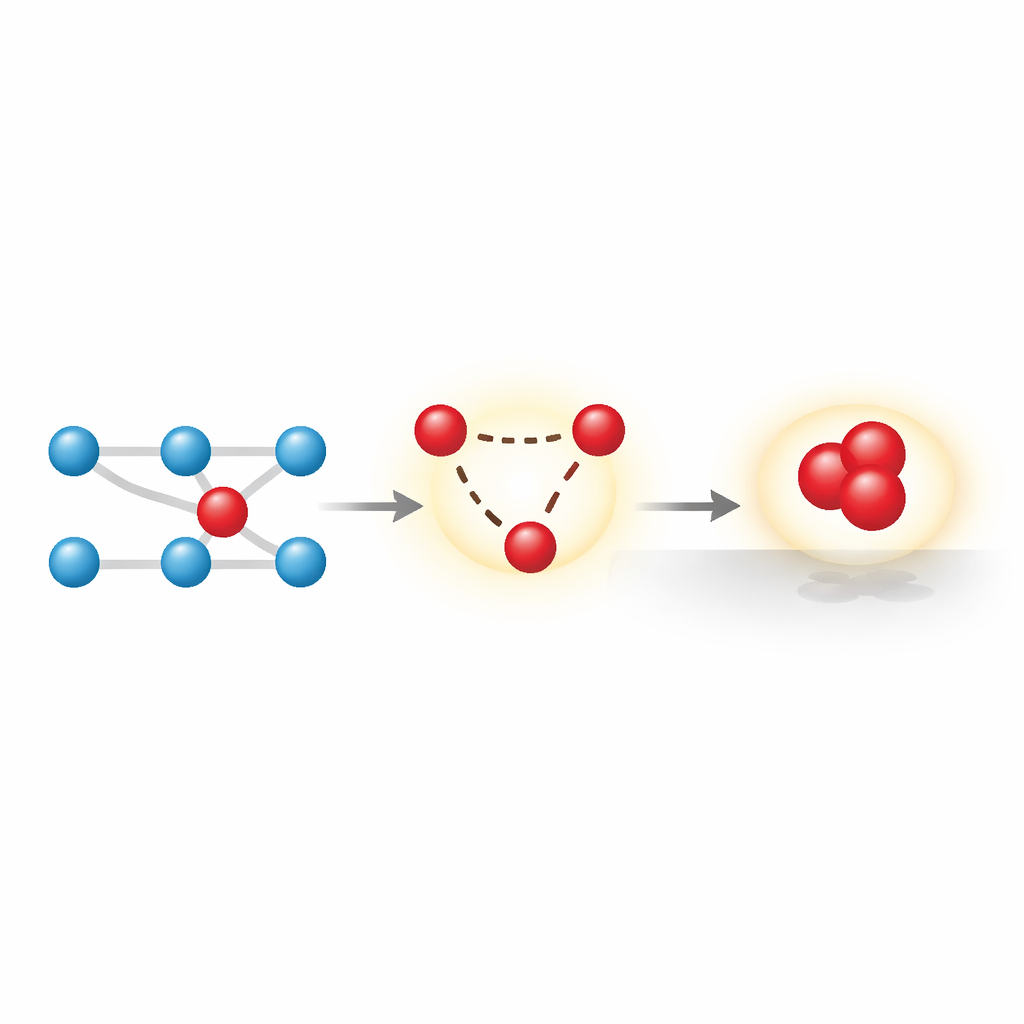
Beyond the theory, the work speaks directly to modern quantum platforms. In trapped-ion experiments, the rate at which spin couplings decay with distance can be tuned via laser settings, and two-magnon bound states have already been observed. The authors outline how spectroscopy or detailed measurements of three-magnon wavefunctions could reveal the predicted Efimov ladder, and suggest that related universal signatures may also appear in systems with a small but finite density of magnons, much like dilute quantum gases. In everyday terms, the paper shows that by carefully engineering how spins in a quantum simulator talk to each other over distance, one can coax a famously elusive three-body quantum effect into a simple, controllable setting, turning an abstract theoretical curiosity into something that could soon be seen and probed in the lab.
Citation: Sun, N., Feng, L. & Zhang, P. Efimov effect in long-range quantum spin chains. Commun Phys 9, 146 (2026). https://doi.org/10.1038/s42005-026-02580-0
Keywords: Efimov effect, long-range spin chains, trapped-ion quantum simulators, magnon bound states, few-body quantum physics