Clear Sky Science · en
Topological surface states in Ta3Sb
Why strange surfaces matter for future computers
Today’s most advanced ideas for quantum computers rely on exotic states of matter that are unusually resistant to disturbance. One promising route uses special electronic states that live only on the surface of certain superconducting materials. This paper explores such surface states in a compound called Ta3Sb, showing how its outermost atomic layers can be carefully tuned so that only the useful, protected states remain—an important step toward building robust quantum devices.
A superconductor with a hidden twist
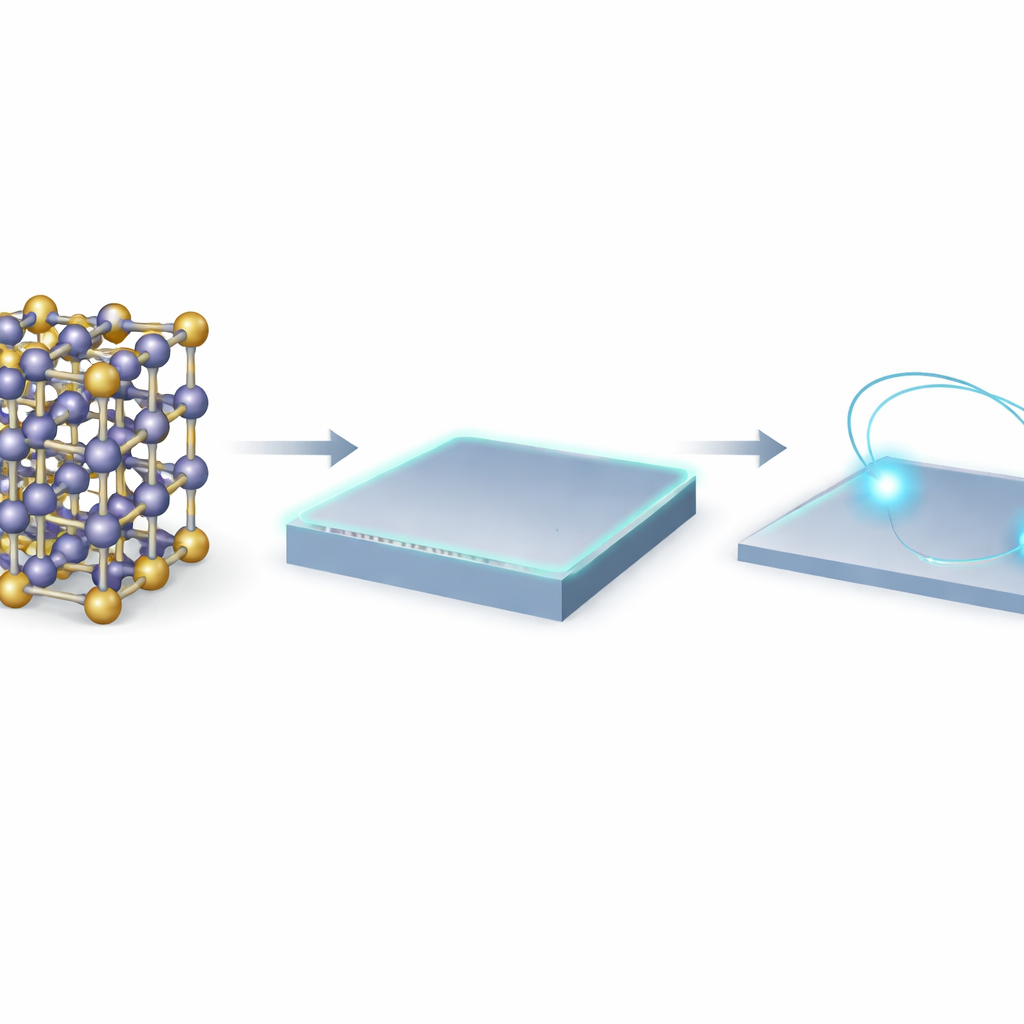
Ta3Sb belongs to a well-known family of superconductors that have been studied for decades because they carry electric current without resistance at low temperatures. What makes Ta3Sb unusual is that, deep down in its electronic structure, it also behaves like a so‑called topological material. In simple terms, the way its electrons fill the energy bands in the crystal forces certain special states to appear at the surface. These surface states form a cone‑shaped energy pattern, often called a Dirac cone, and they are protected by the material’s overall topology: as long as basic symmetries are preserved, these states cannot simply disappear, even if the surface is modified.
How cutting the crystal changes the surface
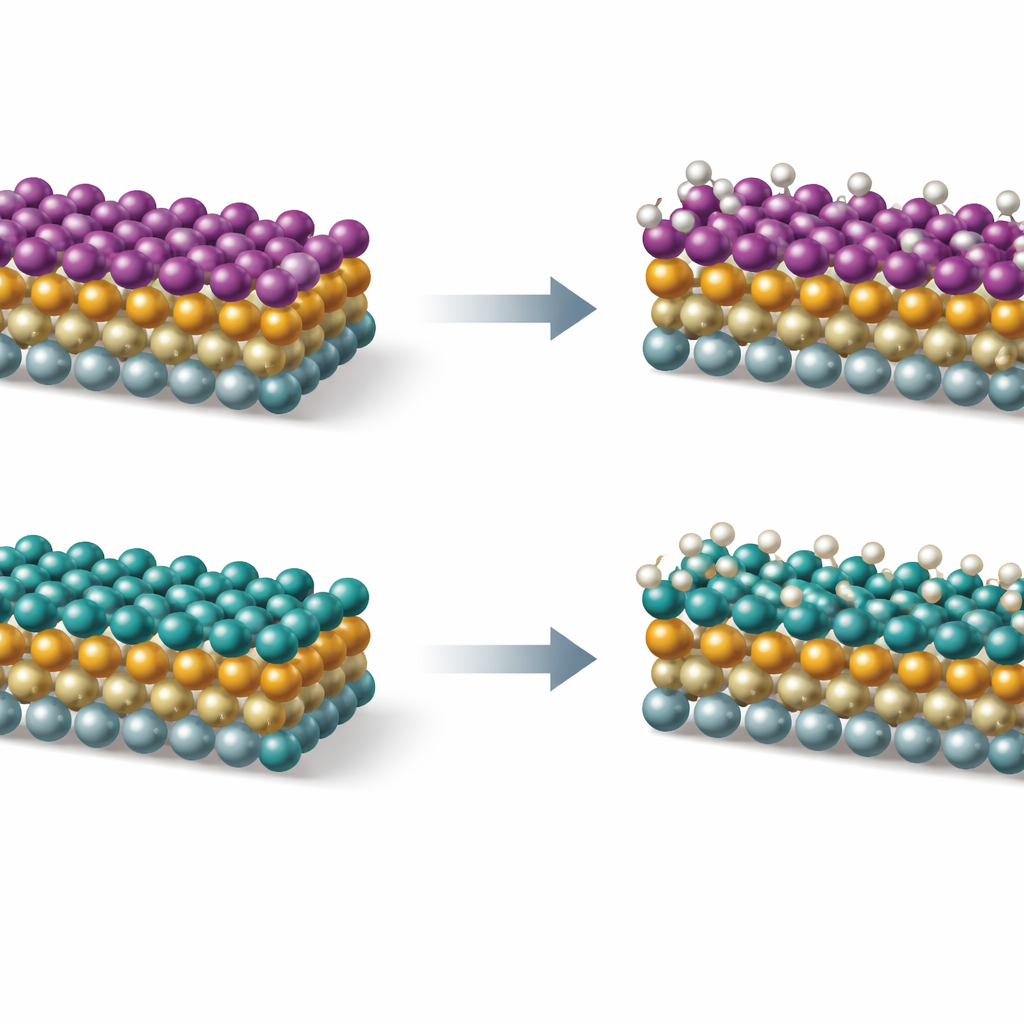
The author studies what happens when Ta3Sb is cut to expose a particular crystal face, known as the (001) surface. At this surface, the topmost layer of atoms can be arranged in different ways, referred to as different “terminations.” In one case, both tantalum (Ta) and antimony (Sb) atoms appear at the top; in another, only Ta atoms cap the surface. Starting from an ideal cut and then allowing the atoms to shift slightly into their most comfortable positions, the calculations show that even small rearrangements of the surface atoms can noticeably reshape the surface electronic pattern—moving the energy of the topological cone up or down and changing how strongly the electrons spread out along the surface.
Cleaning up cluttered surface signals
Real surfaces are messy: besides the desired topological states, they can host ordinary, or “trivial,” surface bands that lie close in energy and confuse experimental measurements. The paper demonstrates that chemical treatment offers a powerful way to clean up this clutter. When hydrogen atoms are attached to the dangling bonds at the surface, many of the unwanted trivial bands are pushed away from the energies of interest. For one mixed Ta–Sb termination, hydrogen passivation largely removes these trivial surface features and leaves behind a much simpler pattern dominated by the topological cone, whose crossing point sits close to the energy level relevant for experiments. On the Ta‑only termination, hydrogen also reshapes the cone, making it narrower and indicating that the electrons move more slowly along the surface, which could influence how they interact with each other.
Stability and practical surface design
Beyond the electronic patterns, the author also examines how energetically favorable different surface terminations and hydrogen treatments are. The mixed Ta–Sb surface is found to be more stable than the Ta‑only one, suggesting it is the configuration most likely to appear in real samples. Hydrogen binding is slightly unfavorable on the mixed surface but favorable on the Ta‑only surface, yet in both cases modern experimental techniques should be able to realize hydrogen‑covered surfaces. The work further shows that while the fine details—such as the exact energy of the Dirac point or the steepness of the cone—depend strongly on surface structure and treatment, the underlying topological character of the surface states remains intact and robust.
What this means for future quantum devices
For readers interested in quantum computing, the key message is that Ta3Sb combines two crucial ingredients in a single material: ordinary superconductivity in the bulk and protected topological states on its surface. The study shows that by choosing how the crystal is cut, allowing the atoms to relax, and applying simple chemical treatments like hydrogen passivation, scientists can push unwanted surface states out of the way and tune the useful ones into the right energy range. This kind of precise surface engineering brings Ta3Sb closer to serving as a platform where elusive Majorana‑type excitations could be isolated and controlled, offering a concrete path toward more stable and scalable topological quantum computing.
Citation: Kim, M. Topological surface states in Ta3Sb. Commun Phys 9, 137 (2026). https://doi.org/10.1038/s42005-026-02575-x
Keywords: topological superconductors, surface states, Ta3Sb, hydrogen passivation, quantum computing