Clear Sky Science · en
Adaptive governance in collective risk social dilemmas
Why this matters for everyday life
From climate change to pandemic control, many of our biggest problems share a simple pattern: everyone must pitch in, but each person is tempted to hold back. This study asks how rules and incentives can be adjusted over time so that groups keep working together instead of sliding into harmful free riding, and offers a recipe for more flexible, realistic cooperation schemes.
The challenge of shared danger
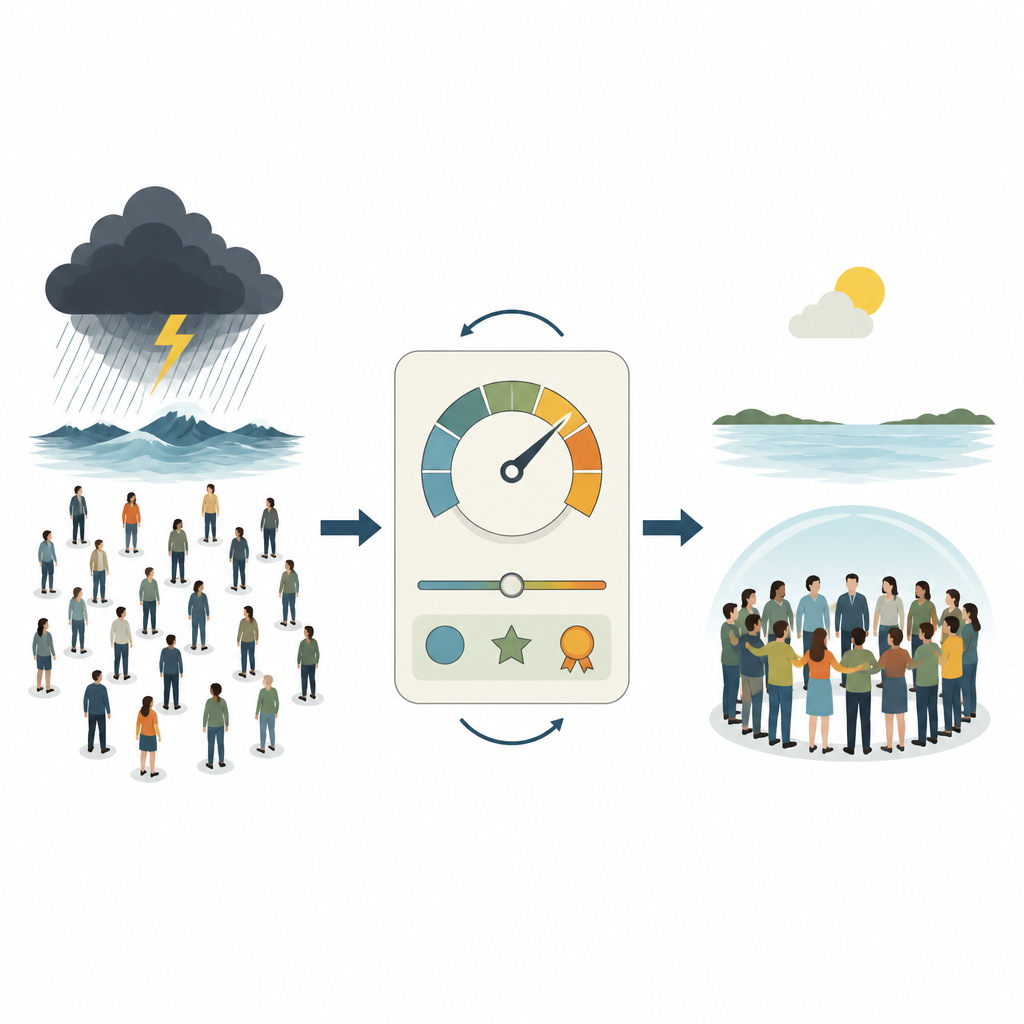
The authors focus on situations where a group faces a common risk, such as failing to cut emissions or to contain an outbreak. Each individual starts with some resources and decides whether to contribute to a common effort. If total contributions reach a target, everyone keeps their resources. If they fall short, there is a chance that everyone loses out. Earlier research showed that higher risk can push people to cooperate, and that rewards or punishments can help. But most models assumed that the collective target is fixed. In reality, international climate pledges or public health goals are revised over time, which raises the question of whether moving targets and changing rewards can actually sustain cooperation.
A simple game with changing rules
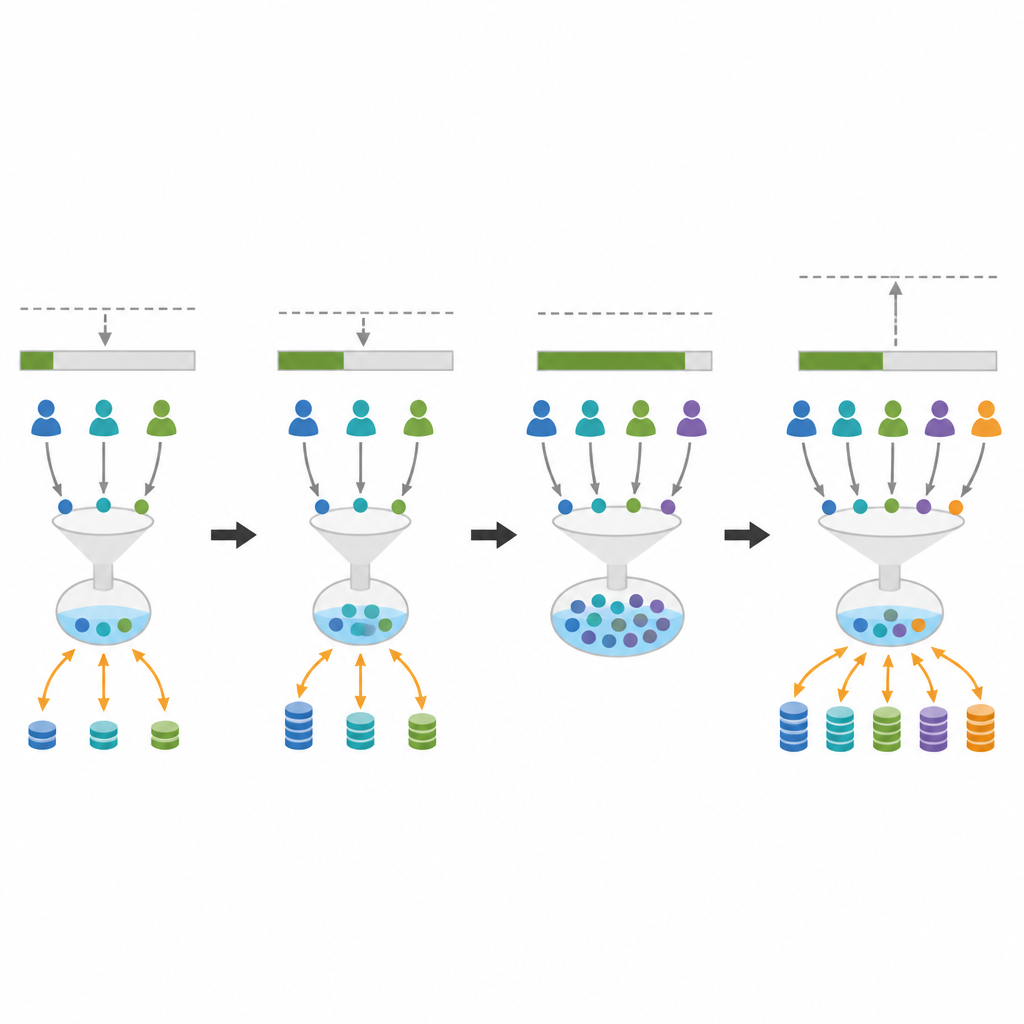
To explore this, the researchers build a repeated game in which people are randomly grouped and decide whether to cooperate or defect. A shared pool of money is set aside to reward those who cooperate, and the game runs for several rounds. The key twist is an adaptive governance rule between stages. If the group meets its current target, the target is raised for the next stage, reflecting higher ambition. If the group falls short, the target stays the same, but the intensity of rewards for cooperators is increased to encourage more effort. Using tools from evolutionary game theory, the authors track how the share of cooperators changes over time under different levels of risk, rewards, and target settings.
What happens when risk is low
When the danger of collective failure is modest, people are less naturally driven to cooperate, and the system tends to settle into mixed outcomes where free riders are common. In this setting, the model shows that modestly raising the collective target can help pull the group toward higher cooperation: people see that more effort is needed and respond accordingly. However, pushing the target too high backfires. The population can get stuck in a state where defection is attractive and the cooperation level drops. Here, increasing reward strength plays a particularly helpful role. By making successful cooperation more lucrative, stronger rewards enlarge the range of starting conditions that lead the group toward high cooperation rather than low.
What happens when risk is high
When the chance of collective loss is large, the threat itself already nudges people toward cooperation. The model finds that in this high risk regime, raising the target remains beneficial: higher goals both lift the typical level of cooperative behavior and increase the likelihood that the group actually reaches the target. Unlike the low risk case, there is no clear downside to aiming higher. By contrast, boosting reward intensity does little at high risk. Cooperation is already attractive because of the danger of failure, so extra rewards add relatively little. The timing of adjustments also matters: changing targets or rewards earlier in the repeated interaction helps stabilize high cooperation, while waiting longer weakens this effect.
Designing flexible rules for real problems
Overall, the study sketches an adaptive governance framework that uses a simple two way rule: when interim goals are reached, raise future targets; when they are missed, increase rewards for contributors. In low risk settings, success depends on combining moderate target increases with stronger incentives. In high risk settings, more ambitious targets are especially effective, while extra rewards are less crucial. The authors argue that this pattern mirrors real climate policies, where countries periodically tighten emission goals or expand subsidies depending on progress. Their results suggest that flexible, feedback based adjustment of targets and rewards can help societies share risks more fairly and keep cooperation alive over the long haul.
Citation: Xu, M., Hua, S., Liu, L. et al. Adaptive governance in collective risk social dilemmas. Commun Phys 9, 177 (2026). https://doi.org/10.1038/s42005-026-02574-y
Keywords: collective risk, cooperation, adaptive governance, climate change, incentives