Clear Sky Science · en
Chiral damping with persistent edge states from the interplay of topologies in open quantum systems
Why edges can beat decay
When we think about a quantum device, we often imagine tiny particles freely moving around until they eventually leak away into their surroundings. This study shows that, under the right conditions, the edges of such a system can act like stubborn highways that keep particles moving long after the interior has faded out. Understanding how and why this happens could help design future quantum circuits, waveguides, or electronic materials that route signals along protected edge channels instead of through their fragile interiors.
Two ways for quantum matter to organize
Modern physics has revealed that quantum particles can organize themselves in unusual ways that depend not just on local details, but on global, “topological” properties of a system. One type of topology lives in the energy bands and gives rise to special edge states that hug the boundaries of a material and are surprisingly robust. Another type appears when loss and gain are present, so that the system continually exchanges energy or particles with its environment. In that case, the mathematical spectrum becomes complex, and a different topological structure can make almost all states crowd toward one side, a phenomenon known as a skin effect. This work asks what happens when both tendencies — robust edge states and directional skin accumulation — are present at the same time.
A playground: electrons on a magnetic grid
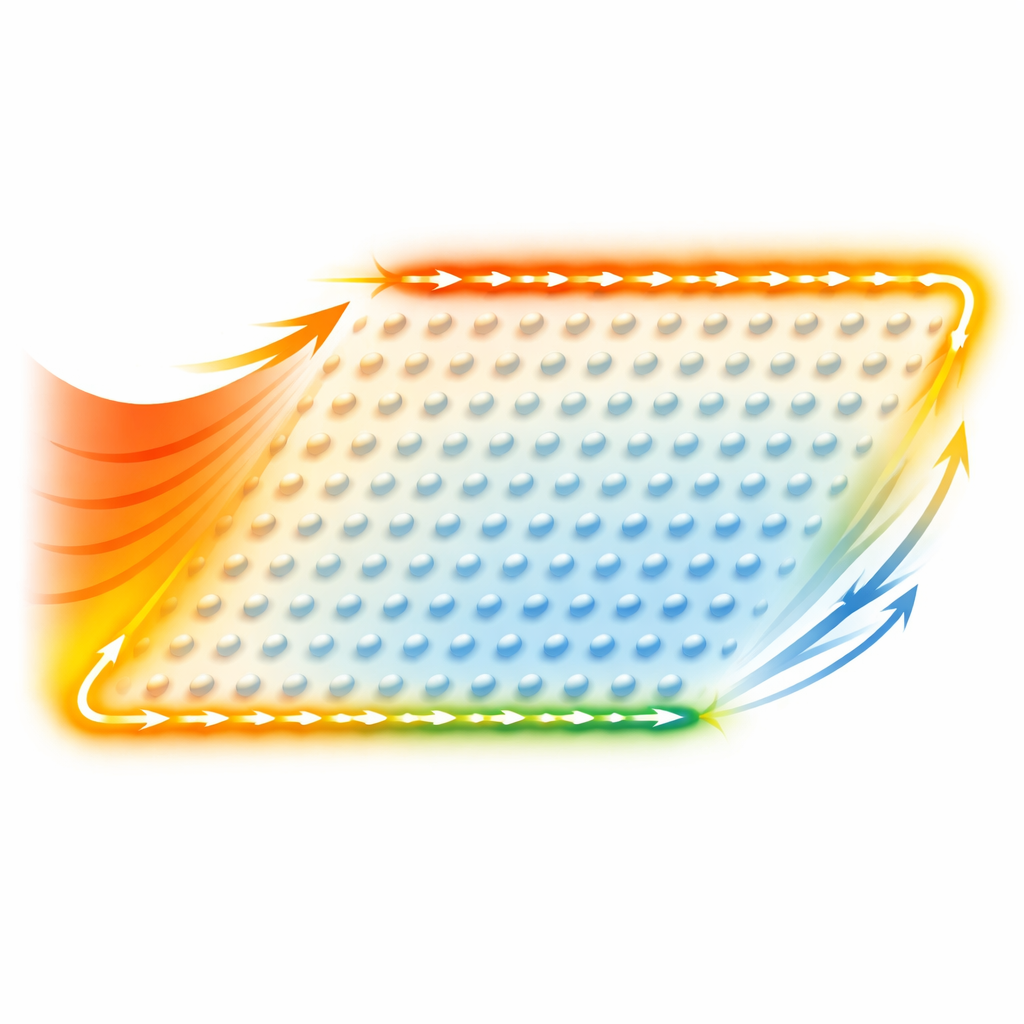
To explore this question, the authors study a well-known model where electrons hop on a two-dimensional square grid threaded by a magnetic field. The magnetic field reshapes the motion into a richly structured pattern with energy gaps and edge states running around the perimeter of the grid. On top of this, the system is coupled to an environment through so-called bond dissipation: the loss or gain processes act not on individual sites, but on the links between neighboring sites. This kind of coupling naturally makes interior sites, which have more bonds, lose particles faster than edge sites. At the same time, it effectively introduces directional hopping, which drives particles toward one edge and creates the skin effect with a chiral, or one-way, damping wavefront sweeping through the bulk.
Edges that outlast the bulk
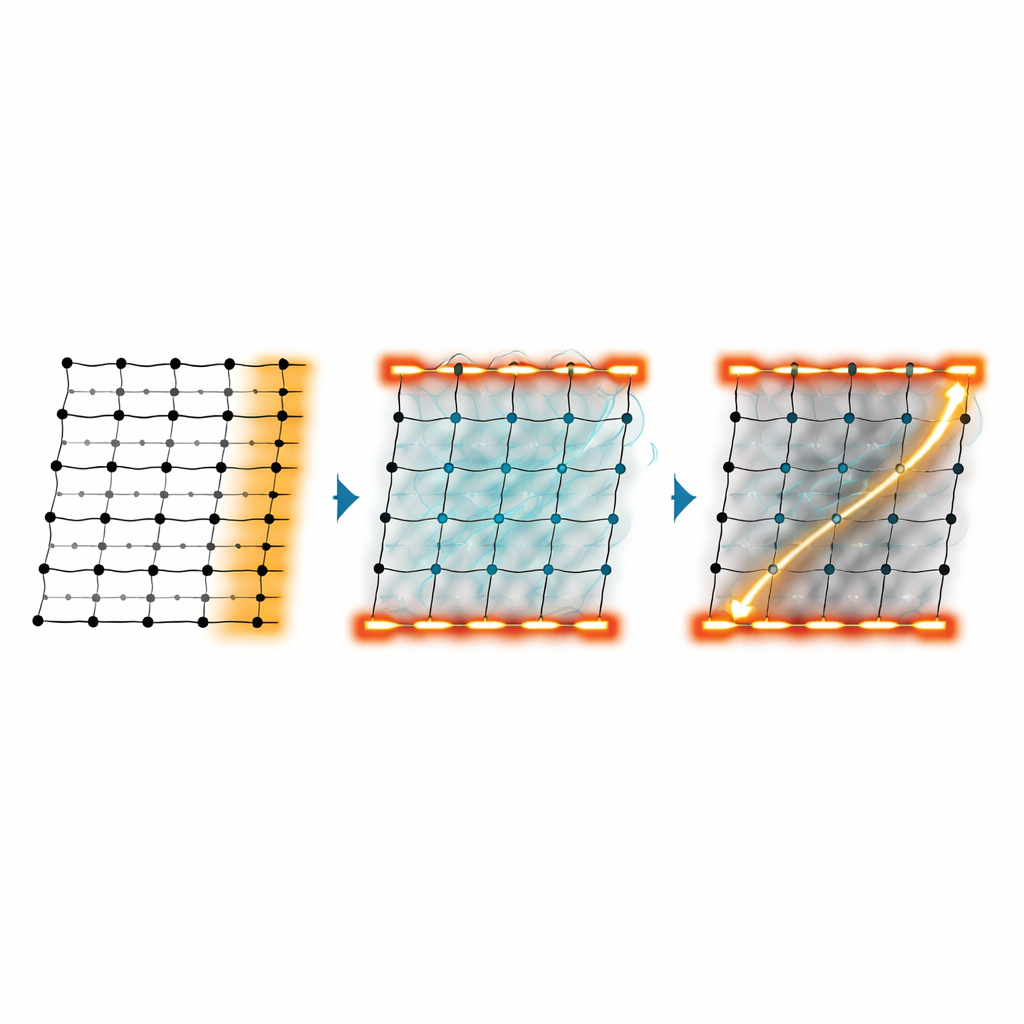
By tracking how particle densities evolve in time, the authors show that two distinct behaviors emerge and are cleanly separated in time. At early times, most of the action is governed by the skin effect: a sharp front of decay moves across the sample, preferentially draining the interior and pushing particles toward one side. At longer times, however, the topological edge states take over. Because edge sites are coupled less strongly to the environment, the corresponding edge modes acquire smaller decay rates — there is an effective “damping gap” that isolates them from the more strongly damped bulk modes. As a result, particles that manage to occupy these edge channels persist, while those in the interior have already faded away. The competition between ordinary skin localization and topological edge localization can stretch one edge mode or squeeze another, but for modest dissipation both edges retain well-defined, long-lived states.
Magnetic tuning of directional decay
The magnetic field plays a second, subtler role by controlling how strongly the skin effect appears. At very weak fields, the field can actually suppress the tendency of states to accumulate at the boundary, making the system more bulk-like and softening the chiral decay front. As the field is increased to intermediate values, the skin effect re-emerges and a strong directional damping pattern is restored, again coexisting with robust edge states. By scanning the spectrum and spatial profiles of the modes, the authors show that the edge states remain pinned near the boundaries while the bulk states switch between weak and strong boundary accumulation depending on the field strength.
What this means for future quantum devices
In plain terms, this work demonstrates that open quantum systems — those constantly losing particles or energy — can display a surprisingly orderly division of labor. The interior rapidly empties out in a directional way, while specially protected edge channels keep carrying particles for much longer times. The key is that the processes that generate one-way damping and those that protect edge modes act on different time scales and in different parts of the spectrum. This insight applies broadly to a wide class of systems with bond-like dissipation, from photonic waveguides to electrical circuits and cold-atom setups. It suggests practical routes to designing robust quantum “wires” along the edges and even, when both directions are open, to concentrating activity at corners, offering new ways to guide and store quantum signals despite inevitable loss.
Citation: Sarkar, R., Hegde, S.S., Narayan, A. et al. Chiral damping with persistent edge states from the interplay of topologies in open quantum systems. Commun Phys 9, 109 (2026). https://doi.org/10.1038/s42005-026-02573-z
Keywords: open quantum systems, topological edge states, non-Hermitian skin effect, chiral damping, dissipative Hofstadter model