Clear Sky Science · en
Intrinsic non-linearity of Josephson junctions as an alternative origin of the missing first Shapiro step
Why a Missing Step Matters
Superconducting devices known as Josephson junctions are central to many visions of future quantum technologies. When these junctions are bathed in microwaves, their electrical response develops a series of voltage plateaus called Shapiro steps. For more than a decade, the disappearance of the very first of these steps has been heralded as a possible fingerprint of exotic particles called Majorana modes, which could power fault-tolerant quantum computers. This paper asks a sobering question: could a perfectly ordinary, non‑exotic effect in the junction itself mimic this eye‑catching signature?
Stepping Stones in a Supercurrent
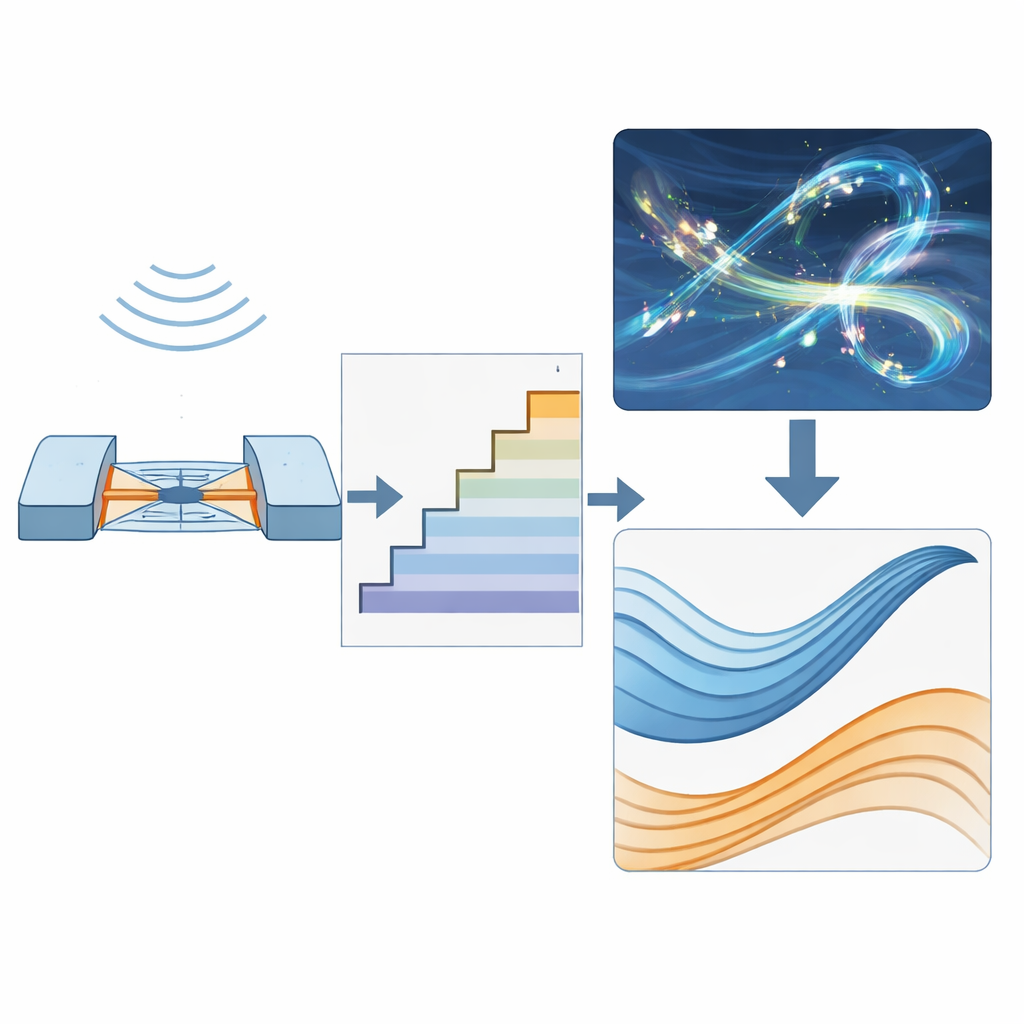
In a Josephson junction, two superconductors are linked through a thin region that can carry current without resistance. Under microwave irradiation, the voltage–current curve no longer rises smoothly but locks into a staircase of flat plateaus. Each plateau, a Shapiro step, corresponds to the junction’s internal rhythms synchronizing with the applied microwaves. Earlier theory suggested that if a junction hosts Majorana bound states, the current would repeat only after the phase advances twice as far as in an ordinary device. That so‑called fractional Josephson effect should selectively erase every other step, starting with the first one, making the missing first Shapiro step a tempting clue for new physics.
Building a Careful Test Device
The authors constructed Josephson junctions using ultrathin flakes of the material WTe2, which in other settings can host topological electronic states. Aluminum electrodes were patterned so they deliberately avoided touching the flake’s edges, suppressing contributions from edge channels where Majorana modes might live. Basic measurements showed a modestly transparent junction with a sharp switching point between superconducting and normal behavior but very little hysteresis, a regime usually modeled with a standard "resistively and capacitively shunted" description. When the team exposed these devices to microwaves over a broad range of frequencies, they indeed observed the first Shapiro step fading away at low frequencies, as well as more subtle half‑step features at higher frequencies.
A Strange Zigzag in the Data
Looking more closely, the researchers uncovered an unexpected pattern at intermediate microwave frequencies: a zigzag boundary between the regions corresponding to zero voltage and the first Shapiro step. This kinked transition appeared only within a narrow frequency window and shifted systematically as the frequency changed. Traditional models that invoke only junction damping or simple heating effects—two common "conventional" explanations for missing steps—could reproduce the sharp switching in the current–voltage curve but failed to generate the distinctive zigzag structure. That mismatch suggested that something more intrinsic in the junction’s behavior was at work.
A New Way to Think About Resistance
To explain these observations, the authors extended the familiar junction model by allowing the junction’s ordinary, resistive current channel to depend strongly on voltage instead of remaining constant. In this non‑linear model, the effective resistance swells dramatically right at the switching point and then relaxes at higher voltages. With parameters anchored to the measured current–voltage curves, numerical simulations based on this refined description reproduced all of the key experimental features: the sharp switching with minimal hysteresis, the complete loss of the first Shapiro step at low drive frequencies, the appearance of half‑integer steps at high frequencies, and—crucially—the zigzag boundary between the lowest steps that the standard model could not capture.
Rethinking a Popular Quantum Clue
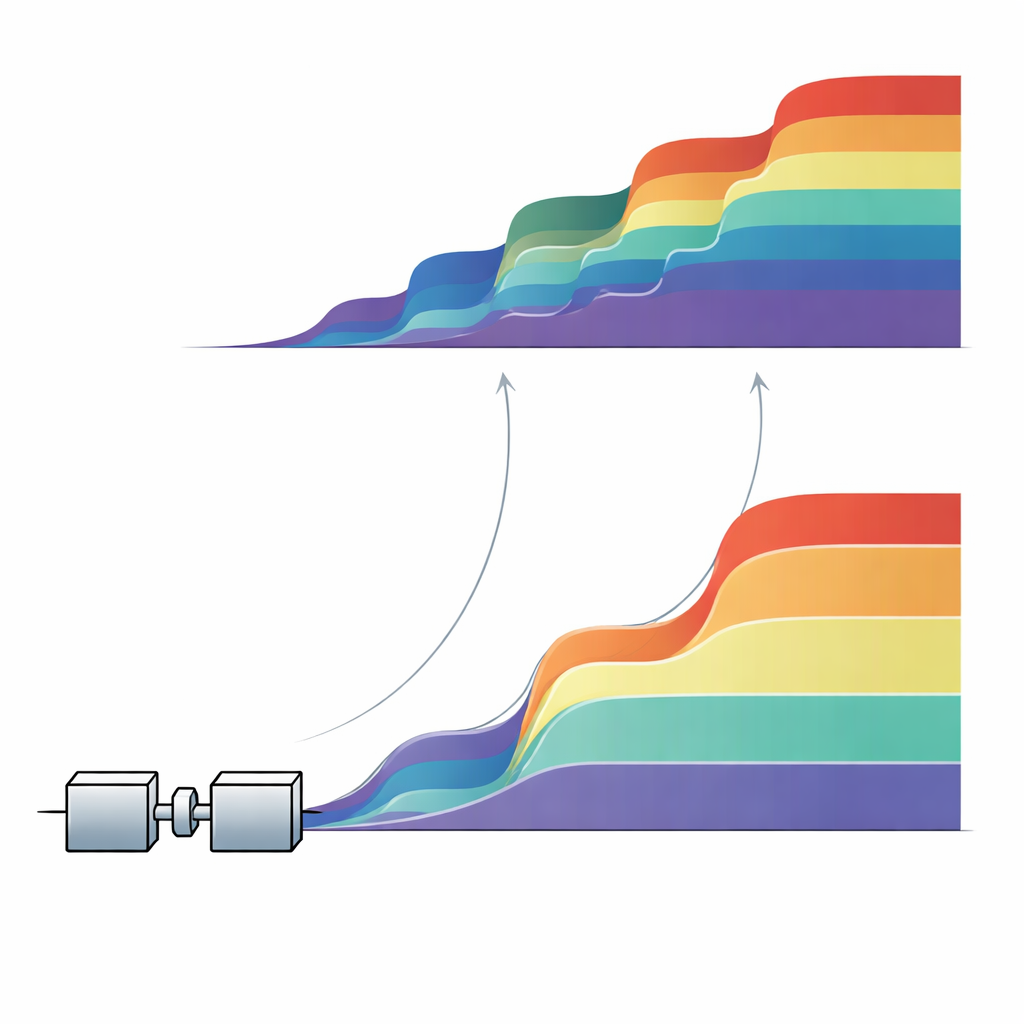
Taken together, these results show that the missing first Shapiro step does not by itself prove the presence of Majorana modes or other exotic quantum states. Instead, the work demonstrates that an intrinsic non‑linearity in how ordinary quasiparticles flow through a modest‑transparency junction can mimic this widely discussed signature, even in devices where topological contributions are deliberately suppressed. The characteristic zigzag pattern identified here emerges as a practical diagnostic: its presence points to non‑linear conventional physics rather than to new types of particles. For researchers hunting robust quantum states, the message is clear—microwave spectra must be examined in detail and interpreted with care before claiming evidence for Majorana‑based superconductivity.
Citation: Xu, L., Mai, S., Xu, M. et al. Intrinsic non-linearity of Josephson junctions as an alternative origin of the missing first Shapiro step. Commun Phys 9, 150 (2026). https://doi.org/10.1038/s42005-026-02571-1
Keywords: Josephson junctions, Shapiro steps, Majorana signatures, nonlinear transport, WTe2 devices