Clear Sky Science · en
Laser-driven annular shock waves as laboratory analogues of wCDM cosmologies and cosmological gravitational waves
A Universe in a Shock Wave
Imagine watching a tiny "universe" expand, speed up, and ripple with waves—all inside a tabletop experiment. This study shows that carefully shaped shock waves in a laboratory plasma can act as stand-ins for the expanding cosmos, including its mysterious dark energy and elusive gravitational waves. By tracking how these shock fronts move and interact, the researchers recreate, in miniature, the same kinds of behaviors that astronomers infer from telescopes looking across billions of light-years.
Creating a Miniature Cosmos
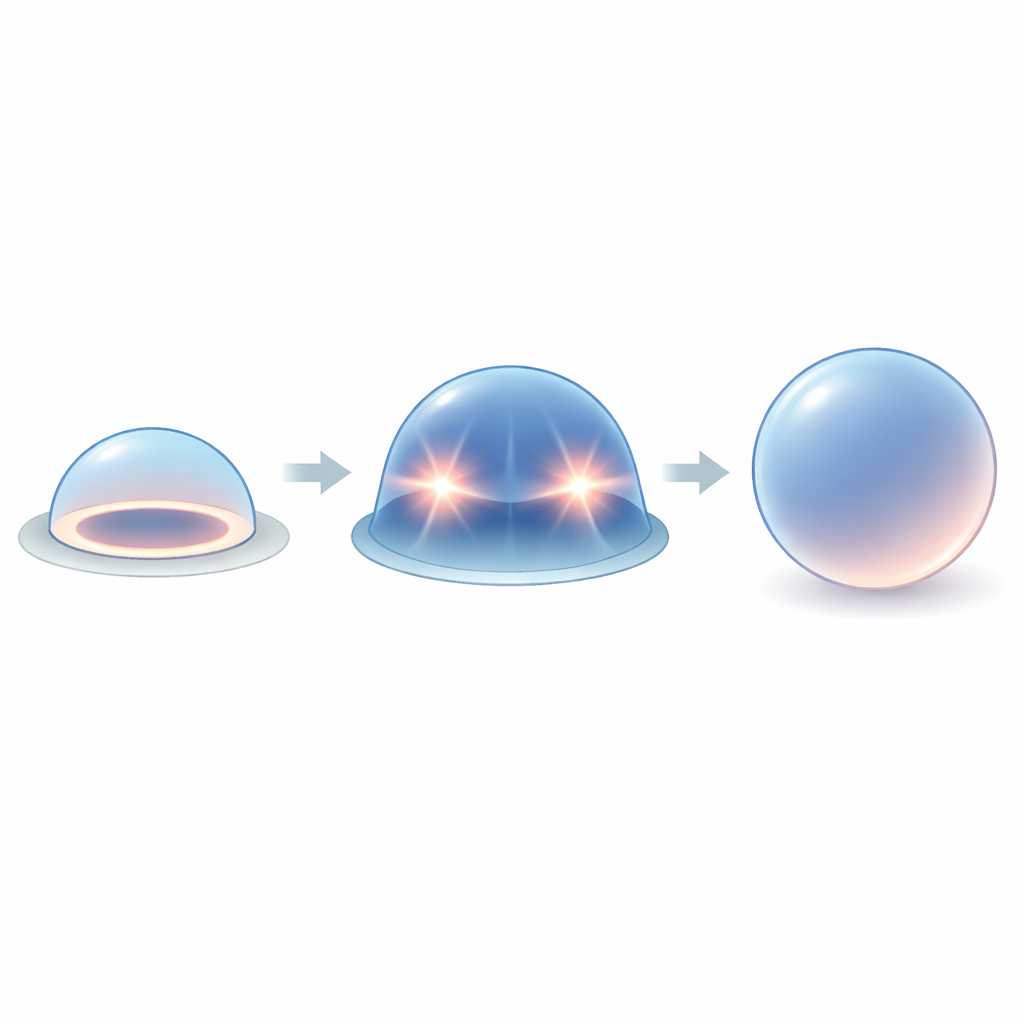
The experiment begins with a powerful laser striking an aluminum target through a special glass element called an axicon, which reshapes the beam into a bright ring rather than a single point. This ring of energy creates an annular, or doughnut-shaped, plasma that pushes the surrounding gas outward, launching a cylindrical shock wave. High-speed imaging captures how this shock front swells like an expanding dome and gradually changes shape over microseconds. Because the underlying mathematics of shock expansion closely mirrors that of a uniform expanding universe, the radius of the shock wave can play the role of the cosmic scale factor, the quantity cosmologists use to describe how space itself stretches with time.
From Simple Expansion to a Cosmic Mix
As the annular shock wave grows, different parts of its surface evolve as if they were different model universes. Along certain fixed paths, the shock first behaves like a cylindrical wave and then transitions to a planar one, echoing a cosmos that starts out dominated by radiation and later becomes dominated by ordinary matter. The researchers show that this change can be captured by an equation that looks almost identical to the standard cosmological model in which multiple components—such as matter and radiation—contribute to the expansion rate. In this picture, the effective "dimension" of the shock’s motion stands in for the type and mix of cosmic ingredients shaping the universe.
Laboratory Dark Energy
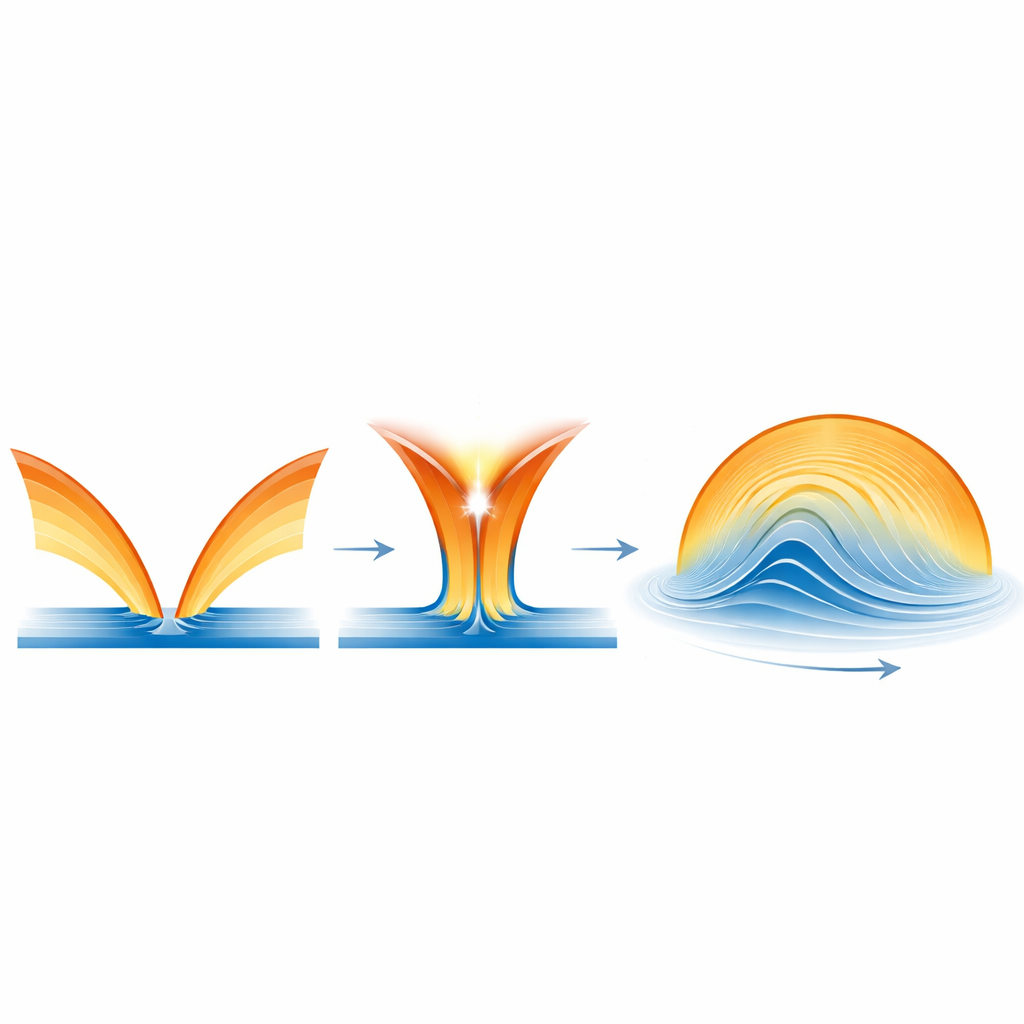
The most striking behavior appears where three shock fronts meet: the incident wave, its reflection, and a third structure called a Mach stem. The junctions of these three fronts, known as triple points, race outward faster and faster, as if driven by an unseen push. When their motion is analyzed with the same tools used in cosmology, it behaves like a universe dominated at late times by a dark energy–like component that causes accelerated expansion. In the shock system, this "acceleration" does not come from any exotic new substance but from the nonlinear interplay of the different wave fronts. The team can write down an analogue of a popular dark energy framework (the so‑called wCDM model), in which the shock’s effective dimension and energy content mimic radiation, matter, and dark energy terms.
Ripples that Echo Gravitational Waves
The Mach stem does more than just accelerate: as it grows and then falls back relative to the rest of the almost spherical shock front, it creates a localized bump that behaves like a small ripple riding on an expanding background. By treating this bump as a tiny perturbation of the main shock radius, the authors find that its amplitude decays over time following the same kind of simple law that describes cosmological gravitational waves in a matter-dominated universe. In other words, the fading of this shock-induced wrinkle in the lab mirrors the way space-time ripples would die away as the real universe expands.
What This Means for Our View of the Cosmos
This work does not measure the actual universe or resolve tensions in today’s cosmological data. Instead, it offers a powerful classical playground where ideas about cosmic expansion, dark energy, and gravitational waves can be tested and visualized under controlled conditions. By showing that a single, well-understood plasma system can reproduce the same mathematical behavior as several key cosmological models, the study builds a bridge between laboratory physics and the large-scale universe. It suggests that some features we attribute to fundamental cosmic ingredients—such as acceleration driven by dark energy—might, in principle, emerge from complex interactions within a system, a perspective that could inspire new ways of thinking about the real cosmos.
Citation: Asenjo, F.A., Veloso, F. & Valenzuela, J.C. Laser-driven annular shock waves as laboratory analogues of wCDM cosmologies and cosmological gravitational waves. Commun Phys 9, 130 (2026). https://doi.org/10.1038/s42005-026-02570-2
Keywords: analogue cosmology, plasma shock waves, dark energy, gravitational waves, laboratory astrophysics