Clear Sky Science · en
Deterministic scale-invariant dynamics in a logistic Game-of-Life model
Why simple rules can create complex worlds
Many natural systems, from forest fires to traffic jams, seem to hover between calm and chaos. At this edge, events of all sizes can occur, from tiny flickers to system-spanning cascades. This article explores whether such scale-free behavior really needs randomness, or whether it can arise in a world that is completely predictable. The authors tackle this question using a twist on Conway’s famous Game of Life, showing that purely deterministic rules can still give rise to critical, scale-invariant dynamics.
A new twist on the Game of Life
Conway’s Game of Life is a grid-based toy universe where each cell is either “alive” or “dead,” and the state of each cell changes according to the status of its neighbors. Traditionally, the rules are all-or-nothing: each site flips between 0 and 1. In the logistic Game of Life studied here, each cell instead carries a value between 0 and 1 that measures how “alive” it is, and a single control knob, called λ, scales how strongly cells update. This change expands the possible states into a finely grained set, allowing cells to adjust in smaller steps while keeping the dynamics fully deterministic. As λ is tuned, the patterns that fill the grid shift in character, offering a rich testing ground for studying when and how critical behavior appears.
Three kinds of long-term behavior
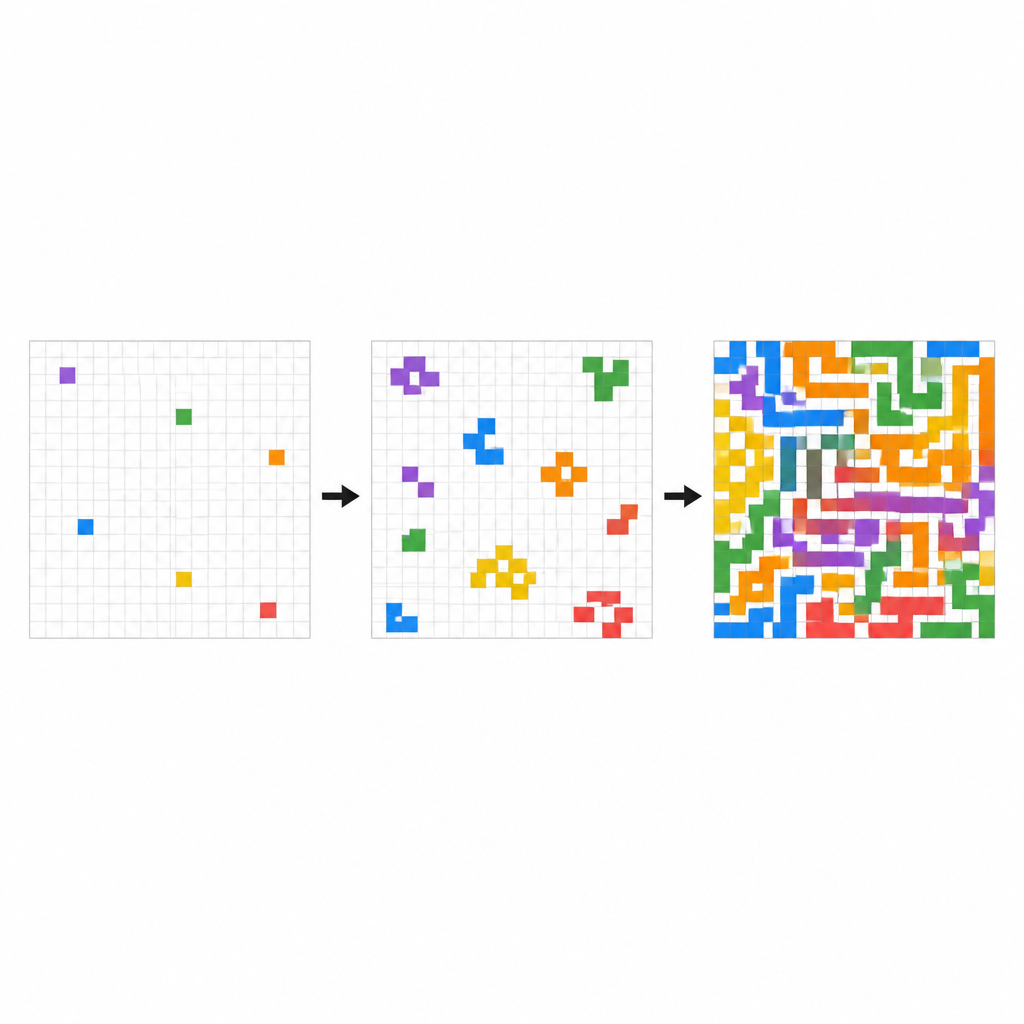
By running large simulations and watching how the grid evolves for many time steps, the authors identify three distinct long-term regimes as λ is varied. For high values of λ, the system behaves much like the classic Game of Life: activity quickly dies out, leaving a mostly empty background dotted with a few frozen blocks or small repeating shapes. This is a sparse-static phase. When λ is lowered past a first threshold, called λA, the system never fully settles. Instead, activity persists forever in the large-size limit, though it remains relatively sparse and moves through a backdrop of mostly quiet cells. This defines a sparse-dynamic phase. Lowering λ even further leads to a dense-dynamic phase in which active sites and quiet sites weave together into intricate, maze-like structures that keep changing in time.
Detecting hidden phase transitions
To tell these phases apart more sharply, the researchers track how many cells change between snapshots, how unevenly that activity is spread out, and how big the connected patches of similar cells become. Near λA, the fraction of changing cells suddenly jumps from almost zero to a finite value, and the fluctuations of activity across space peak. This signals a transition from truly frozen behavior to persistent motion, even though the underlying rules never change. Deeper in the active region, they monitor the size of the largest cluster of quiet sites. As λ is lowered, this “vacuum” cluster shrinks until, at a second special value λP, it suddenly stops spanning the grid. Statistical tests show that, at this point, clusters become self-similar in shape and grow with system size in the same way as in standard percolation problems, where links in a network switch from isolated islands to a single connected continent.
Unusual fingerprints of criticality
Beyond just locating the transition points, the team examines how often clusters of a given size appear. At λP, the distribution of cluster sizes follows a power law: small clusters are common, and larger clusters become rarer in a smooth, scale-free fashion, with an exponent (about 1.81) that is strikingly lower than in familiar two-dimensional percolation models. This hints at a different “universality class,” driven here by the directional influence built into the update rules rather than by random chance. Around λA, a different kind of scale-free pattern emerges: when the dominant, lattice-spanning quiet region is ignored, the remaining quiet patches surrounded by activity also follow a power-law size distribution, but with a steeper exponent near 2.9. Importantly, this behavior appears over a range of λ values without any outside nudging, suggesting a form of self-organized criticality generated purely by the internal dynamics.
Why this matters for real systems
The study shows that complex, scale-invariant behavior can arise in a fully deterministic grid world that uses only local rules and a single, noise-free control knob. One transition behaves much like a classic percolation process, where a giant connected region forms or breaks apart, but with unusual numerical fingerprints that trace back to the geometry of the rule set. The other transition produces self-organized criticality without the random inputs or continual external driving used in earlier models. Together, these results suggest that real-world systems might reach critical, scale-free states even when randomness plays a minor role, provided their local interactions are structured in the right way.
Citation: Akgün, H., Yan, X., Taşkıran, T. et al. Deterministic scale-invariant dynamics in a logistic Game-of-Life model. Commun Phys 9, 173 (2026). https://doi.org/10.1038/s42005-026-02568-w
Keywords: Game of Life, criticality, percolation, cellular automata, self-organized criticality