Clear Sky Science · en
Condensation and intracellular interaction of membrane-anchored receptors and ligands capable of forming catch and slip bonds
How cells feel and respond to pulling forces
Every time your immune cells latch onto a virus-infected or cancer cell, tiny protein “hooks” on their surfaces grab matching partners on the target cell. These hooks do not just stick together; they also feel the push and pull of mechanical forces from moving tissues and restless cell skeletons. This study explores how such pulling forces can make these membrane-bound proteins gather into dense clusters or fall apart, and how that, in turn, could tune vital processes like immune defense and cancer progression.
Sticky molecules that react to force
Cell surfaces are studded with receptors that bind to complementary ligands on neighboring cells, forming bridges that keep cells in contact and pass signals between them. Some of these bonds behave like ordinary “slip” bonds, becoming weaker when pulled. Others are “catch” bonds, which paradoxically hold tighter under moderate force before eventually failing. At the same time, many cell-surface proteins can condense into droplet-like patches, a form of liquid-like clustering related to the phase separation seen in membraneless organelles inside cells. Experiments have shown that such condensates are crucial for immune signaling and cell adhesion, but how mechanical forces promote or hinder this clustering at cell–cell junctions has remained unclear.
A virtual testbed for tugged cell membranes
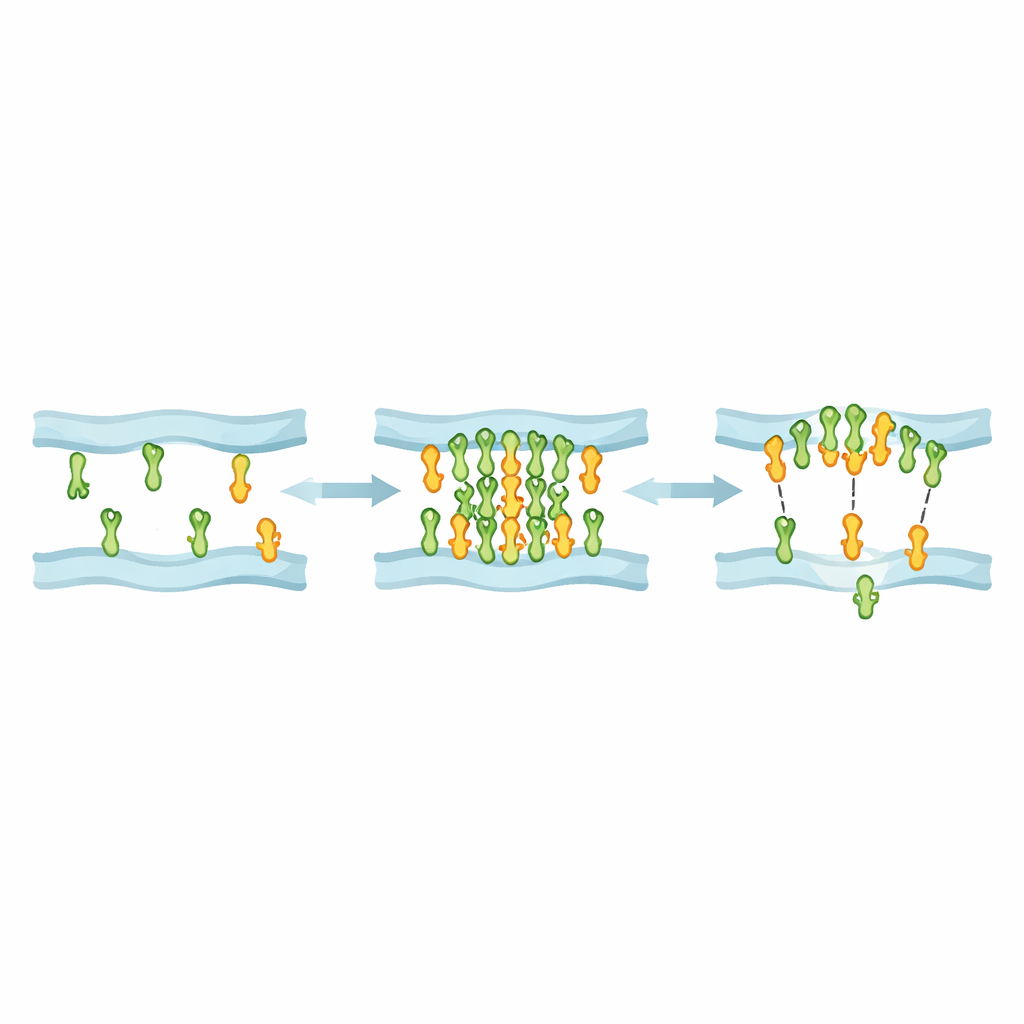
The authors built a detailed computer model of two apposed cell membranes, each divided into tiny patches that can bend, fluctuate, and host at most one receptor or ligand. Receptors and ligands diffuse laterally, bind across the gap when in range, and act like small springs that stretch under tension. Pulling forces are applied across the contact zone, either spread evenly or concentrated at a few spots. By adjusting how bond strength changes with force, the model can reproduce both catch and slip behavior measured in single-molecule experiments on immune receptors. Using Monte Carlo simulations and complementary analytical theory, the team tracked how many bonds form, how long they live, how strongly the two cells adhere, and whether the proteins stay evenly spread or condense into domains.
Forces, fluctuating membranes, and protein clustering
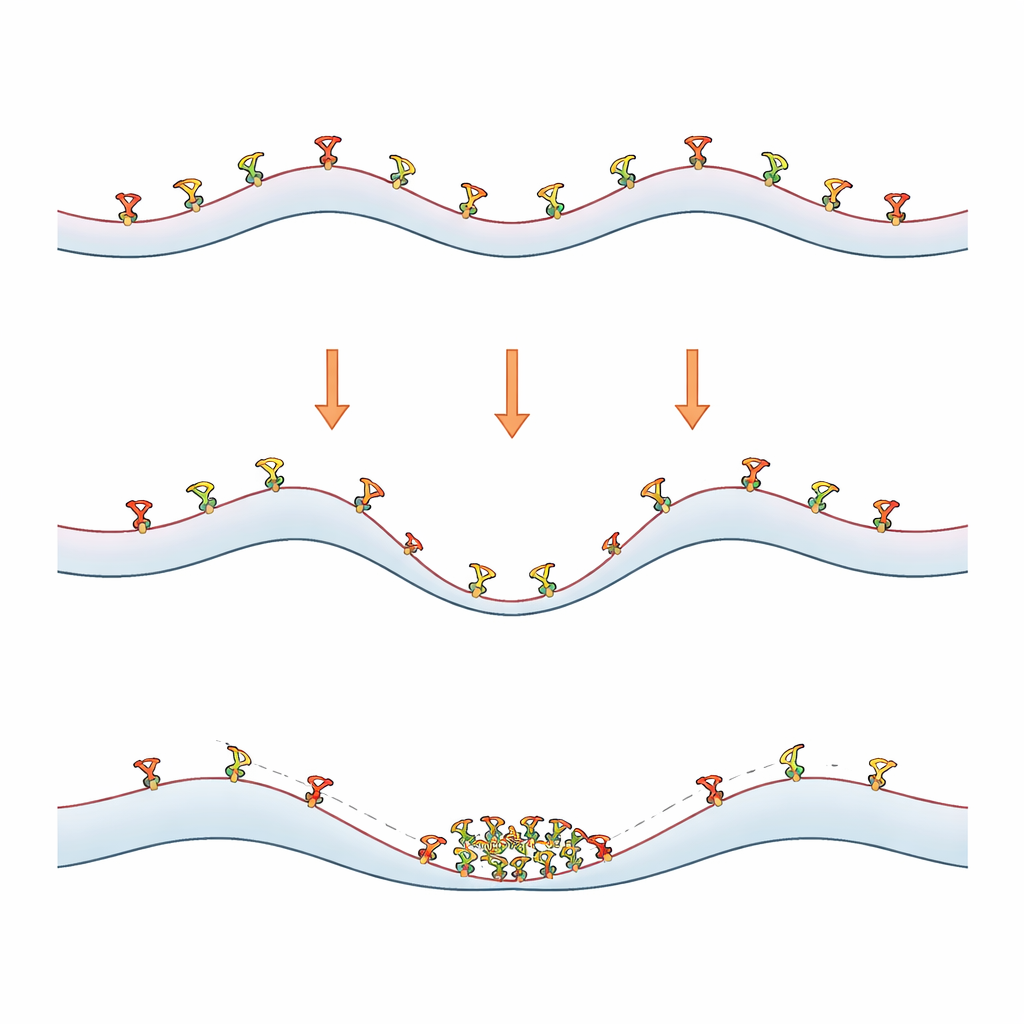
When the membranes are treated as rigid, the outcome is simple: proteins remain uniformly distributed and increasing force eventually peels the membranes apart, regardless of bond type. The picture changes dramatically once realistic thermal fluctuations of soft membranes are included. Now, bending and undulations make it harder for receptors and ligands to meet, shortening bond lifetimes and lowering the pulling force the system can tolerate. Yet those same fluctuations, when combined with tension, promote clustering. Pulling encourages bound regions to come together, which both lowers the energetic cost of deforming the membranes and reduces the loss of “wiggle room” where they are clamped. As a result, beyond a threshold of force and interaction strength, receptors and ligands spontaneously condense into domains, even when their direct lateral attraction is weak or absent.
Different force responses for different kinds of bonds
The model reveals that catch and slip bonds respond to force in distinct ways. For catch bonds, moderate pulling can both increase bond lifetimes and favor condensate formation over a relatively wide range of conditions. For slip bonds, which weaken as they are pulled, the window where force promotes clustering is much narrower and may vanish altogether when the basic binding is weak. The simulations also show that the way force is distributed matters. When the same total force is concentrated into a few hotspots instead of being spread evenly, clustering and membrane detachment both occur at lower overall forces. In other words, local tugs from the cytoskeleton can be far more disruptive—or more effective at driving condensation—than gentle, uniform stretching.
Why these findings matter for health and therapy
By connecting mechanical pulling, membrane flexibility, and protein clustering in a single framework, this work suggests that forces at cell–cell contacts are not just background noise but powerful regulators of how receptors and ligands organize and signal. In flexible, fluctuating membranes, tension can serve as a tunable knob that either stabilizes adhesive contacts and fosters protein condensates or tears them apart, depending on bond type, force level, and where the force is applied. Because many disease processes—from immune dysfunction to cancer metastasis—depend on the behavior of such membrane proteins, the results offer a physical roadmap for designing drugs or biomaterials that either harness or resist mechanical forces to steer cell behavior.
Citation: Li, L., Li, Z., Du, R. et al. Condensation and intracellular interaction of membrane-anchored receptors and ligands capable of forming catch and slip bonds. Commun Phys 9, 125 (2026). https://doi.org/10.1038/s42005-026-02567-x
Keywords: membrane protein condensation, mechanotransduction, catch and slip bonds, cell adhesion, phase separation