Clear Sky Science · en
Thermodynamic anomalies in overdamped systems with time-dependent temperature
Why tiny engines can surprise us
As technology shrinks, scientists are learning how to build engines out of single particles jostling in a fluid. These microscopic engines promise ultra-efficient sensors, lab-on-a-chip devices, and ways to harvest energy from random motion. But there is a catch: the standard mathematical shortcut used to describe such tiny machines breaks down whenever the surrounding temperature changes over time. This study explores how and why that shortcut fails, and shows how to repair our calculations so that we can trust the performance estimates of microscopic engines.
Small particles in a restless heat bath
Many experiments track the position of a microscopic bead or molecule moving in a viscous liquid, while its environment is heated and cooled in a controlled way. Because the particle’s velocity dies out far faster than its position changes, researchers often ignore velocity and use a simplified “overdamped” description that only follows where the particle is, not how fast it is moving. This works well when the temperature is fixed. But when the temperature of the surrounding fluid varies with time, for example in the periodic cycles of a heat engine, that simplification can distort key thermodynamic quantities such as the heat exchanged with the bath and the entropy produced along the way. The authors call these systematic deviations “thermodynamic anomalies.” 
Hidden energy that standard models miss
The full, more detailed description of the particle keeps track of both position and velocity. From this, the researchers derive exact formulas for the rate of heat flow and entropy production. They then compare these with the usual overdamped formulas and compute, in general terms, how large the missing pieces are when the temperature changes in time. The central insight is that, even when motion is strongly damped, the particle’s kinetic energy still adjusts to the changing temperature. That adjustment involves extra heat exchanged with the environment and can add or remove entropy. A model that assumes velocity has already relaxed to its final value at every instant silently omits this contribution, leading to a mismatch between “true” and “overdamped” thermodynamics.
Two ways to reach the same motion but not the same heating
Surprisingly, the authors show that there is not just one overdamped limit. A particle can look overdamped either because the liquid is extremely viscous or because the particle’s mass is very small. In both cases, the observable position dynamics obey the same simplified equation, yet the thermodynamic anomalies differ. Using a mathematical technique called Brinkman’s hierarchy, the authors introduce a scaling exponent, named z, that labels which type of overdamped regime a system is in, ranging from high-viscosity to small-mass conditions and intermediate cases between them. While the motion seen in position space is identical for all these regimes, the extra heat and entropy contributions from the hidden velocity degree of freedom depend sensitively on z. In some regimes, both heat and entropy display anomalies; in others, only the heat does.
Tuning and measuring the hidden regime
Because the exponent z controls the size and nature of thermodynamic anomalies, knowing its value is essential for accurate experiments. The study proposes a practical way to estimate or even set z in the lab or in simulations. By jointly scaling the strength of external forces and the amplitude of temperature variations, one can monitor how different pieces of the heat flow grow or shrink and thereby infer which overdamped regime the system occupies. The authors test this strategy on a simple model: a particle in a harmonic trap subject to a sinusoidally varying temperature. Their numerical results show that the method reliably recovers the expected value of z and reveals when a system behaves as if it were mainly limited by viscosity or by inertia. 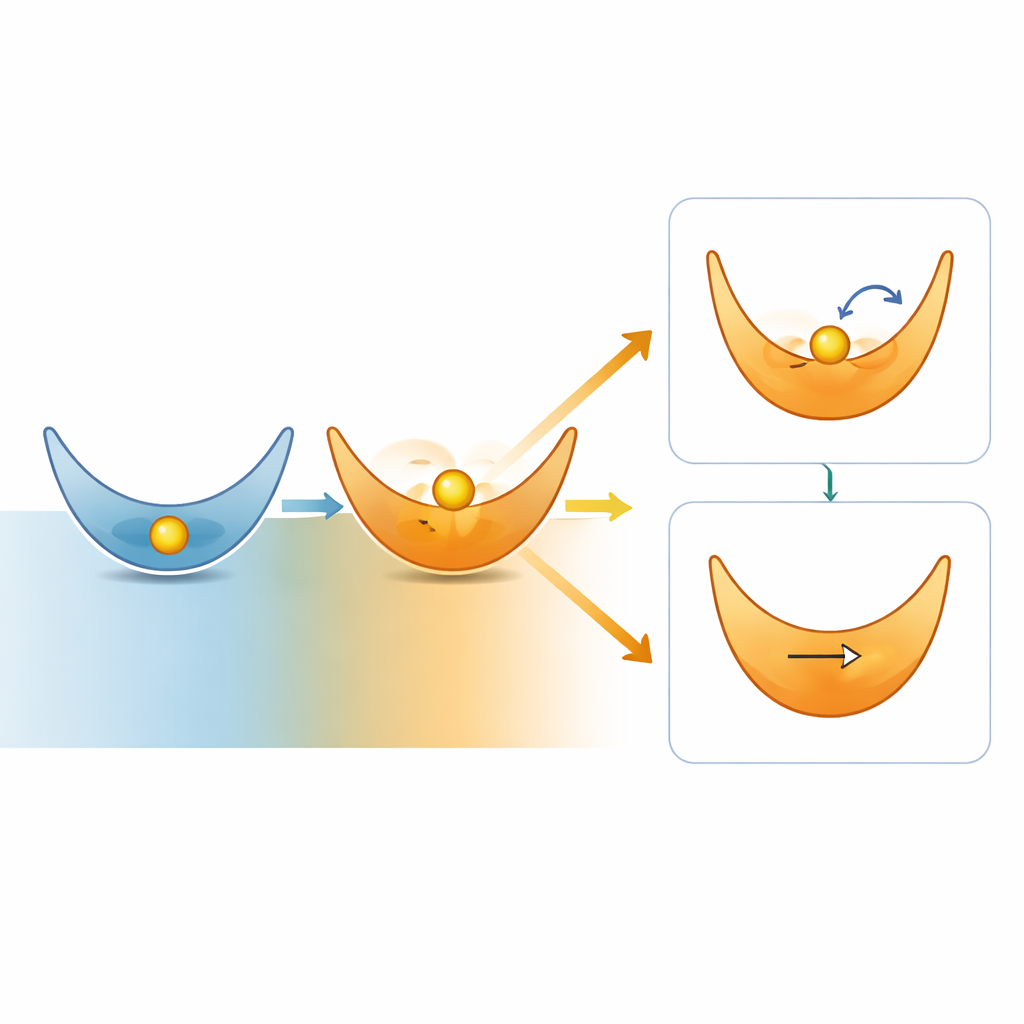
Microscopic engines and kinetic energy without fast measurements
To illustrate the real-world impact of these ideas, the authors analyze a microscopic Carnot-like engine built from a trapped Brownian particle whose stiffness and bath temperature change over time. When they compare three descriptions—fully detailed, standard overdamped, and overdamped corrected by the anomaly—they find that the usual overdamped model can significantly misestimate both heat flows and efficiency, especially for strongly damped systems. Once the anomaly terms are added, the corrected overdamped description closely matches the full theory. Importantly, the same formulas also provide a new way to estimate the particle’s kinetic energy in overdamped experiments, even when temperature changes rapidly, without needing ultrafast measurements of velocity.
What this means for future tiny machines
This work shows that even when friction seems to drown out inertia, the hidden kinetic energy of microscopic particles still matters whenever the temperature varies in time. Ignoring it leads to systematic errors in heat, entropy, and efficiency—quantities that are central to designing and optimizing microscopic engines. By identifying how these thermodynamic anomalies depend on the underlying physical regime and by providing practical tools to measure and correct them, the authors offer a roadmap for turning simplified models into quantitatively reliable ones. This paves the way for more accurate control and better performance of tiny heat engines and other devices that exploit fluctuations at the microscopic scale.
Citation: Awasthi, S., Park, H. & Lee, J.S. Thermodynamic anomalies in overdamped systems with time-dependent temperature. Commun Phys 9, 140 (2026). https://doi.org/10.1038/s42005-026-02566-y
Keywords: microscopic heat engines, overdamped Brownian motion, time-dependent temperature, stochastic thermodynamics, entropy production