Clear Sky Science · en
Regularized micromagnetic theory for Bloch points
A Hidden Twist in Magnetic Materials
Modern technologies—from hard drives to futuristic spin-based computers—rely on how tiny magnetic patterns move and change inside solids. But at the heart of some of the most intriguing patterns lies a severe mathematical problem: special point-like defects, called Bloch points, make our standard theory of magnetism break down. This paper introduces a new way to describe these defects so that their motion can be predicted reliably, opening the door to more accurate design of magnetic devices that harness complex three-dimensional structures.
When Magnetic Theory Hits a Wall
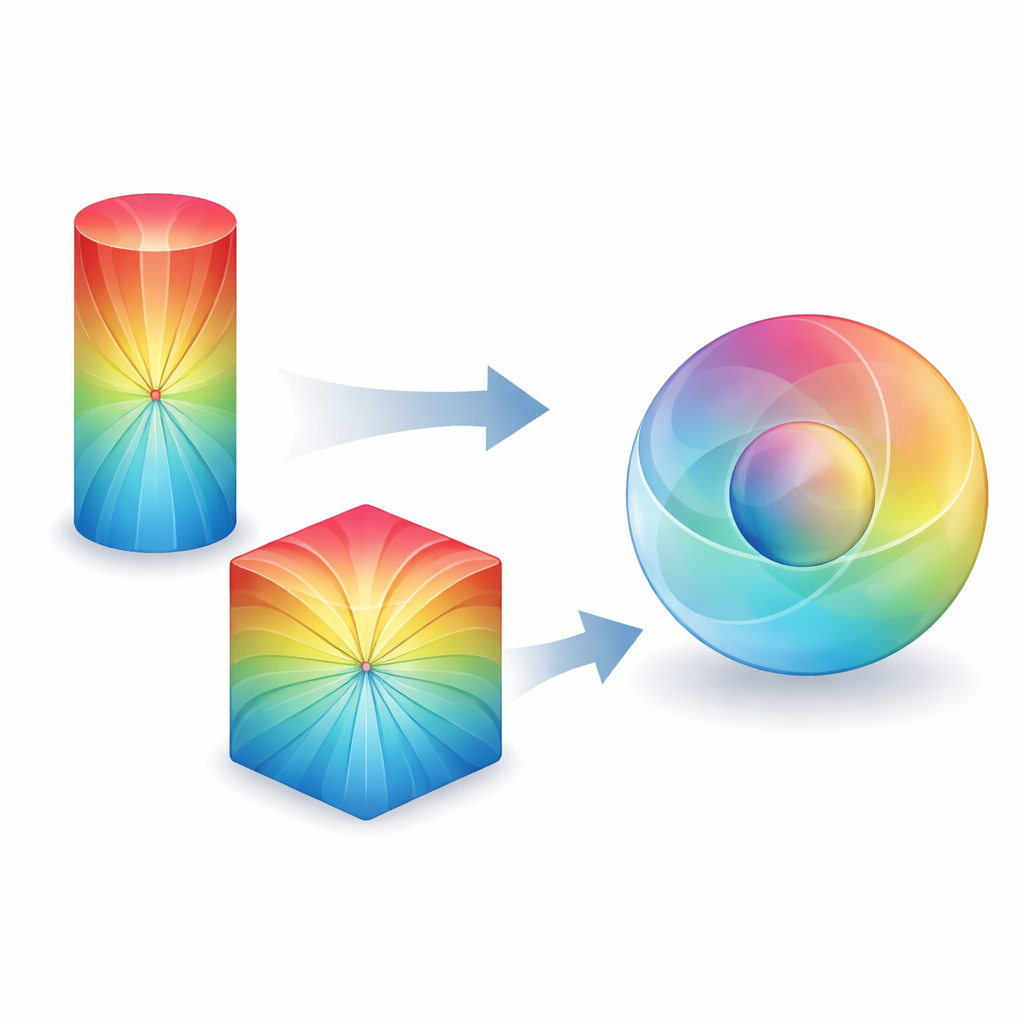
Conventional micromagnetism treats the magnetization in a solid as a smooth field of tiny arrows, each with the same fixed length, changing direction from point to point. This description has been extraordinarily successful for many phenomena, such as the motion of domain walls in memory devices or the behavior of magnetic bubbles and skyrmions. However, decades of theory and experiment have shown that in some configurations the arrows must converge into a single point where their direction changes in all possible ways. These are Bloch points, true three-dimensional topological defects. At such a point, forcing the arrow length to remain fixed makes the equations produce infinite fields, so the standard model cannot meaningfully describe how Bloch points form, move, or interact.
Allowing Magnetism to Breathe
Quantum calculations suggest a simple but powerful correction: near a Bloch point, the effective magnetic moments of atoms do not keep their full length. Instead, quantum fluctuations reduce their magnitude and can even drive it to zero exactly at the defect core, although it never exceeds its usual maximum value. The authors build a new micromagnetic model that respects this behavior by allowing the magnetization length to vary between zero and its maximum, rather than enforcing a rigid unit length. Mathematically, they replace the usual two-dimensional surface that represents all possible magnetization directions with a three-dimensional “sphere” of states, called S3. The first three components still correspond to the observable magnetization, while a fourth, auxiliary component encodes how much the length has been reduced. This higher-dimensional description smooths out the singularity at the Bloch point.
A New Equation for Smooth but Complex Motion
With this extended description in hand, the authors derive a regularized version of the standard Landau–Lifshitz–Gilbert equation, the workhorse that predicts how magnetization evolves in time. The new equation governs motion on the S3 sphere but is constructed so that, whenever no Bloch points are present, it reduces exactly to the familiar form used throughout micromagnetics. Building on this, they develop a counterpart of the Thiele equation, an effective rule that relates the applied forces—such as electric currents—to the steady drift velocity of magnetic textures like domain walls and skyrmion tubes. Crucially, the new framework also accommodates extra driving effects, such as spin-transfer torques from electric currents, while guaranteeing that the magnetization length never overshoots its physical limit.
Putting the Model to the Test in Realistic Structures
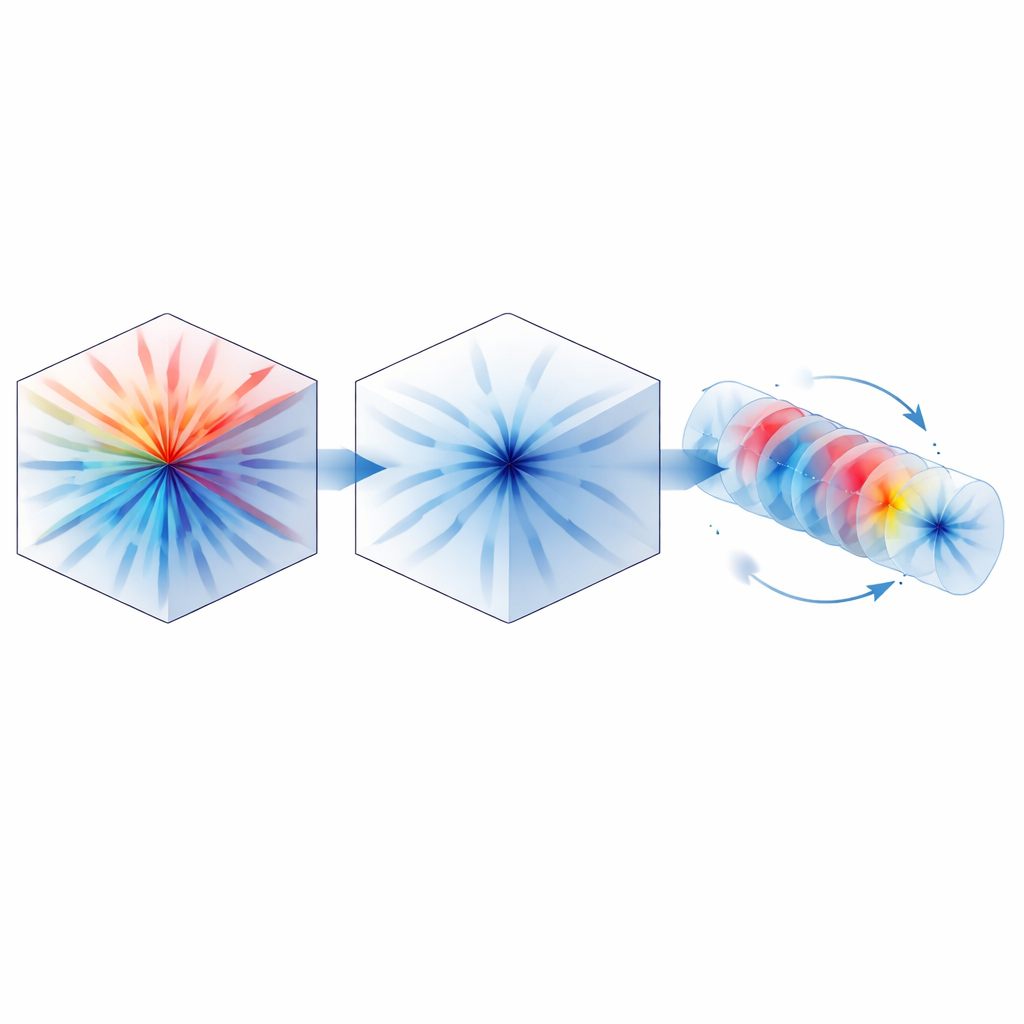
To demonstrate the practicality of their approach, the authors simulate several three-dimensional magnetic textures in which Bloch points play a central role. These include chiral bobbers and dipolar strings in chiral magnets, as well as domain walls in cylindrical nanowires. When driven by electric currents or magnetic fields, these textures host one or more Bloch points that are set into motion. Using the standard theory, numerical results show unphysical behavior: the predicted velocities depend strongly on the artificial size of the simulation grid, apparent critical currents and fields emerge where motion should in fact be smooth, and even the direction of the transverse motion can spuriously flip sign. In contrast, the regularized S3-based model produces velocities that scale linearly with current or field and converge cleanly as the numerical resolution is refined, matching the expectations from the generalized Thiele equation and from experimental trends.
What This Means for Future Magnetic Technologies
By allowing the magnetization length to shrink near Bloch points, this work removes the infinities that plagued older models while keeping the successful parts of classical micromagnetics intact. The result is a unified description that treats ordinary smooth textures and singular ones on the same footing, and that can be implemented in widely used simulation tools. For a non-specialist, the key message is that we now have a trustworthy way to calculate how these elusive point defects move and interact under realistic conditions. This paves the way for designing next-generation devices that exploit three-dimensional magnetic structures, from ultra-dense memory elements to novel spintronic components, with a solid theoretical foundation that no longer breaks down at the most interesting spots.
Citation: Kuchkin, V.M., Haller, A., Michels, A. et al. Regularized micromagnetic theory for Bloch points. Commun Phys 9, 147 (2026). https://doi.org/10.1038/s42005-026-02565-z
Keywords: Bloch points, micromagnetism, magnetic textures, spintronics, topological defects