Clear Sky Science · en
The superconducting diode effect in Josephson junctions fabricated from a structurally chiral superconductor
Why One-Way Supercurrents Matter
Electronics depend on diodes—tiny components that let current flow one way but not the other. Now imagine a diode that works not in ordinary metals or semiconductors, but in a superconductor, where electricity can flow without resistance. Such a “superconducting diode” could dramatically cut energy losses in computing and quantum technologies. This paper explores whether a special kind of crystal, whose atoms form a left- or right-handed spiral pattern, can be used to build such a one-way, lossless electrical element.
Twisting Matter into Left and Right
The researchers focus on a material called Mo3Al2C, a superconductor whose atoms arrange in a chiral, or handed, pattern—much like your left and right hands are mirror images but not superimposable. These crystals come in two mirror versions: right-handed and left-handed. Theory and earlier experiments on other chiral systems suggest that such handedness can make moving electrons prefer one spin or direction over another, a phenomenon known as chirality-induced spin selectivity. If that bias could be harnessed inside a superconductor, it might create a built-in directionality for resistance-free current, the essence of a superconducting diode.
Pressing Crystals to Make a Super Device
Instead of using atomically thin layers, which are hard to make with chiral superconductors, the team used bulk single crystals with naturally flat faces. They gently pressed two crystals together so that their surfaces formed a narrow barrier, like a very thin insulating film between two blocks. This contact region acts as a Josephson junction—a weak link through which pairs of electrons can tunnel while still behaving as a coherent supercurrent. The authors built two kinds of devices: ones where both sides had the same handedness (right/right) and ones where one side was right-handed and the other left-handed (right/left). They then cooled the devices to just a few degrees above absolute zero and wired them to measure how much current could flow before the superconducting state broke down.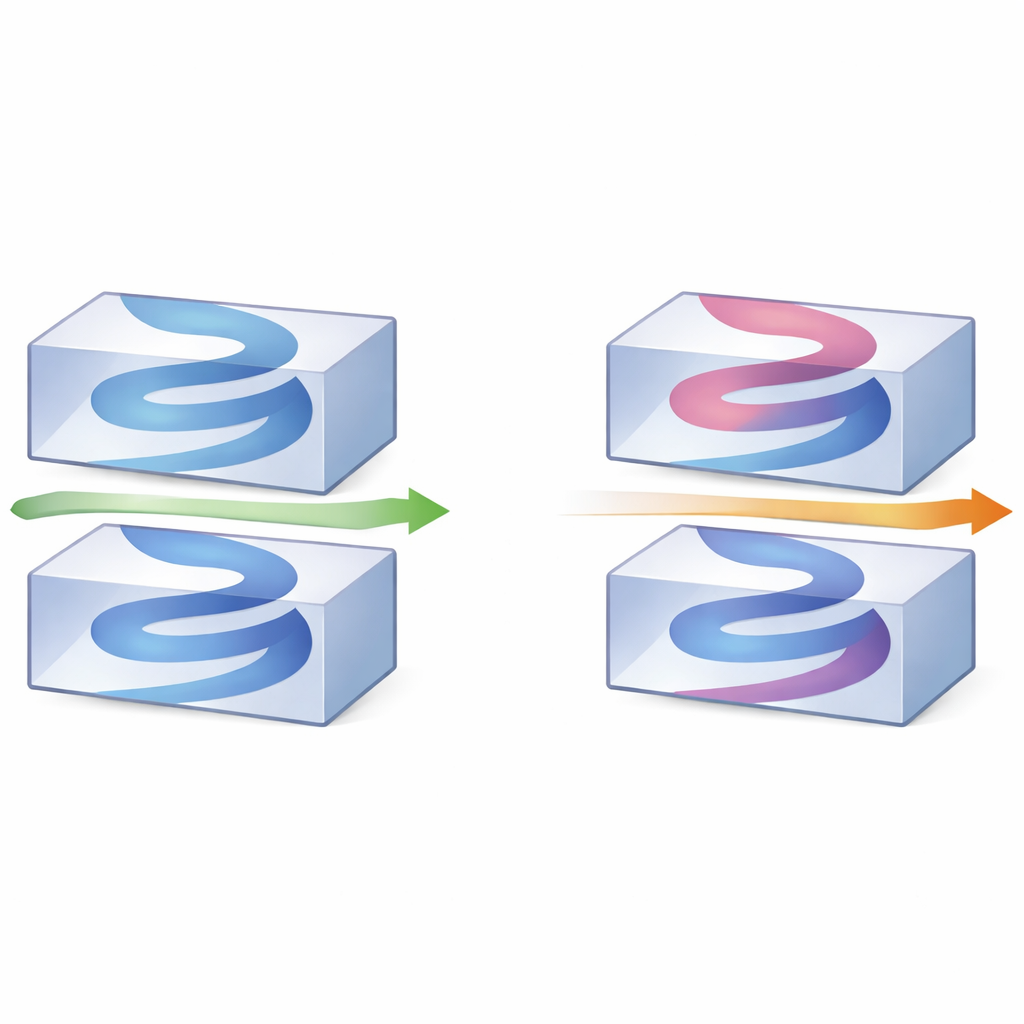
Watching Supercurrent Respond to a Magnetic Nudge
To confirm that their pressed interfaces really behaved as Josephson junctions, the researchers applied a small magnetic field parallel to the junction and tracked how the maximum supercurrent changed. In ideal junctions, this produces a ripple-like pattern reminiscent of light diffracting through a slit. The right/left and one of the right/right devices showed such Fraunhofer-like oscillations, signaling genuine Josephson behavior, while one right/right device behaved differently, likely due to a non-uniform current distribution. Crucially, the team compared how much current could flow in the positive direction (Ic+ ) versus the negative direction (|Ic−|) as they swept the magnetic field and repeated the measurements many times to build up statistics.
Finding the One-Way Supercurrent
In the mixed-handed devices, Ic+ and |Ic−| were not the same at many magnetic field values: the junction carried more supercurrent one way than the other, with an asymmetry of up to about 5 percent. Moreover, as the magnetic field changed, the preferred direction of current flipped, showing that the effect was tunable and robust rather than random noise. In contrast, the same-handed control device showed nearly identical behavior for positive and negative current, indicating no intrinsic diode effect. Another same-handed junction displayed skewed patterns that the authors attribute to ordinary self-generated magnetic fields, not a true built-in directionality. By carefully comparing all devices, they argue that only the interface between opposite-handed crystals produces a genuine superconducting diode effect under an applied field.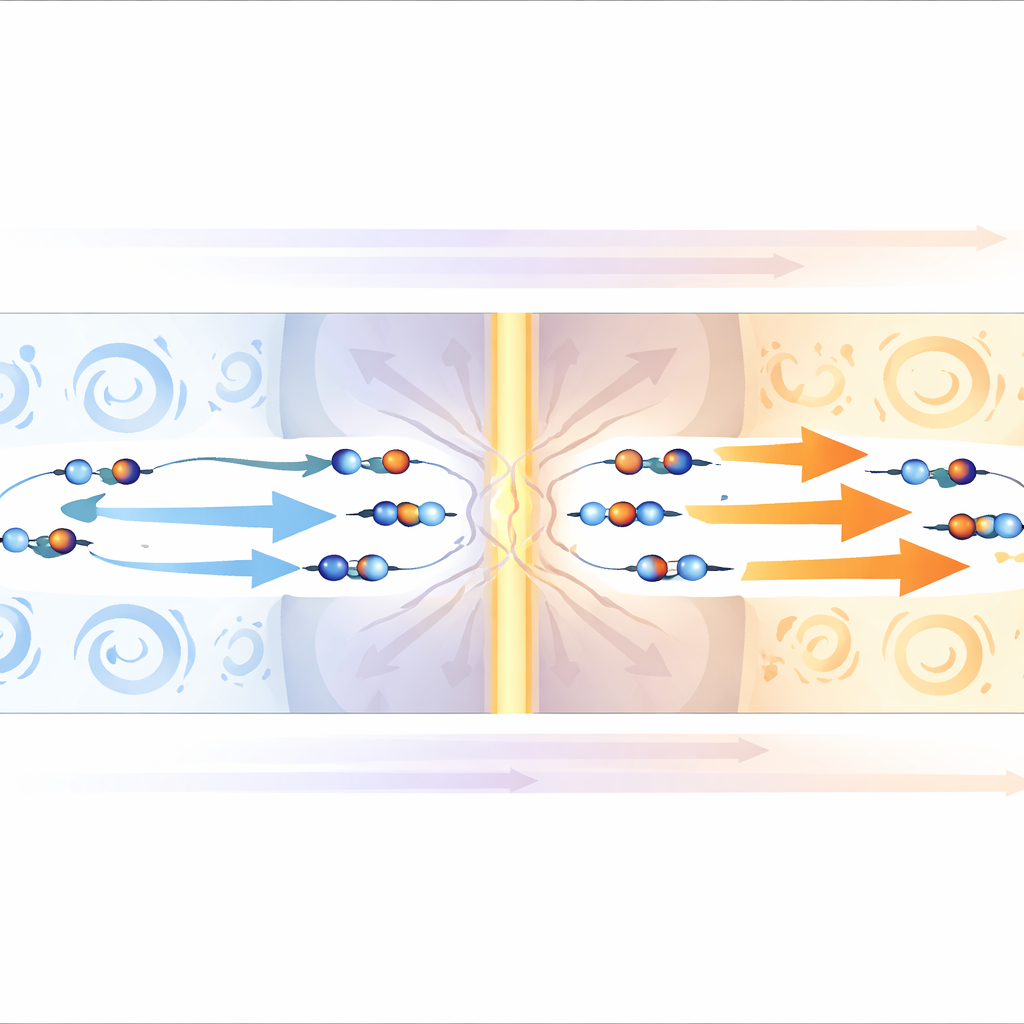
What This Means for Future Electronics
For non-specialists, the key takeaway is that a simple mechanical assembly—pressing two tiny, mirror-image superconducting crystals together—can create a device where resistance-free current prefers one direction when a small magnetic field is applied. This behavior does not appear when the two crystals share the same handedness, pointing to the importance of structural chirality at the junction. Although the observed effect is modest compared with some other superconducting diodes, it demonstrates a new platform: three-dimensional, structurally chiral materials. With better control over crystal orientation and interface quality, this approach could lead to more efficient, compact superconducting components that steer supercurrents much like today’s diodes steer ordinary electrical currents.
Citation: Orban, P.T., Bassen, G., Crites, E.N. et al. The superconducting diode effect in Josephson junctions fabricated from a structurally chiral superconductor. Commun Phys 9, 124 (2026). https://doi.org/10.1038/s42005-026-02564-0
Keywords: superconducting diode, Josephson junction, chiral superconductor, nonreciprocal transport, spin selectivity