Clear Sky Science · en
Application of catastrophe theory to multicolor-laser-field-assisted scattering
Why tiny crashes in light-matter interactions matter
When very intense laser light hits atoms, electrons can be kicked to high energies or made to emit flashes of X-rays lasting less than a trillionth of a second. These extreme “light–matter collisions” underpin technologies such as attosecond cameras for observing electron motion. Yet the signals they produce often show sudden peaks, sharp edges, and intricate ripples that are hard to predict or explain. This paper shows that a mathematical framework called catastrophe theory can reveal the hidden structure behind these dramatic changes, offering a clearer, more unified way to understand how multicolor laser fields steer scattering electrons.
From many photons to complex patterns
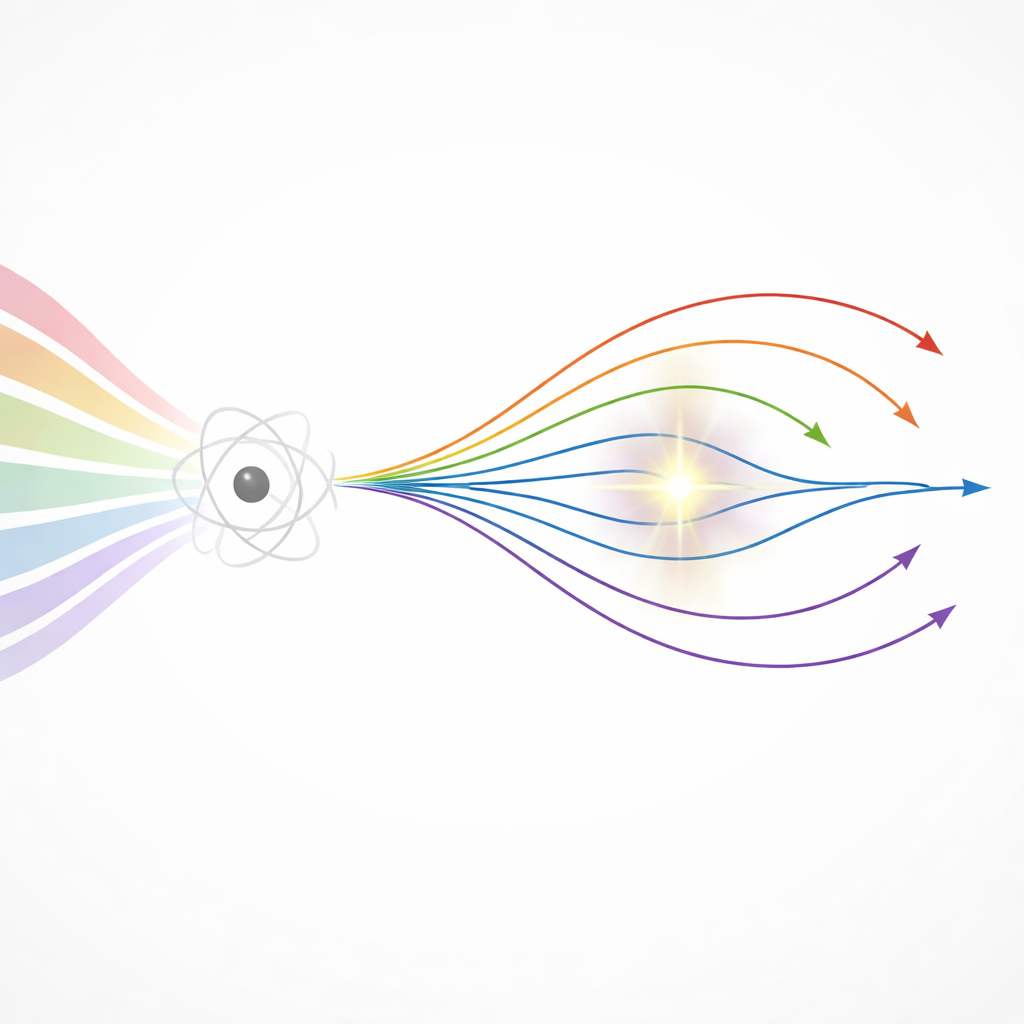
In strong laser fields, an electron interacting with an atom can absorb or emit not just a few, but hundreds or thousands of photons. The probability for each outcome is encoded in an integral over time whose phase depends on the laser field. Physicists usually analyze this using the stationary-phase method: instead of tracking all possible paths, they focus on a handful of special “quantum orbits” where the phase changes most slowly. Each such orbit contributes a partial wave, and the observable spectrum—the differential cross section—arises from the interference of these contributions. When only a couple of orbits are involved, the spectrum looks smooth. As more orbits enter, the pattern quickly becomes densely oscillatory and seemingly chaotic.
Using mathematical catastrophes as a map
Catastrophe theory was originally developed to describe sudden changes in systems ranging from optics to population dynamics. It classifies how solutions of an equation appear, merge, or disappear when external conditions—the control parameters—are varied. In the present work, the authors reinterpret laser-assisted scattering in this language. The time variable plays the role of the system’s internal state, while laser characteristics (such as relative colors, strengths, and phases) and electron energies act as control parameters. Critical situations arise when two or more quantum orbits coalesce: standard approximations fail, and small parameter changes can produce large spectral rearrangements. Each type of coalescence corresponds to a standard “catastrophe” with a characteristic geometry and diffraction fingerprint.
Folds, cusps, and higher shapes in multicolor fields
The authors first explore a two-color laser field composed of a base frequency and its second harmonic. In this case, the relevant parameter space effectively has three dimensions, allowing fold, cusp, and swallowtail catastrophes to appear. By tracking where the first, second, and higher derivatives of the action vanish, they map out curves and surfaces in parameter space that separate regions with different numbers of contributing quantum orbits. Crossing a fold line changes the number of real orbits by two, turning a smooth spectrum into one with clear oscillations; approaching a cusp or swallowtail leads to more dramatic reshaping, mirroring known caustic patterns in optical diffraction. The team compares these catastrophe boundaries with detailed numerical calculations and finds that sharp modulations and new structures in the spectra line up precisely with the predicted lines and surfaces.
Pushing to richer behaviors with three-color light
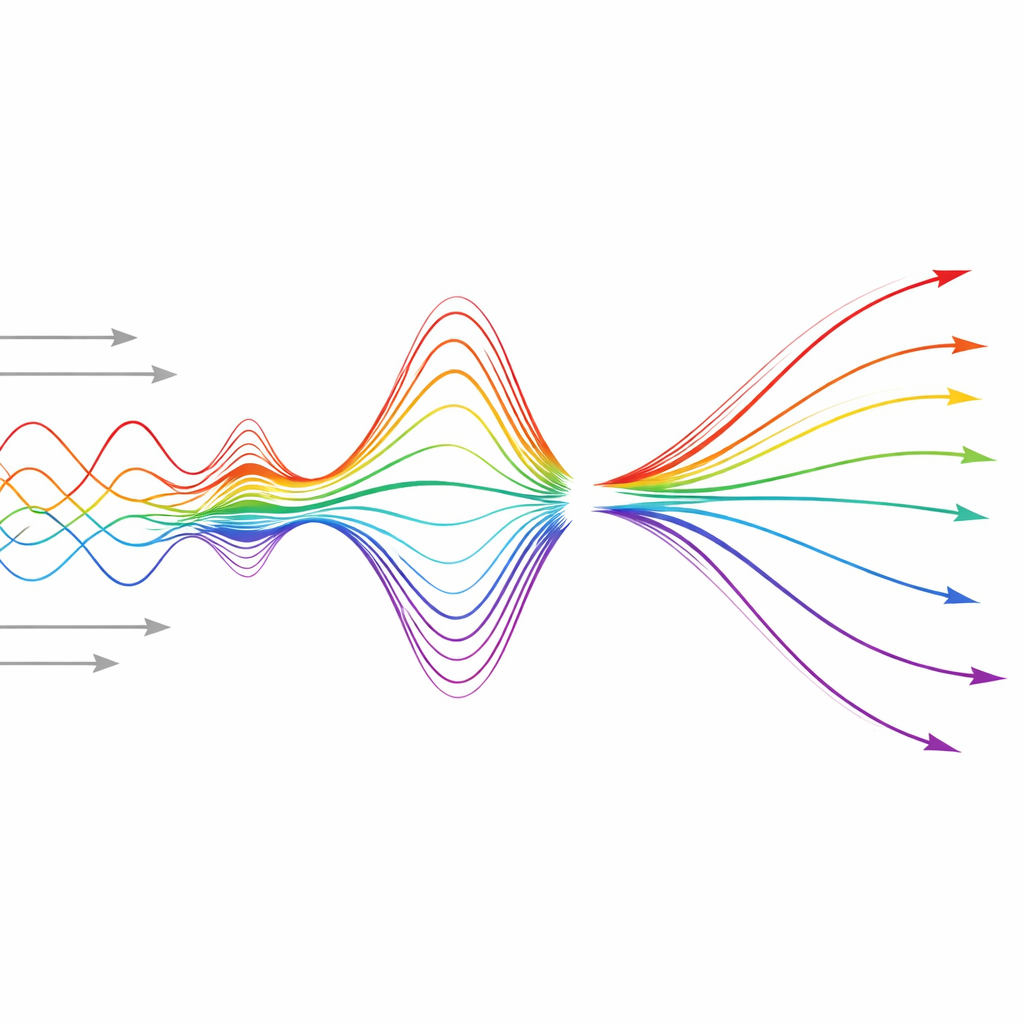
Going beyond two colors, the researchers consider a three-color field containing the base frequency, its second harmonic, and its third harmonic. This introduces five independent control parameters, enough to realize higher-order catastrophes that lie beyond the classic list introduced by René Thom. By examining suitable cross-sections of this enlarged parameter space, they identify configurations associated with an A6, or “wigwam,” catastrophe, in which six quantum orbits come together. Although such high-order singularities are hard to visualize directly, the authors show how strategic slices of parameter space still display their distinctive folded patterns. This suggests that by tuning multicolor fields, experimentalists can deliberately engineer a wide variety of these geometric structures in electron spectra.
A new lens on extreme laser physics
Overall, the study demonstrates that catastrophe theory offers a powerful and broadly applicable lens for understanding strong-field phenomena. Instead of laboriously computing scattering amplitudes for every setting, one can use the catastrophe framework to locate where qualitative changes will occur and choose the right approximation tools to describe them. While the current work focuses on real-valued trajectories in laser-assisted scattering, the same ideas can, in principle, be extended to more complex situations involving tunneling and fully complex quantum orbits, such as in high-harmonic generation and attosecond pulse formation. For non-specialists, the key message is that the bewildering richness of patterns in extreme laser–matter interactions is not random: it is organized by a small set of universal geometric catastrophes that can now be systematically charted and used to guide future experiments.
Citation: Habibović, D., Rook, T. & Milošević, D.B. Application of catastrophe theory to multicolor-laser-field-assisted scattering. Commun Phys 9, 138 (2026). https://doi.org/10.1038/s42005-026-02559-x
Keywords: strong-field physics, laser-assisted scattering, catastrophe theory, multicolor laser fields, attosecond science