Clear Sky Science · en
Non-Hermitian impurity problem
Why tiny flaws can reshape waves
In many materials and optical devices, waves such as electrons or light usually travel freely through a regular grid of identical sites. But real systems are never perfect: there are always flaws or “impurities.” This article asks a deceptively simple question with far-reaching consequences: what happens when just one site in such a grid behaves in a way that includes both ordinary energy storage and gain or loss, as in an open, leaky, or amplifying system? The answer turns out to be surprisingly rich, revealing new kinds of wave trapping and shedding light on how disorder works in advanced photonic and quantum materials.
From simple defects to active imperfections
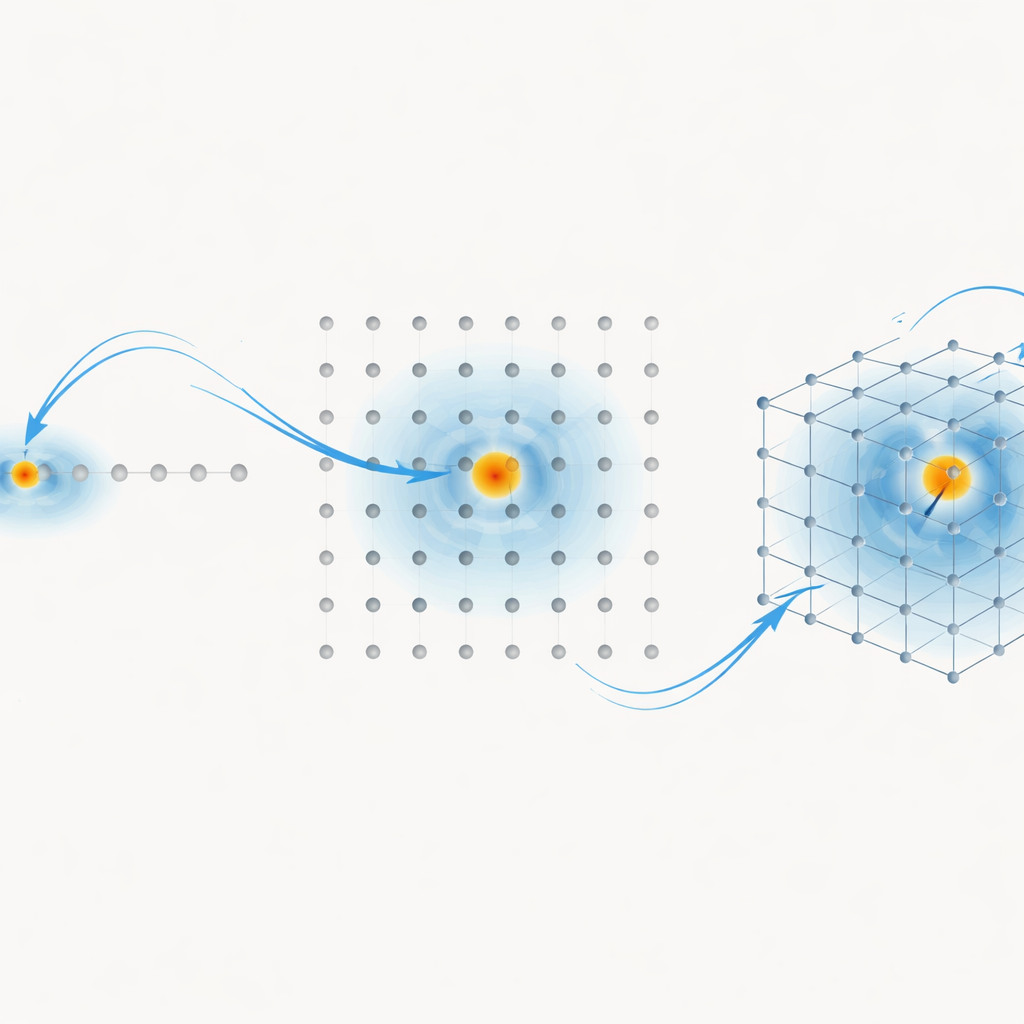
Physicists have long used the “single impurity problem” as a clean way to understand how flaws affect electrons in solids. In the standard, energy-conserving setting, a lone defect can trap a particle in its vicinity, forming a bound state that is localized in space. This concept underpins Anderson localization, where many random defects can halt transport altogether. However, many modern platforms—especially in photonics—are not closed: they feature gain and loss, leakage, or driven dissipation. These systems are described by so‑called non-Hermitian models, where energies can be complex numbers. Until now, the basic question of how a single such non-Hermitian impurity localizes waves in one, two, and three dimensions had not been fully settled.
Probing a single complex site in infinite grids
The authors study an idealized lattice—a one‑, two‑, or three‑dimensional grid where each site couples only to its nearest neighbors—and then alter just one site by giving it a complex on‑site energy. The real part acts like an ordinary potential, while the imaginary part represents local gain or loss. Using a mathematical tool known as the Green’s function, they map out when this lone defect can create a bound state that lives outside the usual energy band of the clean lattice. The results are markedly different from the textbook, purely real case. In one dimension, a purely lossy or amplifying impurity needs to exceed a finite strength before it can trap a state, unlike a purely real defect which traps for any strength. In two dimensions, even an infinitesimally weak imaginary or real defect alone can trap a state—but combining small real and imaginary parts can actually destroy localization within a finite region of parameter space. In three dimensions the picture is even more intricate, with “no‑go” zones where no bound state can exist and curious regimes where localization appears, disappears, and then re‑emerges as the defect strength is varied.
Finite systems and exotic localized patterns
Real experiments use finite arrays of waveguides, resonators, or circuit nodes, so the authors next examine large but finite lattices. Here, the single impurity can affect not just one but many eigenmodes. In one dimension with a purely imaginary defect, increasing its strength causes one eigenvalue to split off from the rest in the complex plane; the corresponding eigenmode becomes sharply peaked around the defect, resembling a conventional localized state whose size no longer grows with the system. At the same time, many other modes show “scale‑free localization,” where their intensity is largest near the defect but still extends across the whole lattice, with a localization length that grows with system size. These scale‑free states are a hallmark of non-Hermitian physics: they look localized in a snapshot yet do not behave like standard trapped modes when the lattice is made larger.
Cross-shaped and higher-dimensional trapping
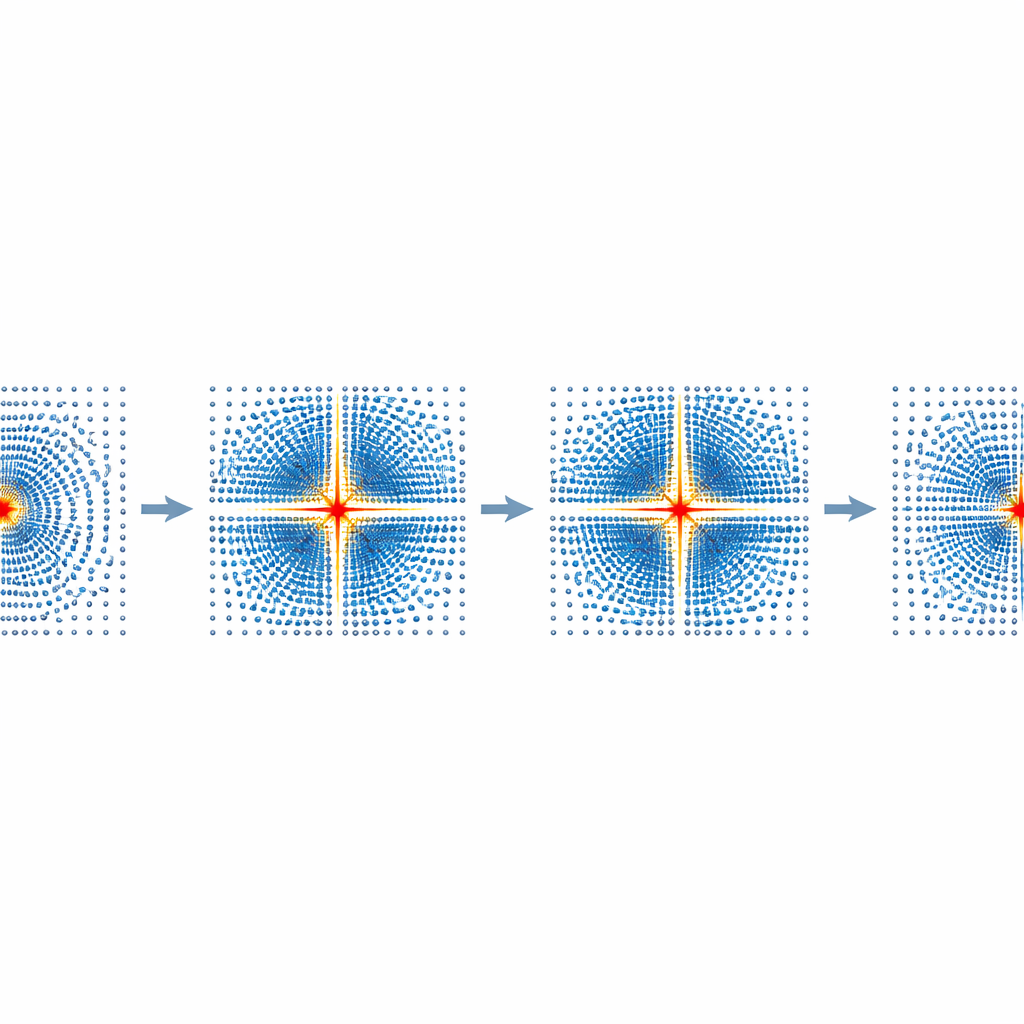
In two‑dimensional lattices, the impurity produces even stranger patterns. For moderate imaginary defect strength, the most strongly amplified mode forms a cross-shaped intensity profile, with bright “arms” along the horizontal and vertical directions of the grid and a pronounced peak at the center. This non-Hermitian cross-localized state is still truly localized—it does not spread out as the lattice grows—but its shape is very different from the usual circular, exponentially decaying bound state created by a real defect. As the defect becomes stronger, this cross gradually gives way to a more conventional, tightly peaked localized mode. In three dimensions, the authors again find thresholds for localization and families of modes that are enhanced near the impurity yet remain extended overall. Across all dimensions, adding a real component to the defect breaks certain spectral symmetries and reshapes which combinations of gain and loss can trap waves.
What this means for future devices
By fully solving the single non-Hermitian impurity problem in one, two, and three dimensions, this work establishes a new foundation for understanding how disorder and defects behave in open, gain‑and‑loss systems. It shows that even a single “active” flaw can create unusual localized states—such as scale‑free and cross‑shaped patterns—and that mixing real and imaginary parts of the defect can both help and hinder trapping in counterintuitive ways. Because these lattices can be realized in photonic waveguides, optical cavities, electrical circuits, and superconducting platforms, the results provide concrete design rules for engineering or avoiding localization in next‑generation devices that harness non-Hermitian physics.
Citation: Kokkinakis, E.T., Komis, I., Makris, K.G. et al. Non-Hermitian impurity problem. Commun Phys 9, 152 (2026). https://doi.org/10.1038/s42005-026-02558-y
Keywords: non-Hermitian impurity, wave localization, photonic lattices, complex disorder, tight-binding models