Clear Sky Science · en
Role of mechanical allostery in kindlin-mediated integrin activation
How Cells Stick Under Stress
Every second, your cells are grabbing onto their surroundings, letting you heal a cut, fight infections, or even grow a tumor. This gripping is done by tiny molecular “hands” called integrins, helped by support proteins such as kindlin. For years, scientists knew kindlin was essential but didn’t understand how it switched from an idle state to an active one fast enough inside living cells. This study shows that the missing ingredient is mechanical force: pulling on kindlin physically reshapes it so it can quickly turn on integrin-based adhesion.
A Molecular Helper With Two Personalities
Kindlin sits at crowded contact points where a cell meets its surroundings. It binds to integrins in the cell membrane and to partners linked to the internal scaffolding of actin filaments. In simple test-tube experiments, kindlin mostly sits alone as a quiet single unit, and when it does pair up into the active form, the process is extremely slow, taking days. Yet in living tissue, cells must strengthen their grip within seconds. This puzzling mismatch hinted that something important present in real cells—but missing in the test tube—was changing how kindlin behaves.
Forces That Reshape a Protein
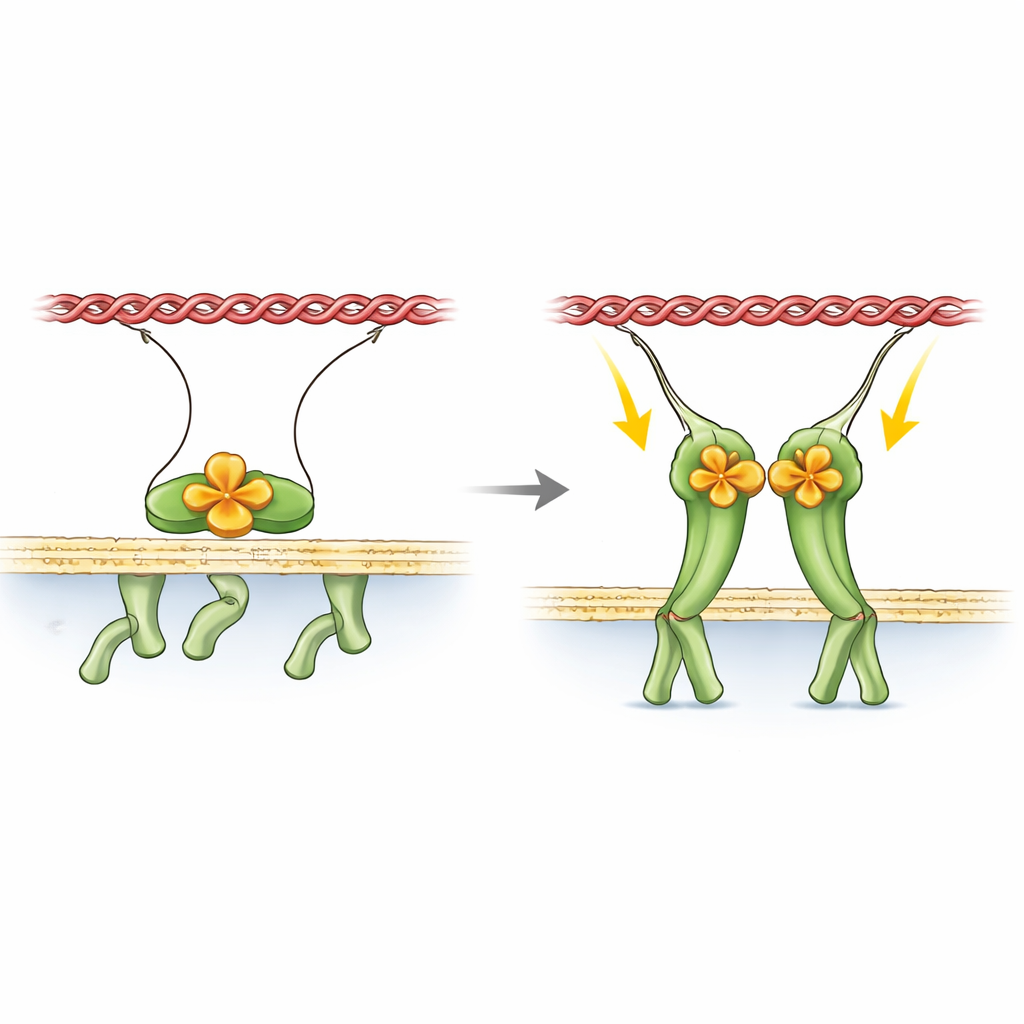
The authors used multiscale molecular simulations to watch kindlin respond to pulling forces similar to those generated by the cell’s actin skeleton. In its resting form, a central region of kindlin is folded into a compact “closed” shape that hides the surfaces needed to pair with another kindlin. Simulations showed that shifting from this closed form to an “open” one faces a high energy barrier, explaining the slow pairing seen in experiments without force. When the team applied tensile forces between the part of kindlin that talks to actin and the part that anchors near the membrane, the energy landscape changed: the open form became more favorable, and the barrier between closed and open dropped. As a result, the rate of opening sped up by orders of magnitude under moderate pulling.
How Pulling Drives Pairing
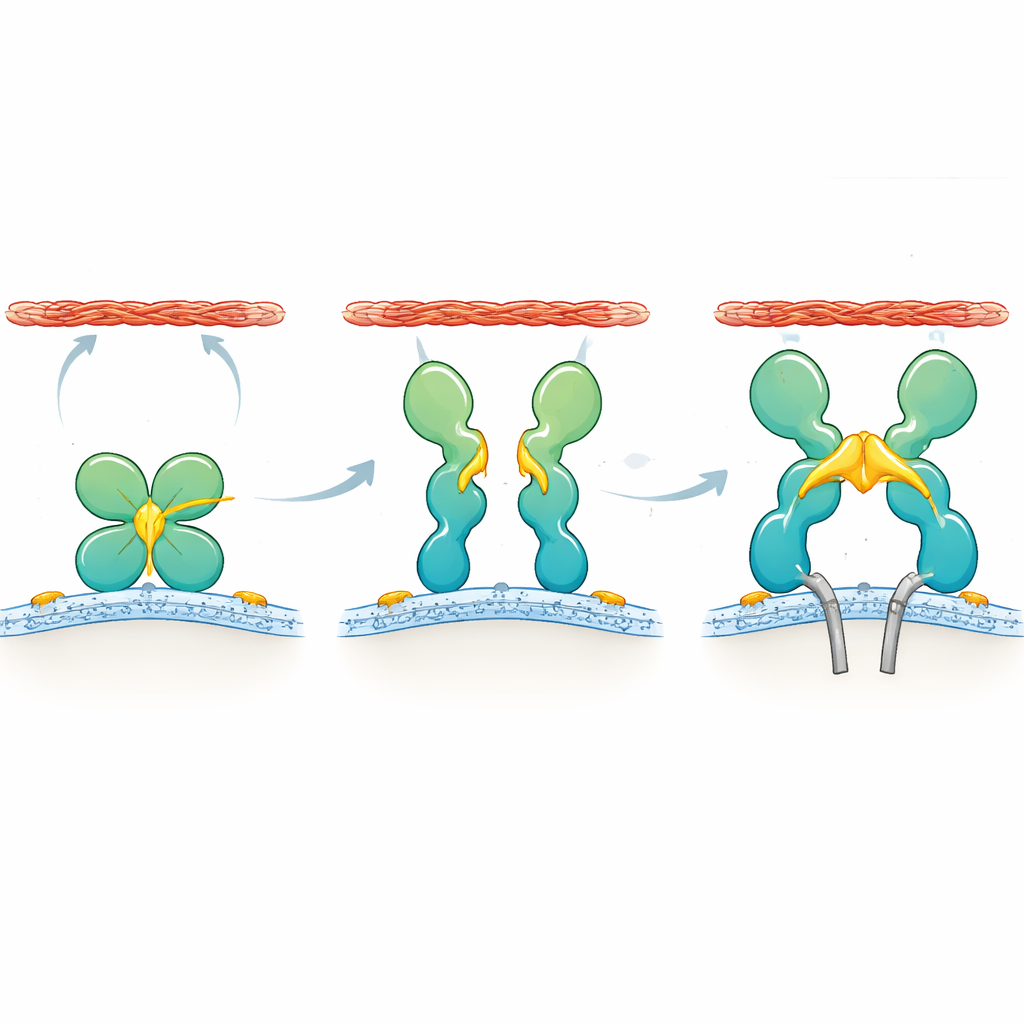
Opening is only half the story—kindlin also has to find a partner and form a tightly intertwined dimer. The simulations revealed a step-by-step pathway: initially, the two proteins approach, then one and finally both reshape key helical segments that swap places between the partners. This “domain swapping” proceeds over a rugged path, with dead ends where early contacts actually block the final arrangement. Mechanical force helps here too. By stretching the protein, it encourages temporary “backtracking” that breaks unhelpful contacts so the correct intertwined structure can form. Interestingly, the effect of force is not simply “more is better”: moderate pulling optimally speeds pairing, while very high forces start to hinder some of the bending steps needed to lock the dimer together.
Built-In Levers and Control Knobs
The study also uncovered how force is routed through kindlin. A small domain that binds membrane lipids is connected to the central sensitive region by two flexible linkers of unequal length. The shorter linker acts like a stiff lever arm that delivers force efficiently into the part of the protein that must open. When the researchers lengthened this short linker in their models, kindlin’s response to force nearly disappeared, and dimer formation stayed slow even under load. They further identified a specific helix acting like a latch that stabilizes the closed form; weakening its contact in simulations, and deleting it in lab experiments, both made dimerization much easier even without external pulling.
Why This Matters for Health and Disease
Taken together, the work paints a picture of kindlin as a true mechanical switch. In the absence of stress, it tends to remain monomeric or in self-inhibited assemblies that do little to activate integrins. When actin filaments pull against the membrane, forces are funneled through kindlin’s short linker into its central domain, nudging it open and encouraging two molecules to intertwine rapidly. The resulting dimer can then cluster and activate integrins, helping cells adapt their grip to changing mechanical environments. Because faulty adhesion underlies disorders from bleeding diseases to cancer spread, understanding this force-based control suggests new ways to tune cell sticking—either strengthening it for tissue repair or softening it to hinder invasive tumors.
Citation: Zhang, W., Yang, H., Yang, Z. et al. Role of mechanical allostery in kindlin-mediated integrin activation. Commun Phys 9, 154 (2026). https://doi.org/10.1038/s42005-026-02557-z
Keywords: cell adhesion, integrins, mechanotransduction, kindlin, molecular dynamics