Clear Sky Science · en
Super light-by-light scattering in vacuum induced by intense vortex lasers
Light Talking to Light in Empty Space
We usually think of empty space as truly empty, a perfect stage on which light simply flies straight through. This paper explores a striking prediction of quantum physics: when light is intense enough, even a perfect vacuum behaves like a strange, invisible glass that can make beams of light bump into and scatter off one another. The authors show that by shaping one of the laser beams in a special way, these elusive light–light encounters could finally be spotted in a single experimental shot with today’s most powerful lasers.
A Subtle Glow in the Quantum Vacuum
According to quantum electrodynamics, the vacuum is filled with fleeting particle–antiparticle pairs. In the presence of extremely strong electromagnetic fields, this restless background makes the vacuum act like a weak, nonlinear optical material: it can bend light, split it, or cause two photons to interact. Such effects have been hinted at in extreme astrophysical environments and in high-energy collisions of heavy ions, but they have never been observed clearly in the laboratory using real photons from lasers. The challenge is twofold: the effect is extraordinarily weak, and any scattered photons are usually buried under a flood of unperturbed X-ray photons from the probe beam.
Why Earlier Approaches Struggle
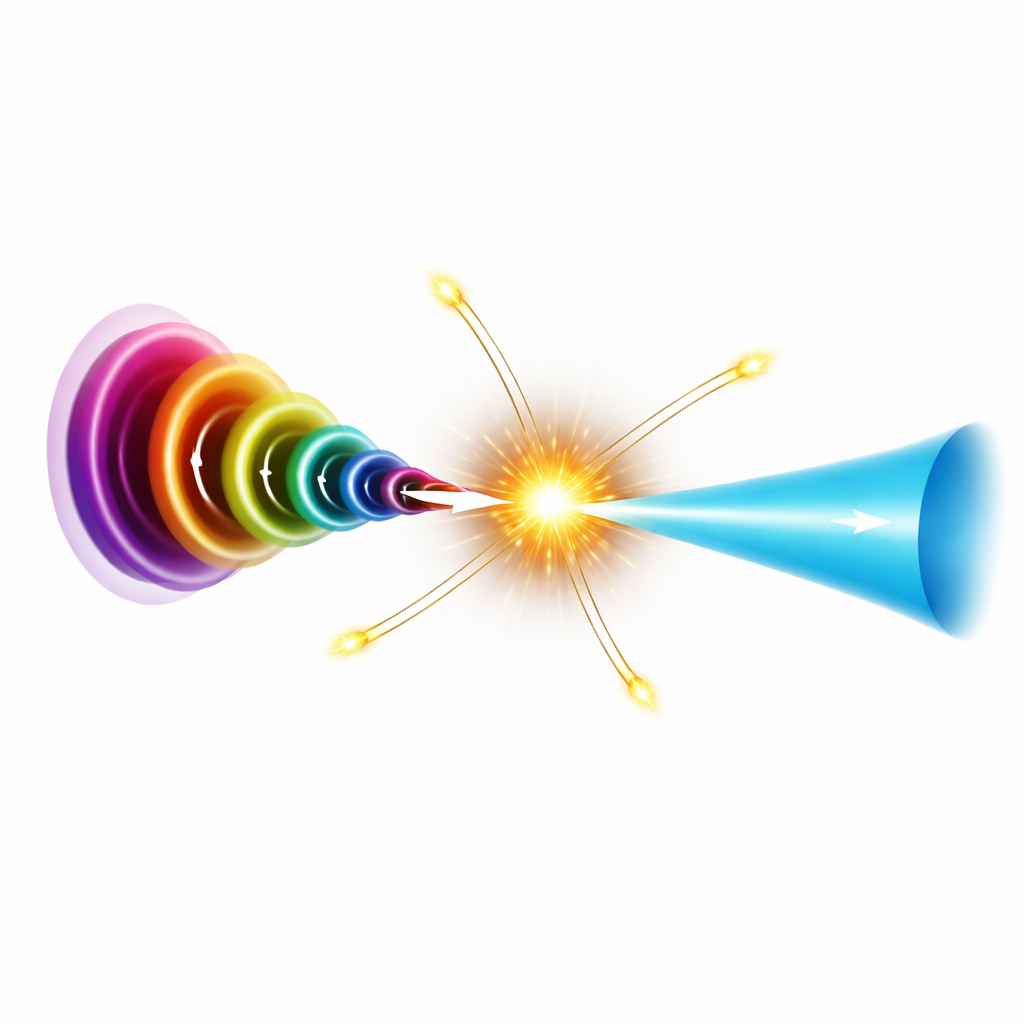
Existing proposals follow two main paths. One is to look for a tiny twist in the polarization of an X-ray beam after it crosses a powerful optical laser, a vacuum version of birefringence in crystals. This requires exquisitely pure X-ray polarizers and still yields only a handful of altered photons out of ten billion. The other is to look for photons that have changed direction or energy in light-by-light scattering, but in typical head-on beam collisions, the scattered photons almost perfectly follow the original X-ray direction, making them nearly impossible to pick out. Multi-beam setups and beams carrying orbital angular momentum have been suggested to push some photons off-axis, but they tend to reduce the total signal or still leave most of the scattered light hidden in the background.
Using Twisted Light to Deliver a Superkick
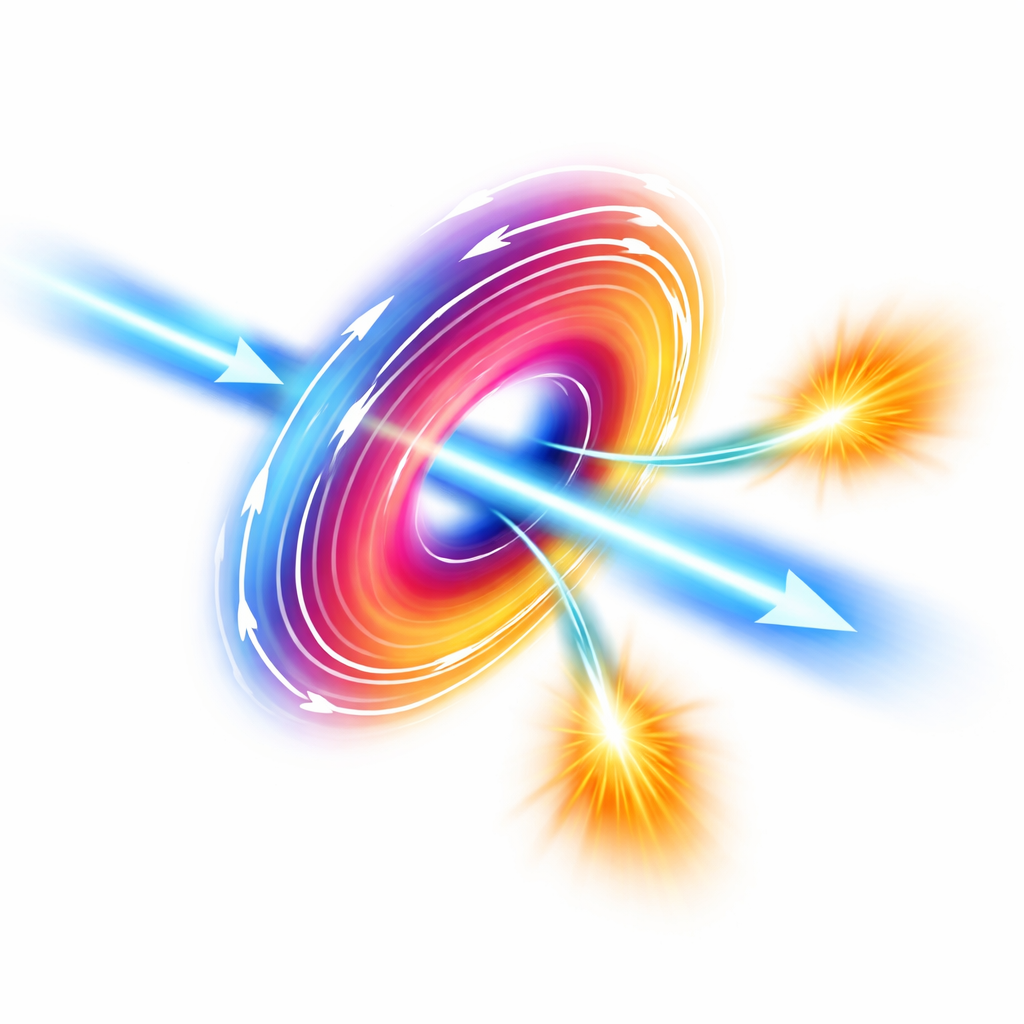
The authors propose a different strategy that exploits a subtle property of “vortex” lasers—beams whose wavefronts twist like a corkscrew and carry orbital angular momentum. Instead of relying on global angular-momentum bookkeeping, they focus on the local phase structure of a specially prepared drive laser that is a superposition of two vortex modes. In this configuration, the laser’s phase changes very rapidly around a ring, creating a strong tangential “phase gradient” in the surrounding vacuum. When a tightly focused X-ray beam collides head-on with this structured laser at a small offset, the quantum vacuum in the overlap region becomes a vortical source that can pass an unusually large sideways kick to some of the scattered photons. This “super light-by-light scattering” transfers tangential momentum several times larger than what ordinary laser photons carry transversely, pushing signal photons cleanly out of the narrow X-ray cone.
From Theory to a Real-World Experiment
Using analytical calculations and full three-dimensional particle-in-cell simulations, the team shows that this superkick effect creates two bright side lobes of scattered photons, clearly separated from the intense X-ray core and with a signal-to-noise ratio above 100 even without any polarization filters. For realistic parameters of the Station-of-Extreme-Light facility—an optical laser with petawatt-scale power and an X-ray free-electron laser delivering about a trillion photons per pulse—the scheme can produce over a hundred detectable signal photons in a single shot. Crucially, the required mixed vortex beam can be generated using a double-ring spiral phase plate: a patterned optical element that imprints opposite twists on the inner and outer parts of the incoming laser beam, yielding two overlapping vortex modes with nearly equal strength.
What This Means for Our Picture of “Empty” Space
In plain terms, the paper shows how to make light knock light off course in a vacuum strongly enough, and cleanly enough, that we can finally see it happen in the lab with existing technology. By cleverly shaping the drive laser, the authors turn a barely detectable effect into a clear spatial signal, avoiding the losses and complexity of ultra-precise X-ray polarizers or multi-beam collision setups. Confirming this super light-by-light scattering would not just tick a long-standing box for quantum electrodynamics; it would directly reveal that empty space itself can whirl and twist under extreme light, opening the door to new ways of probing the quantum structure of the vacuum and to future applications of vortex light in high-field optics.
Citation: Bu, Z., Zhang, L., Liu, S. et al. Super light-by-light scattering in vacuum induced by intense vortex lasers. Commun Phys 9, 144 (2026). https://doi.org/10.1038/s42005-026-02556-0
Keywords: quantum vacuum, light-by-light scattering, vortex lasers, X-ray free-electron lasers, nonlinear optics