Clear Sky Science · en
Transformability of dynamics on higher-order networks
Why Group Interactions Matter
When we think about contagion—whether it is a virus, a rumor, or a political idea—we usually picture it spreading along simple person‑to‑person links. But real life is full of group gatherings: classrooms, meetings, online chats, and family dinners. In these settings, people influence one another in groups, not just in pairs. This paper asks a deceptively simple question: can we relate the rich, messy dynamics of group interactions to simpler pair‑based models in a systematic way, and if so, when is it safe to “compress” group behavior into pairwise links without losing what really matters?
From Pair Links to Group Networks
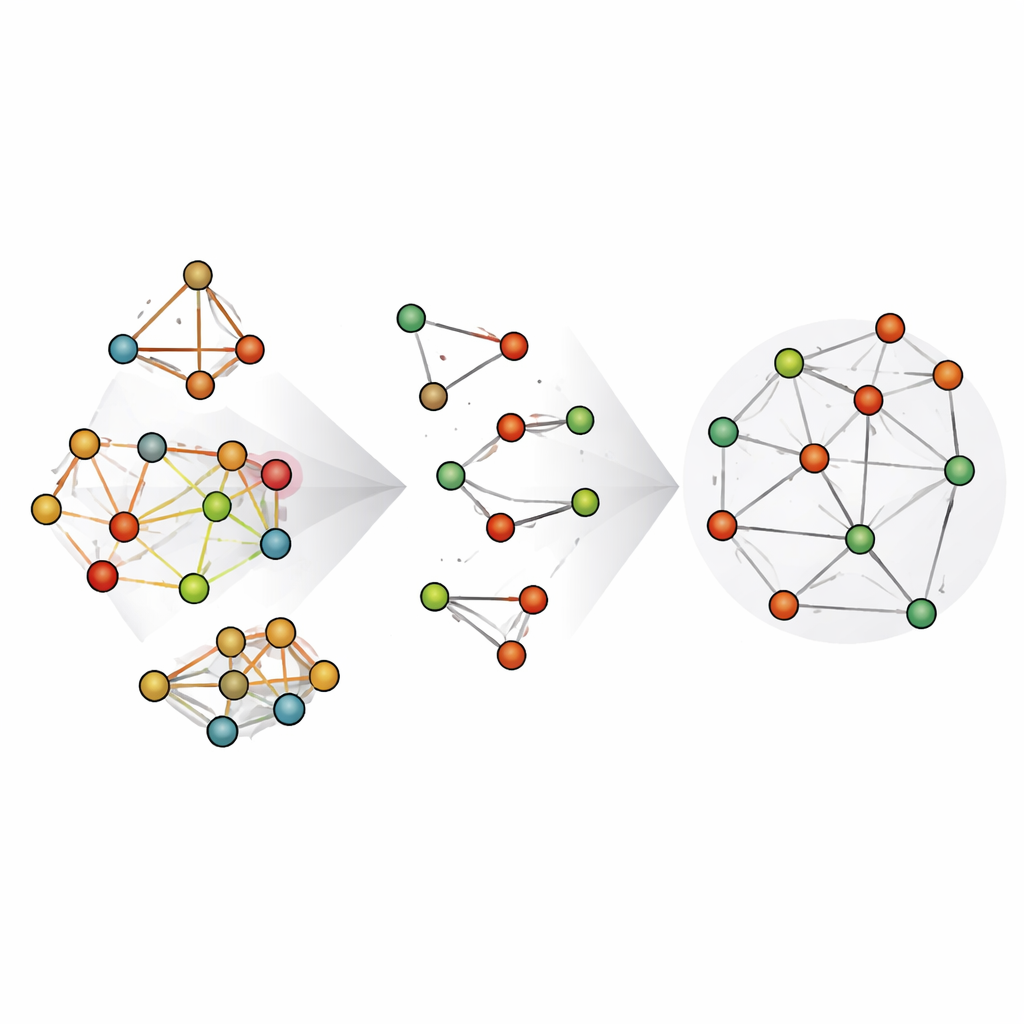
Modern network science distinguishes between ordinary networks, where links connect pairs of individuals, and higher‑order networks, where single “hyperedges” or “simplices” can bind three, four, or more individuals at once. These higher‑order structures better capture situations like group conversations or shared projects. Previous studies showed that such group interactions can produce surprising phenomena—abrupt outbreaks, multiple stable outcomes, and other complex patterns not seen in simple pairwise models. However, most work treated each modeling choice in isolation, without a common language for comparing dynamics across different network types.
A Map Between Different Worlds
The authors introduce the idea of transformability: the ability to map a spreading process on one kind of network to an equivalent process on another. They focus on simple contagion models—where individuals switch from susceptible to infected—and show mathematically how a process running on a hypergraph (with group interactions) can be transformed into an equivalent process on a simplicial complex, and then into a standard pairwise network. Under specific conditions relating infection rates in groups of different sizes to those on links, the overall course of the outbreak—how many individuals are infected over time—becomes nearly indistinguishable across these representations. Simulations on real social‑contact data from schools confirm that when these conditions are met, the infection curves on different network types almost perfectly overlap.
Measuring Disorder in the System
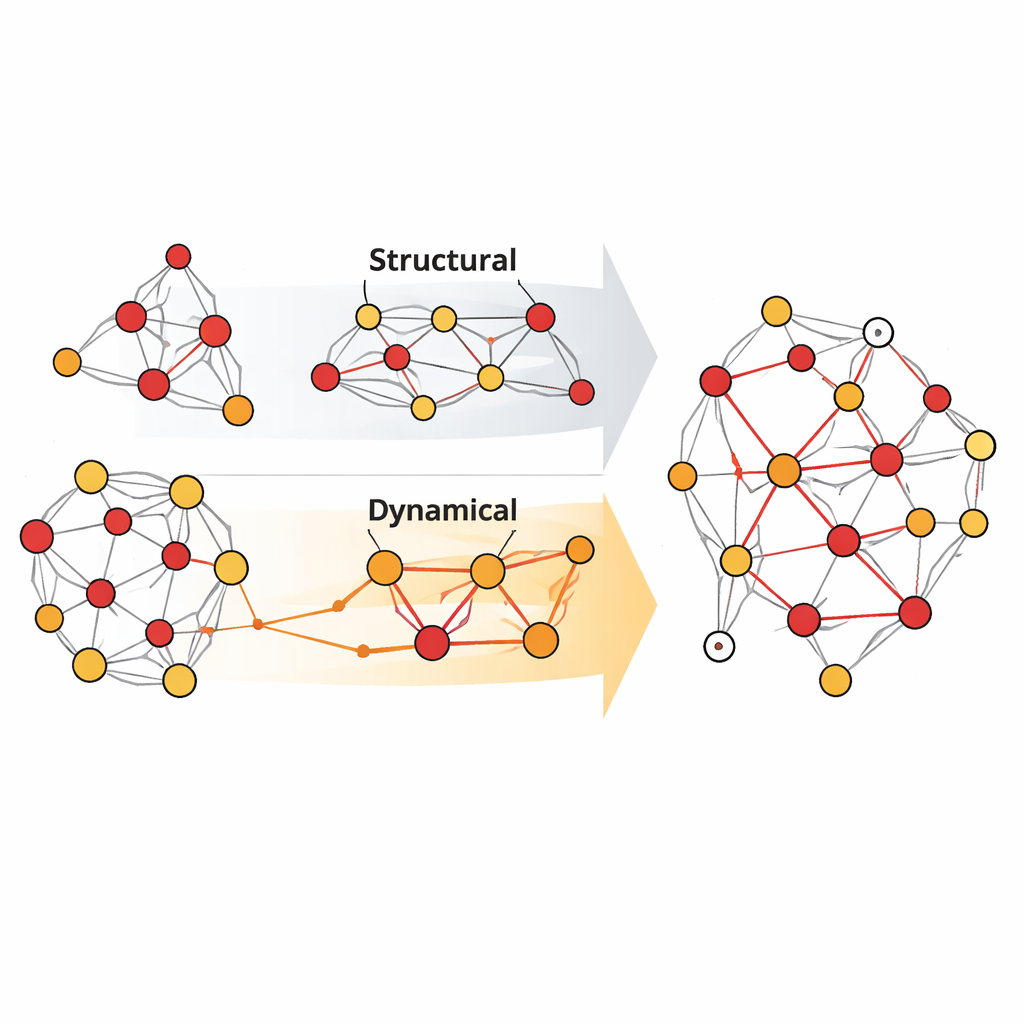
To understand what drives the differences when the mapping is not perfect, the authors step back from individual nodes and look at the system as a whole. They introduce a measure of system disorder, quantified by information entropy for contagion (how mixed the population is between susceptible and infected) and by opinion variance for opinion dynamics (how spread out people’s views are). By following how this disorder changes over time on higher‑order networks and on their pairwise projections, they show that the gap between the two can be cleanly split into two parts: a structural contribution from multiple group contacts, and a dynamical contribution from nonlinear effects (for example, when additional infected peers in a group more than linearly increase the chance of infection).
Two Main Levers: Structure and Nonlinearity
This “structural‑dynamical” decomposition gives a practical recipe. First, adjust the rules so that the nonlinear part of the dynamics matches a simpler, more linear reference; this captures the purely dynamical contribution. Second, compare a higher‑order network to two different pairwise projections: one that keeps multiple edges between frequent partners and another that collapses them to single links. The difference between these two captures the purely structural effect of having many overlapping group contacts. Across a range of synthetic and real networks, and for several contagion models (including variants where individuals can recover), the total difference in disorder between higher‑order and simple networks is almost exactly equal to the sum of these two contributions. The authors further explore when such a clean split is possible, identifying parameter regimes where group interactions are too strong or too dense to be faithfully reduced to pairwise descriptions.
Beyond Epidemics: Opinions and Beliefs
To test how general their framework is, the authors apply it to opinion dynamics, where each node’s state is a belief rather than an infection status. They study both gradual adjustment of continuous opinions and abrupt copying of neighbors’ views. In both cases, they extend the rules to account for group discussions on hypergraphs and track the evolution of opinion diversity. Remarkably, the same structural‑versus‑dynamical decomposition still works: the change in overall disorder when compressing a higher‑order network to a simple graph is well explained by the sum of structural and dynamical contributions. They also show that some inherently group‑based models resist such reduction, highlighting that not all higher‑order processes can be safely replaced by pairwise ones.
What This Means for Real‑World Spreading
In everyday terms, this work clarifies when it is acceptable to ignore the full complexity of group interactions and use simpler pair‑based models—without misrepresenting how an epidemic spreads or how opinions evolve. By pinpointing the separate roles of network structure and behavioral nonlinearity, the framework can guide modelers in deciding when higher‑order models are truly necessary and when they are an expensive luxury. This, in turn, can help in designing better strategies for controlling disease outbreaks or curbing misinformation, by revealing whether changing group structures (such as limiting gatherings) or adjusting individual responses (such as reducing nonlinear peer pressure) will have the stronger impact on collective behavior.
Citation: Xie, M., He, S., Li, A. et al. Transformability of dynamics on higher-order networks. Commun Phys 9, 149 (2026). https://doi.org/10.1038/s42005-026-02555-1
Keywords: higher-order networks, contagion dynamics, hypergraphs, opinion dynamics, network science