Clear Sky Science · en
Distinct uniaxial stress and pressure fingerprint of superconductivity in the 3D kagome lattice compound CeRu2
Why squeezing a crystal matters
Superconductors are materials that can carry electricity without any resistance, but most of them only work under very specific conditions. This study explores an unusual superconductor called CeRu2, whose atoms form a three-dimensional pattern of corner-sharing triangles known as a kagome lattice. Because of this special geometry, the electrons in CeRu2 behave in exotic ways that scientists think could be key to understanding and controlling superconductivity. By gently squeezing the crystal in different ways, the researchers show that they can subtly reshape how electrons pair up, without ever changing the underlying crystal structure. 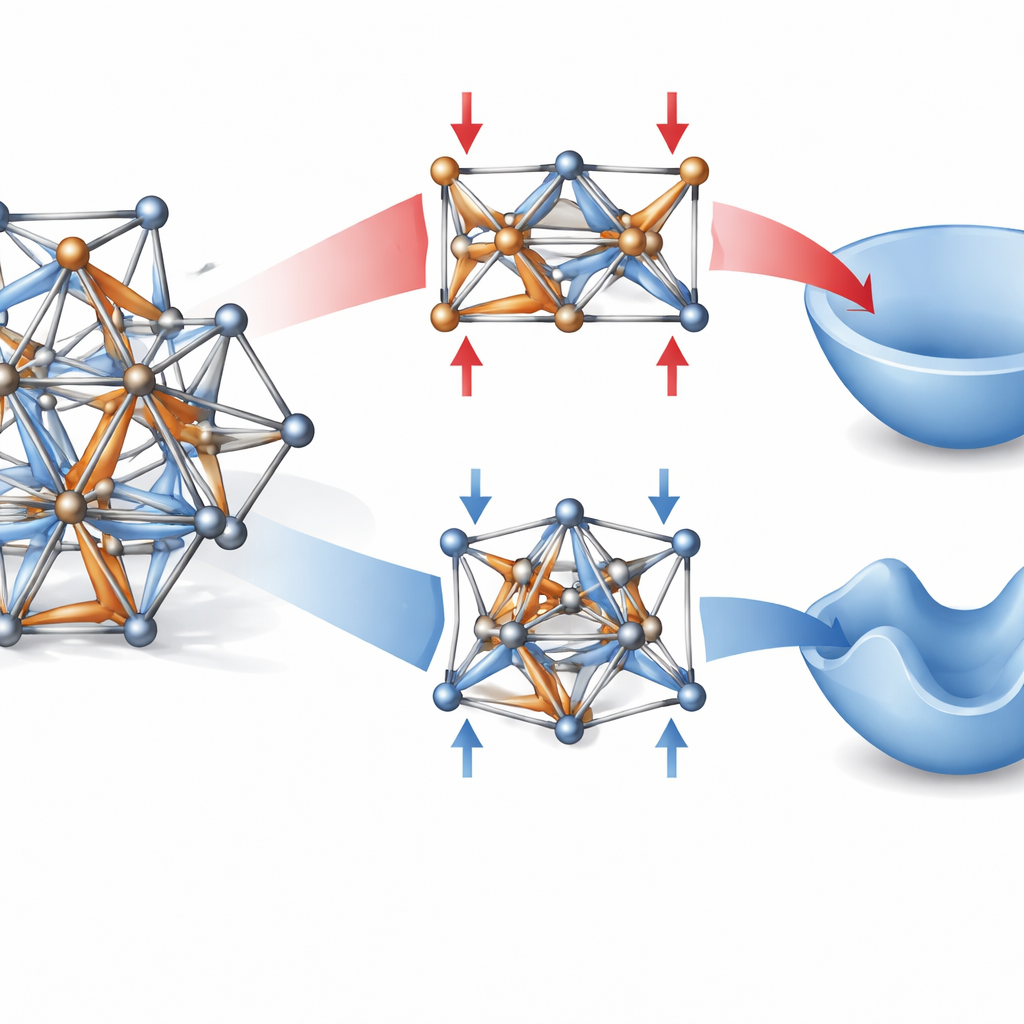
A special kind of atomic scaffold
In CeRu2, the atoms sit on a pyrochlore framework, which naturally hosts a three-dimensional version of the kagome lattice. This arrangement creates unusual electronic features with names like flat bands and Dirac points—technical terms that simply mean that electrons can become both highly mobile and strongly interactive. Earlier measurements had already shown that CeRu2 is a superconductor and that its electrons show signs of complex, correlated behavior. The material also displays hints of a subtle magnetic rearrangement around 40 kelvin, well above the temperature where it becomes superconducting. All of this makes CeRu2 an ideal playground to ask a central question: can we tune its superconductivity just by pushing on it, and if so, what does that reveal about how the electron pairs are organized?
Stretching in one direction changes the pairing
The team first applied uniaxial stress, meaning a push along a single in-plane direction aligned with the kagome layers. They tracked the superconducting transition temperature and the internal magnetic response using a technique based on implanted muons, which act as tiny local probes inside the crystal. As the stress increased up to about 0.22 gigapascals—still gentle enough to avoid any structural phase transition—the transition temperature followed a dome-like pattern: it stayed flat at low stress, rose to a small maximum, and then gradually fell by about 16 percent. At the same time, detailed analysis of the magnetic signals showed that the pattern of the superconducting energy gap on the Fermi surface evolved from being uneven to becoming more uniform. In plain terms, pushing along one direction smooths out the differences in how strongly electrons pair in different momentum directions, turning a somewhat lumpy superconducting state into a more even one.
Pressurizing from all sides creates weak spots
Next, the researchers compared this directional squeezing with hydrostatic pressure, where the sample is compressed equally from all sides. Up to pressures of 1.9 gigapascals, the superconducting transition temperature barely changed, suggesting that the overall strength of pairing was not dramatically altered. However, the low-temperature magnetic response told a very different story. At the highest pressure, the way the supercurrent density approached its zero-temperature value changed from an exponential-like to a nearly linear behavior with temperature—a hallmark of so-called nodes, points where the superconducting gap drops to zero. In addition, the diamagnetic response, which reflects how strongly the material expels magnetic field, almost doubled and developed a small counterintuitive paramagnetic upturn at the lowest temperatures. These features point toward a more fragile, highly anisotropic superconducting state emerging under uniform compression. 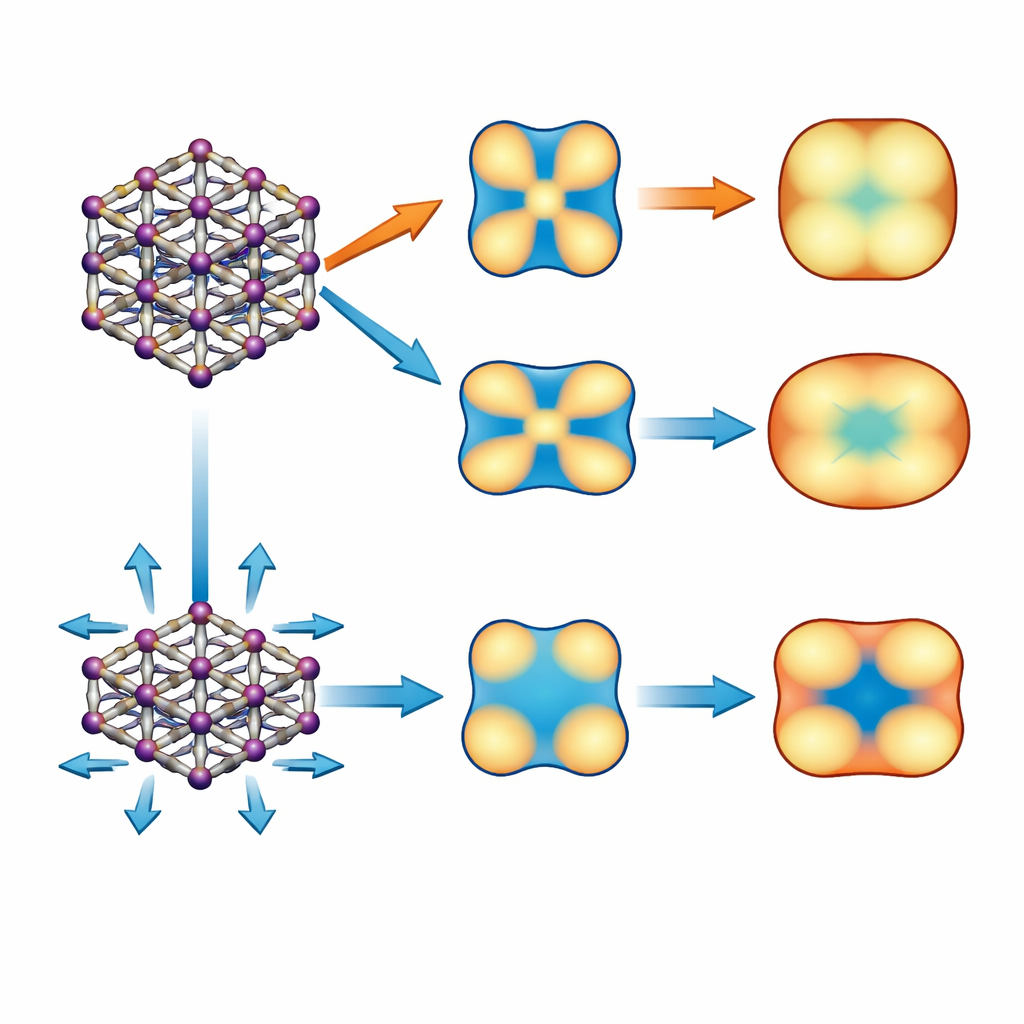
Two knobs, two distinct superconducting faces
To make sense of these contrasting effects, the authors propose a qualitative picture. In CeRu2, superconductivity likely arises from a complex mixture of extended s-wave components, whose strength varies across the Fermi surface. Uniaxial stress, by breaking symmetry in a specific direction, appears to reduce the competition between different tendencies and drive the system toward a more even, nodeless gap. Hydrostatic pressure, which preserves the overall symmetry, instead enhances certain anisotropic components until accidental nodes appear. Both effects occur with only modest mechanical tuning, highlighting how delicately the superconducting state depends on the details of the electronic structure—especially on the flat electronic bands associated with the kagome geometry.
What this means for future superconductors
In everyday terms, this work shows that gently squeezing a complex superconductor can reveal and control hidden aspects of how its electrons pair. CeRu2 stands at the crossroads of two rich areas of physics: heavy-fermion materials, where electrons behave as if they are extremely heavy, and kagome systems, where lattice geometry drives unusual quantum states. By demonstrating that uniaxial stress and hydrostatic pressure leave very different fingerprints on its superconductivity—one smoothing it, the other carving weak spots—the study provides a powerful blueprint for mechanically tuning quantum materials. These insights could guide future efforts to design superconductors whose properties can be dialed in on demand, bringing us closer to practical, robust zero-resistance technologies.
Citation: Gerguri, O., Das, D., Sazgari, V. et al. Distinct uniaxial stress and pressure fingerprint of superconductivity in the 3D kagome lattice compound CeRu2. Commun Phys 9, 122 (2026). https://doi.org/10.1038/s42005-026-02553-3
Keywords: kagome superconductors, mechanical tuning, flat band physics, hydrostatic pressure, uniaxial stress