Clear Sky Science · en
Dynamic local operations and classical communication for automated entanglement manipulation
Why turning noisy quantum links into reliable ones matters
Today’s quantum computers are small and fragile, but many of their most exciting uses—from secure communication to powerful simulations—need machines that can act together over long distances. That requires sharing a special kind of connection called entanglement between distant labs. In the real world, these links are easily damaged by noise, making them expensive and unreliable. This paper introduces a new way to automatically design step-by-step procedures that clean up these noisy quantum links and help distant devices work together more effectively.
Building a smarter playbook for distant quantum labs
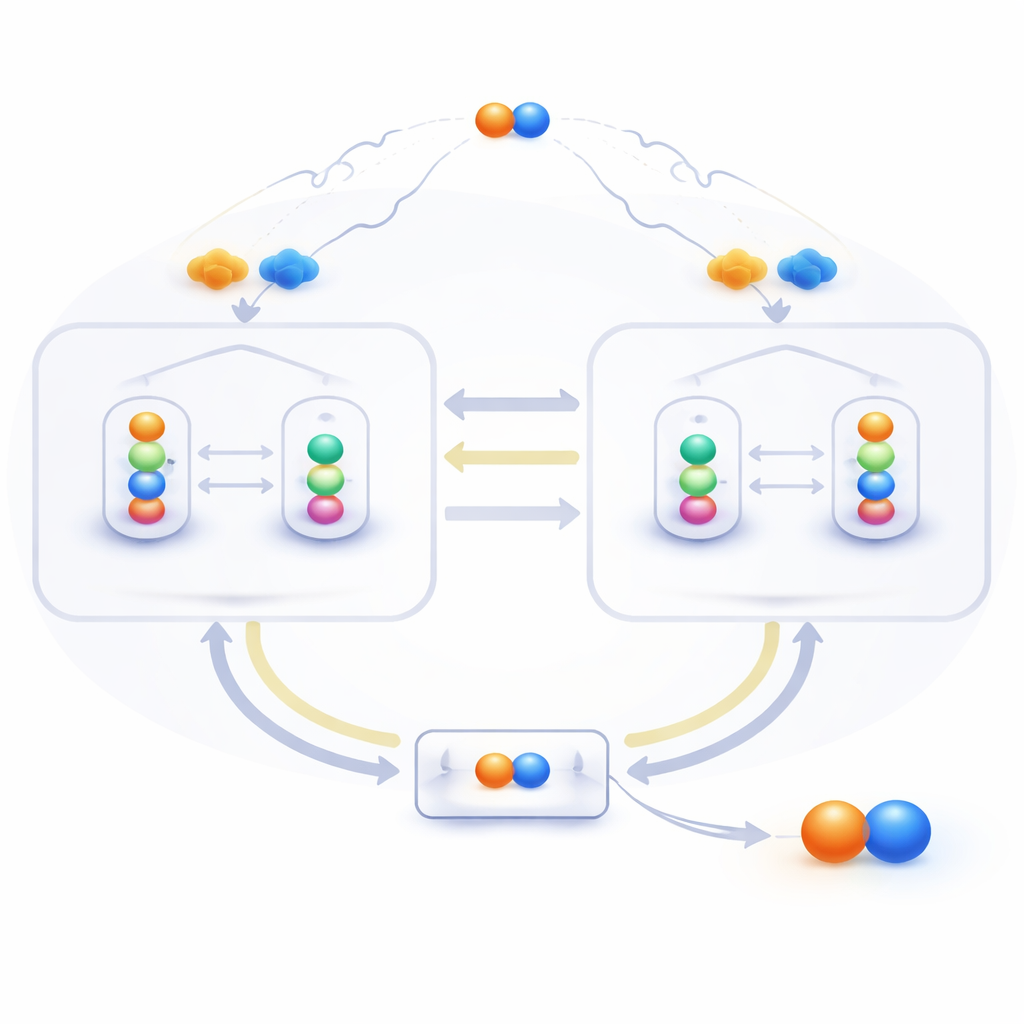
The study focuses on a restricted but realistic setting: distant labs are allowed to manipulate only their own local quantum systems and to talk over an ordinary classical channel. This rule set, known as “local operations and classical communication,” is the backbone of distributed quantum computing. Designing good strategies under these rules is notoriously hard; the space of possibilities grows explosively as systems get bigger. Earlier work used machine learning (a framework called LOCCNet) to search for useful strategies, but its computational cost ballooned so quickly that it was practical only for small problems. The new framework, called dynamic LOCCNet (DLOCCNet), keeps the spirit of automatic design while restructuring the process so it scales to much larger systems.
Breaking big quantum tasks into smaller reusable steps
The key idea behind DLOCCNet is to avoid building one giant protocol that touches all copies of a shared state at once. Instead, the method breaks the task into a sequence of rounds, each operating on just a small number of qubits in each lab. In every round, the two parties run a compact, tunable local circuit, measure some qubits, exchange the measurement results over a classical channel, and then decide how to act in the next round—possibly resetting some qubits with a fresh entangled pair. A classical optimizer adjusts the circuit parameters so that, after many simulated runs, a chosen performance measure (such as the quality of the final entangled state or the success rate of a discrimination task) is maximized. Because each round only involves a small fixed subsystem, the computational effort grows gently with the number of copies, instead of exploding.
Cleaning up noisy quantum links more efficiently
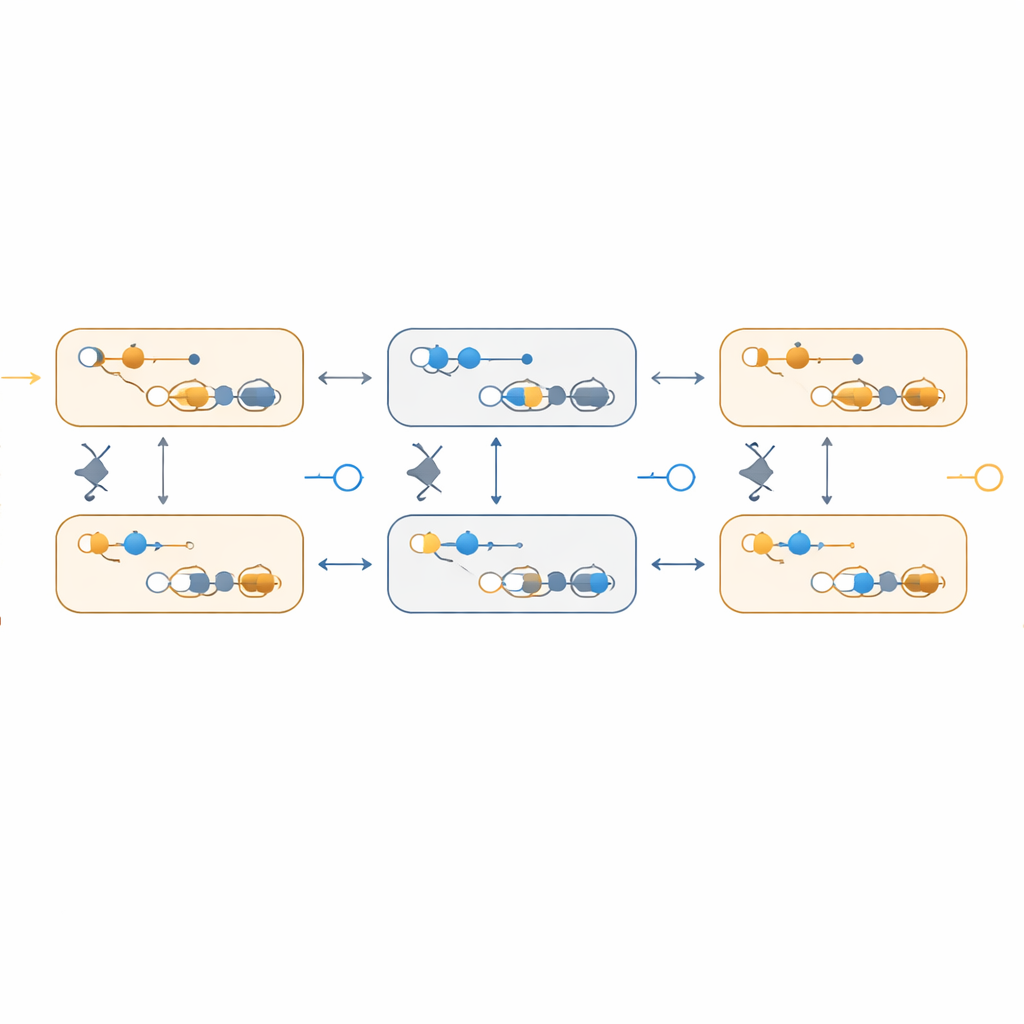
The authors first apply DLOCCNet to entanglement distillation, the process of consuming several noisy entangled pairs to produce fewer, higher-quality ones. They test their approach on several standard types of noise, including loss (erasure), random flips and mixing (depolarizing noise), and energy leakage (amplitude damping and its thermal variant). For a simple model of loss, DLOCCNet discovers an analytical protocol that uses only a small set of basic quantum gates yet comes close to the best possible performance, and it surpasses a widely used benchmark protocol known as DEJMPS when more copies are available. For more complicated noise models, DLOCCNet consistently produces higher-quality final pairs than dynamic versions of older methods and does so with dramatically shorter training times, even when using many more input copies than previous machine-learning approaches could handle.
Using multiple copies to tell quantum states apart
Next, the framework is used for distributed state discrimination, where distant labs must decide which of two possible joint quantum states they share. Rather than widening the circuit to process many copies at once, DLOCCNet keeps the circuit width fixed and feeds the copies through sequentially, adjusting later actions based on earlier measurement outcomes. The goal is to minimize the chance of making the wrong guess. Numerical experiments show that as more copies are used, the probability of correctly identifying the state rises significantly, even though the per-round circuit remains small. Comparisons against theoretical benchmarks indicate that these automatically designed strategies make good use of the limited communication and control allowed in realistic distributed settings.
What this means for future quantum networks
In everyday terms, this work provides a recipe for teaching distant quantum devices how to cooperate under strict rules, using modest computational resources. By turning a daunting, all-at-once design problem into a chain of small, trainable steps, DLOCCNet can craft practical protocols that clean up noisy entanglement and distinguish delicate quantum states more reliably. For future quantum networks—where many small processors will need to share high-quality connections over imperfect links—such scalable, automatically designed playbooks could be an essential ingredient in turning fragile lab experiments into robust, large-scale technologies.
Citation: Liu, X., Zhao, J., Zhao, B. et al. Dynamic local operations and classical communication for automated entanglement manipulation. Commun Phys 9, 113 (2026). https://doi.org/10.1038/s42005-026-02549-z
Keywords: distributed quantum computing, entanglement distillation, local operations and classical communication, quantum networks, quantum state discrimination