Clear Sky Science · en
Optical aberration-assisted three-dimensional manipulation of the focused spatiotemporal optical vortex
Light That Twists in Space and Time
Modern optics is learning not just to shine light, but to sculpt it in space and time. This paper explores a special kind of "twisting" light pulse and shows how usually unwanted imperfections in lenses can instead be used as steering knobs. The result is a way to move tiny, doughnut-shaped flashes of light in three dimensions with great precision, opening doors for manipulating nanoparticles, reading out information, or performing ultrafast measurements on the smallest scales.
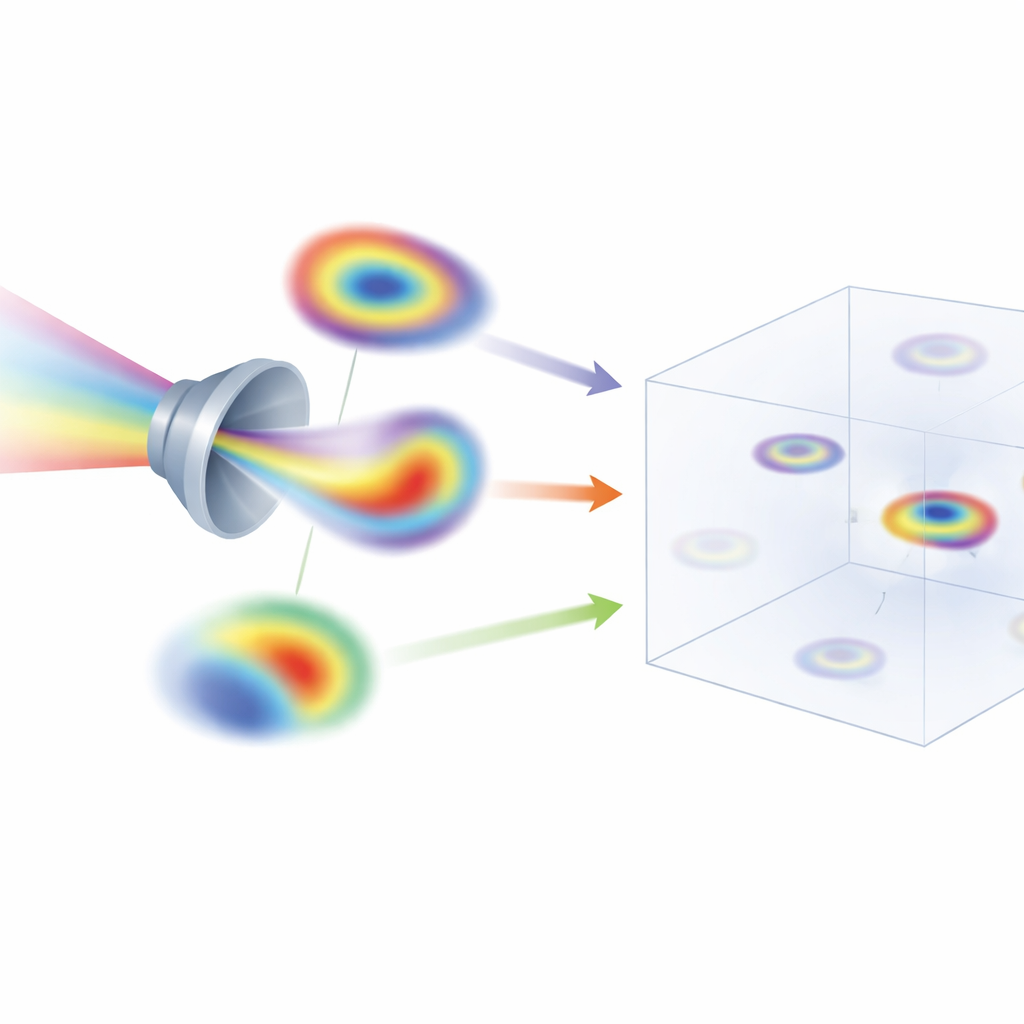
Strange Doughnuts of Light
The work focuses on spatiotemporal optical vortices, pulses of light whose energy is arranged like a doughnut and whose twist is not just in space but also in time. Unlike more familiar vortex beams, where the light’s swirl runs along the direction of travel, these pulses carry their twist sideways. That sideways twist, called transverse orbital angular momentum, makes them promising for tasks such as driving tiny objects, encoding information, or probing materials in unusual ways. Until now, however, most studies treated these pulses on relatively large scales, limiting how closely they could interact with microscopic structures.
Bringing Twisting Pulses Down to the Nanoscale
To unlock new applications, the authors look at what happens when these pulses are brought to a sharp focus with a high-performance microscope-like lens. At such tight focus, the light can be confined to dimensions comparable to the wavelength itself, reaching the micro- and nano-scale where single particles, nanostructures, or even individual molecules reside. Earlier work showed how to form such tightly focused vortices, but controlling exactly where the bright doughnut appears inside the focus region remained difficult. This study tackles that challenge by treating lens imperfections not as flaws to be removed, but as tools for control.
Turning Flaws into Steering Knobs
The team examines three simple types of lens imperfection: one that distorts the wavefront symmetrically (spherical aberration) and two that tilt it slightly in different sideways directions (x-tilt and y-tilt). Using detailed calculations of how the lens reshapes the incoming pulse, they show that each imperfection shifts the tiny vortex in a predictable way. Spherical aberration moves the doughnut forward or backward along the optical axis, while the two tilts slide it sideways in perpendicular directions. Importantly, these shifts change almost linearly with the strength of each imperfection, so the position of the light packet can be dialed in like turning three knobs that control depth and sideways motion.
Placing Many Doughnuts Where You Want Them
Because these effects add together, combining the three imperfections allows the vortex to be placed at essentially any point within the focal volume, all while keeping its tightly confined size and its sideways twist intact. The authors then go a step further: instead of using just one distorted wavefront, they coherently combine two with opposite tilts. This creates not one but two separate doughnut-shaped pulses inside the focus, symmetrically placed on either side of the center, each still carrying the transverse twist. By choosing different combinations of distortions, they can design multiple, distinct light packets in the same tiny region, suggesting a route to complex light patterns engineered at the micro- and nano-scale.
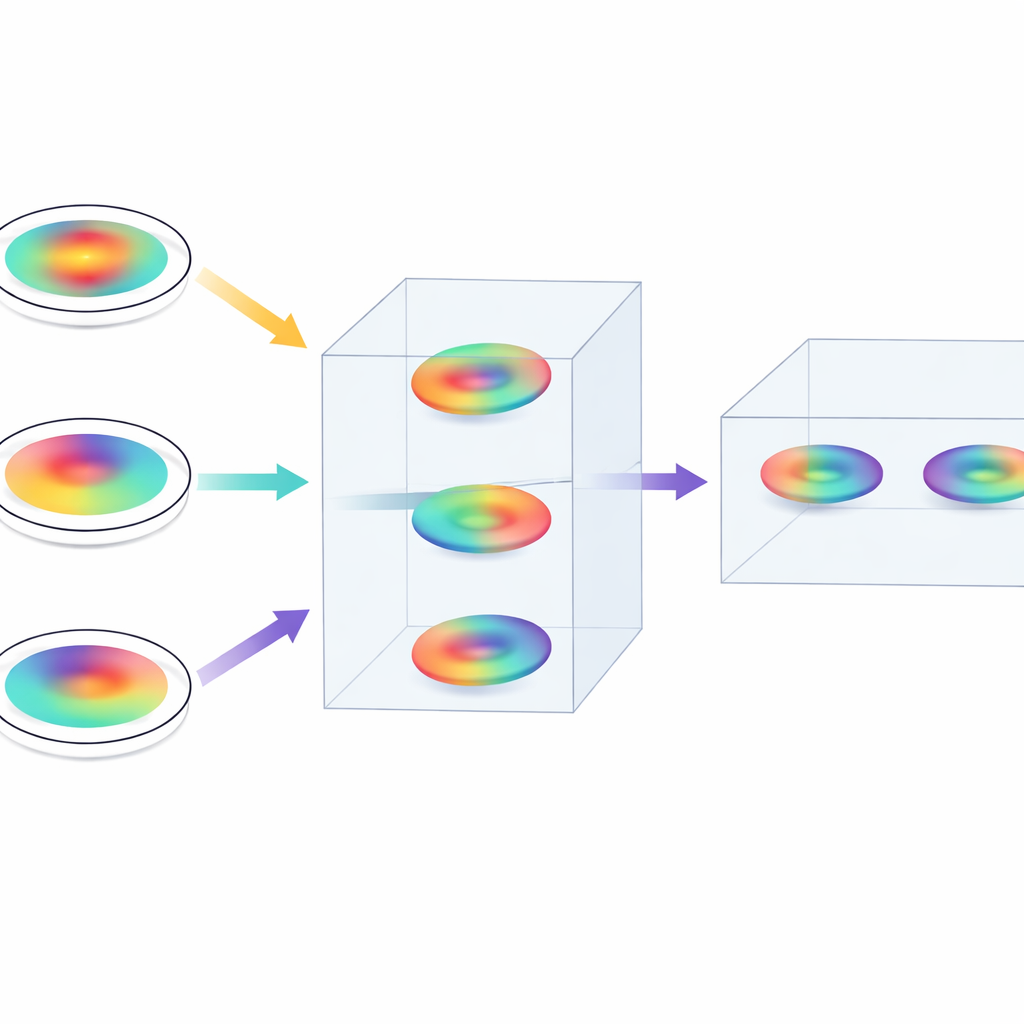
From Unwanted Blur to Useful Control
In everyday imaging, aberrations are a nuisance because they blur the picture. This study shows that, for structured light pulses, those same imperfections can be repurposed as precise control handles. By carefully programming the wavefront—using devices such as spatial light modulators or custom metasurfaces—researchers could steer nanoscopic doughnuts of light in three dimensions and even create several at once. In simple terms, the paper’s conclusion is that what was once an optical flaw can become a powerful steering wheel for twisted light, with potential payoffs in particle manipulation, optical computing, and new ways of exploring the hidden structure of matter.
Citation: Liu, T., Liu, Y. & Chen, J. Optical aberration-assisted three-dimensional manipulation of the focused spatiotemporal optical vortex. Commun Phys 9, 108 (2026). https://doi.org/10.1038/s42005-026-02548-0
Keywords: spatiotemporal optical vortex, optical aberrations, structured light, nanophotonics, light-matter interaction