Clear Sky Science · en
Fermi surface reconstruction and anisotropic linear magnetoresistance in the charge density wave topological semimetal TaTe4
Why this strange metal matters
Modern electronics increasingly leans on “quantum materials,” where the collective behavior of electrons gives rise to surprising effects. The compound TaTe4 sits at the crossroads of two such behaviors: it is both a topological semimetal, expected to host exotic electronic states, and a charge density wave material, where electrons and atoms self-organize into a repeating pattern. This study shows, in unprecedented detail, how these two tendencies reshape the landscape in which electrons move, and how that reshaping leads to an unusual, nearly perfectly linear response of the material’s resistance to magnetic fields.
Electrons on rails in a quantum crystal
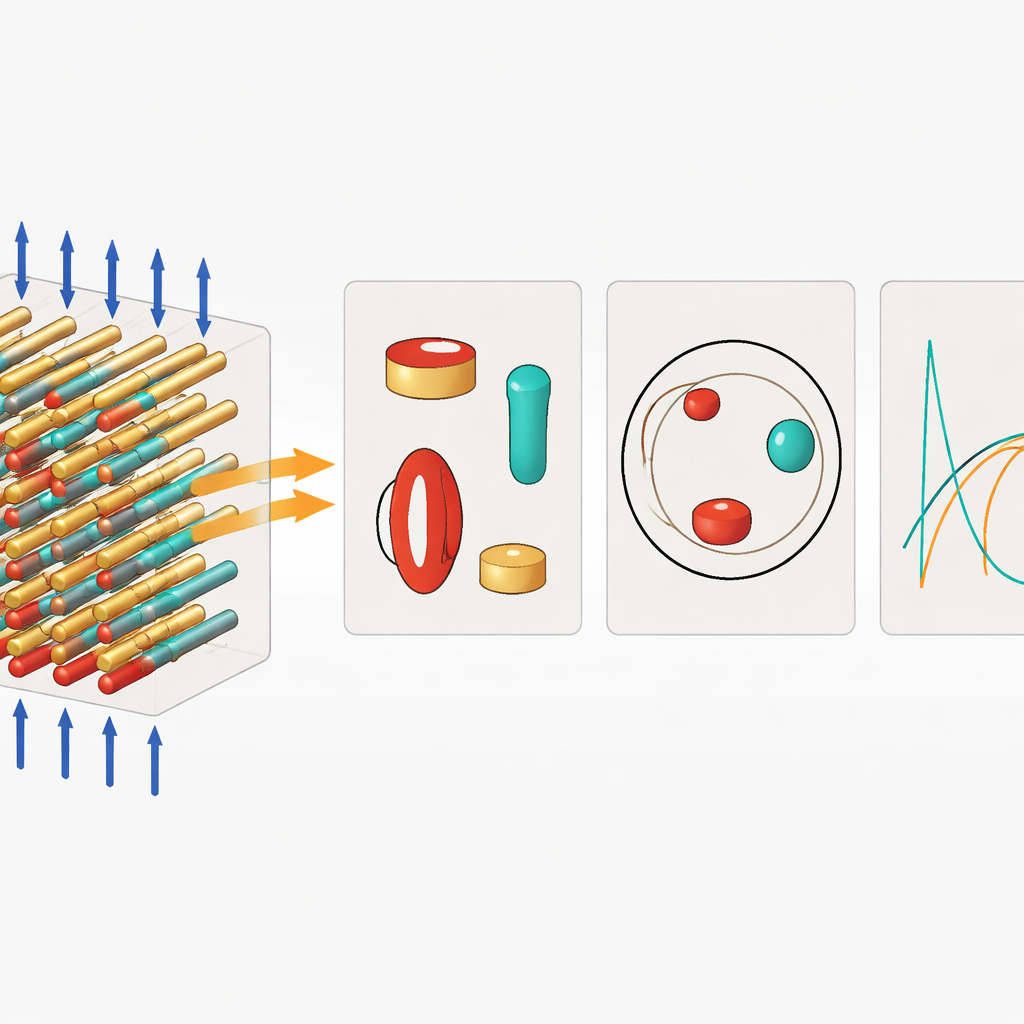
TaTe4 is built from chains of tantalum and tellurium atoms stacked into a crystal. Because the chains run along one direction, electrons tend to move most easily along that axis, giving the material a quasi-one-dimensional character. At room temperature and below, TaTe4 also forms a charge density wave, a pattern in which the electronic charge and atomic positions modulate periodically. This extra ordering enlarges the basic repeating unit of the crystal and reshuffles the allowed energy levels, strongly modifying the so-called Fermi surface—the abstract surface that marks which quantum states are occupied by electrons at low temperature.
Drawing the hidden map of electron motion
To see how the charge density wave reshapes this Fermi surface, the authors combined two powerful tools. First, they used advanced computer calculations based on density functional theory to predict where the allowed electron states should lie once the charge pattern is present. Second, they subjected high-quality TaTe4 crystals to intense magnetic fields up to 35 tesla while measuring how the electrical resistance oscillates. These oscillations, known as Shubnikov–de Haas oscillations, depend sensitively on the size and shape of the closed loops that electrons trace in momentum space under a magnetic field, allowing the researchers to reconstruct the main pockets of the Fermi surface deep inside the bulk of the crystal.
Rebuilt electronic landscape and hidden shortcuts
The measurements revealed that the Fermi surface seen by electrons in the bulk matches the charge-density-wave–modified predictions, with four of six expected pockets clearly detected and no sign of leftover, pre-reconstruction bands. Among these pockets, the team identified a previously unseen, nearly cylindrical one and carefully tracked how several pockets changed as the magnetic field was rotated. At some field orientations, they observed an additional, very large quantum-oscillation frequency that could not be explained by any single predicted pocket or by simple harmonics. Instead, its behavior fits a picture in which electrons tunnel across small gaps between neighboring pockets, stitching them into a larger combined orbit through a process known as magnetic breakdown. From how this breakdown sets in with field strength, they inferred an energy gap of about 0.29 electron volts associated with the charge density wave, in line with independent photoemission measurements.
When resistance grows in a straight line
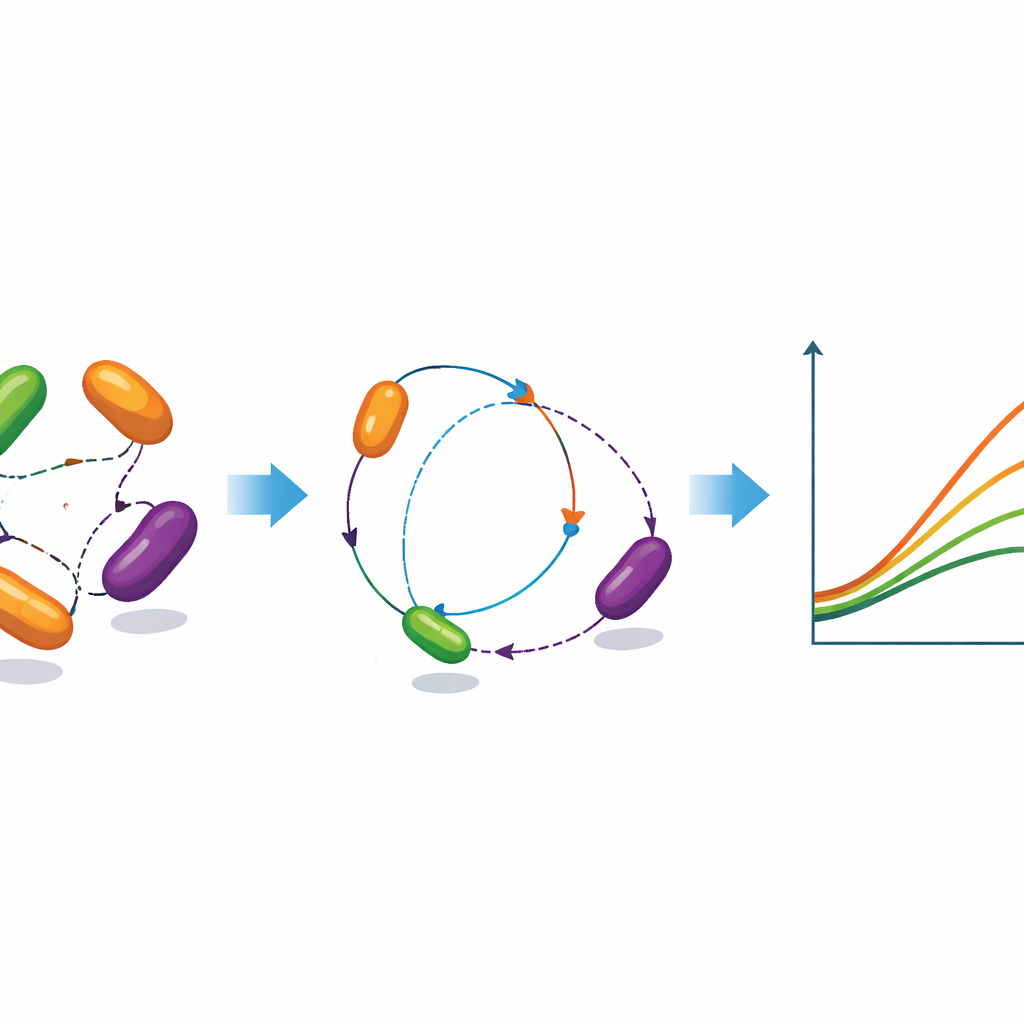
Beyond mapping the Fermi surface, the researchers discovered a striking transport property. When electric current is driven across the chains and a magnetic field is applied in various directions, the resistance grows almost perfectly linearly with field over a wide range, rather than showing the more typical quadratic rise and eventual saturation. Moreover, when the field is steered close to the chain direction, the resistance exhibits two distinct linear regimes with a clear bend between them. The onset of the high-field linear regime coincides with the field scale at which magnetic breakdown becomes likely, suggesting that scattering from special “hot spots” created by the charge-density-wave reconstruction plays a major role. The low-field linear regime, which appears at all angles, cannot be explained by breakdown or by simple disorder, and may instead be tied to the topological character of the electronic states and how a magnetic field splits their degeneracies.
What it all means for future quantum devices
In accessible terms, this work shows that TaTe4 is a clean example of a material whose electronic “road map” is completely rebuilt by a charge density wave, while still hosting topological features that can be nudged and probed by magnetic fields. The team not only charts this map pocket by pocket, but also uncovers how electrons can take hidden shortcuts between pockets and how these shortcuts and special scattering regions likely underpin an unusually robust linear magnetoresistance. That combination makes TaTe4 a promising platform for exploring new quantum effects and could guide the design of future devices that exploit direction-dependent and nearly linear responses to magnetic fields.
Citation: Silvera-Vega, D., Rojas-Castillo, J., Herrera-Vasco, E. et al. Fermi surface reconstruction and anisotropic linear magnetoresistance in the charge density wave topological semimetal TaTe4. Commun Phys 9, 112 (2026). https://doi.org/10.1038/s42005-026-02544-4
Keywords: topological semimetal, charge density wave, Fermi surface, magnetoresistance, TaTe4