Clear Sky Science · en
Equitability and explosive synchronisation in multiplex and higher-order networks
Why patterns of connection matter
From brain circuits to power grids and social media, many systems are made of units that influence one another and can start to "march in step"—a phenomenon known as synchronisation. Often, not all elements lock together at once; instead, subgroups fall into step while others behave differently. This paper asks a subtle but important question: when are such synchronised clusters possible, and why do some complex systems seem to jump suddenly from disorder to full lockstep instead of forming intermediate groups?
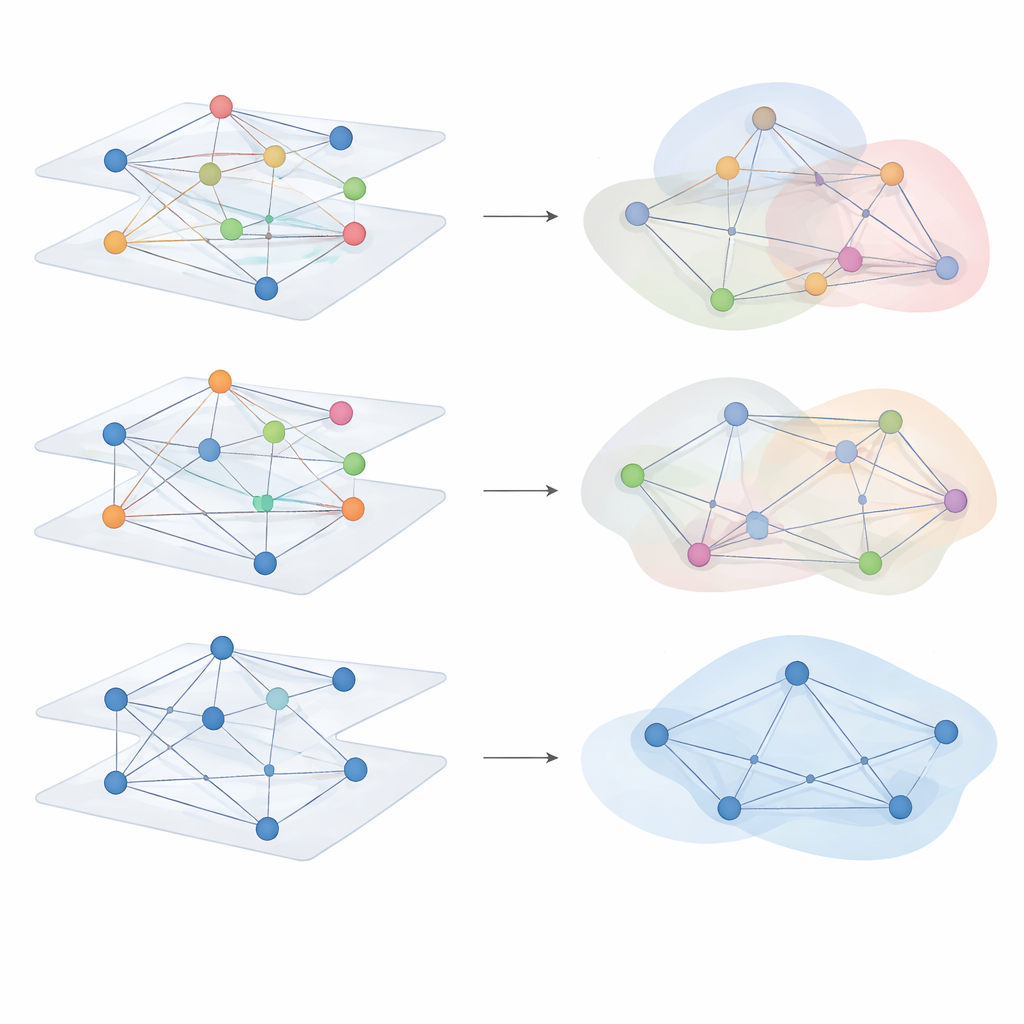
Groups that move together
The authors study systems where many identical units interact through a web of links. In simple networks, each pair of units is either connected or not. But real systems are richer: the same units can be linked in several ways at once (multiplex networks, like different types of relationships in a social network), or they can interact in groups of three or more at a time (higher-order networks, or hypergraphs, like teams making a decision together). In these settings, a synchronised cluster is a set of units that follow exactly the same time course, even though other units may do something different or remain unsynchronised.
Fairness in incoming influence
The central idea is a structural property called equitability, which informally means that units inside a candidate cluster receive the same overall influence from every other cluster. In ordinary pairwise networks, this condition is already known to be linked to cluster synchronisation. This work proves, in a very general mathematical framework, that for multiplex and higher-order interactions the same principle governs when clusters can exist—but with a twist: the fairness condition must hold separately for each layer or each type of group interaction, and for the same set of units across all of them. When this strict requirement is met, the authors show that one can systematically construct solutions where the chosen groups synchronise, by reducing the original system to a smaller “quotient” system in which each cluster is treated as a single effective unit.
When clusters cannot form
To make the theory precise, the authors focus on what they call independent cluster synchronisation: situations where the various ways clusters talk to each other are not accidentally related by simple algebraic rules. Under this mild assumption, they prove that synchronised clusters can exist only if the underlying partition of nodes into groups is equitable in the strict, layer-by-layer sense. If this fairness fails, then no matter how one tunes the strengths or detailed shapes of the coupling functions, independent cluster solutions are impossible. Numerical simulations of chaotic Lorenz oscillators on carefully designed multiplex networks and hypergraphs support this view: only those node groups that satisfy equitability across all interaction types settle into cluster synchrony before the whole system locks together.
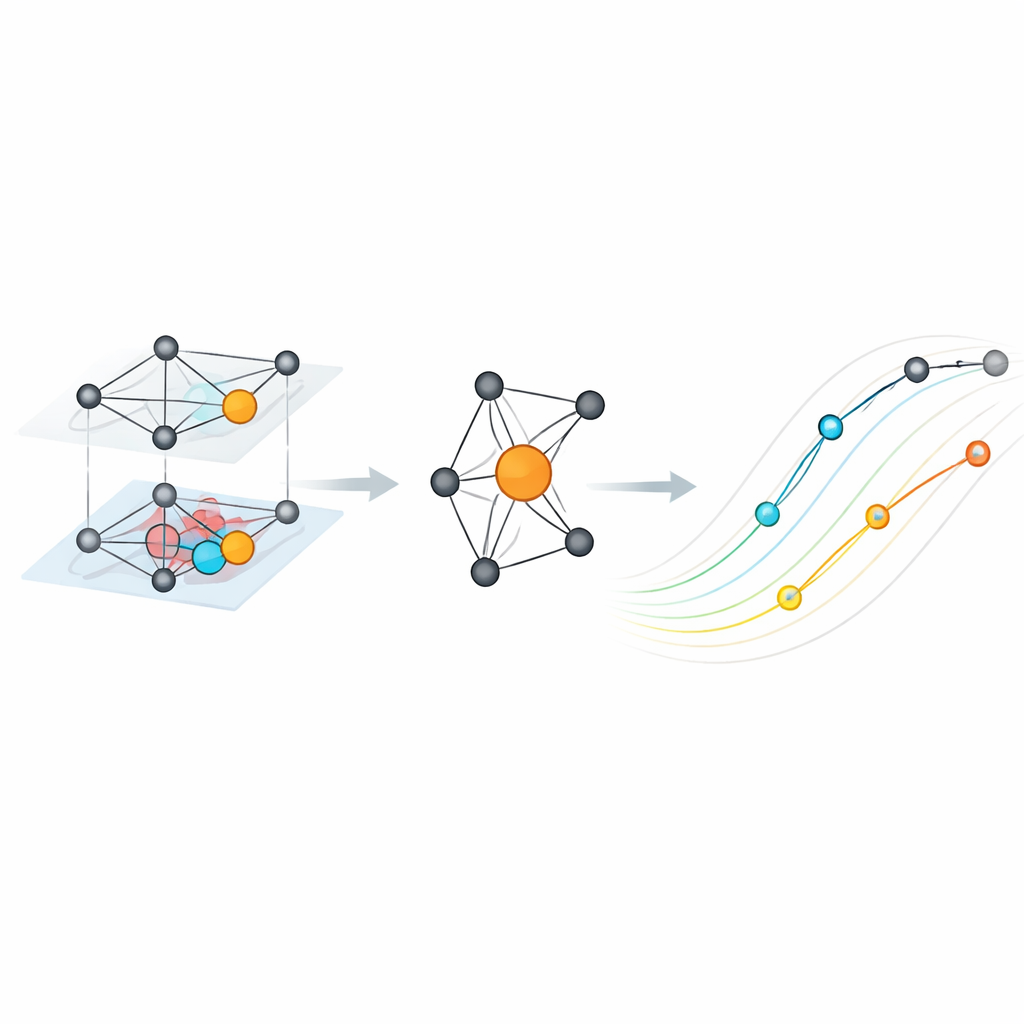
Why sudden lockstep is common
An important consequence is an explanation for the widespread observation of explosive synchronisation in multiplex and higher-order networks—a sharp transition directly from desynchronised behaviour to full global synchrony, with no stable intermediate clusters. Because equitability must hold simultaneously on each layer and for each kind of group interaction, it becomes statistically rare for the same set of units to satisfy the condition everywhere. In many realistic multilayer or many-body systems, the only equitable partitions are the trivial ones: either every unit is alone, or everyone is in the same group. In those cases, the only generic synchronised state is the fully synchronised one, so as coupling increases the system tends to jump straight into global lockstep.
Designing collective behaviour
Finally, the authors show that the link between equitability and cluster synchronisation can be turned around and used constructively. Given any desired grouping of units, if one engineers the interaction pattern so that the partition is equitable (per layer and per interaction type), then cluster-synchronised solutions are guaranteed to exist and can be obtained by solving the smaller quotient system. This provides a blueprint for designing and controlling complex dynamical systems—from engineered networks to synthetic biological circuits—so that they exhibit targeted patterns of coordinated behaviour, and clarifies why such patterns are scarce when the hidden fairness conditions are not met.
Citation: Kovalenko, K., Contreras-Aso, G., del Genio, C.I. et al. Equitability and explosive synchronisation in multiplex and higher-order networks. Commun Phys 9, 117 (2026). https://doi.org/10.1038/s42005-026-02543-5
Keywords: cluster synchronisation, multiplex networks, higher-order interactions, explosive synchronisation, equitable partitions