Clear Sky Science · en
Laser cooling of ytterbium-erbium Co-doped nanoparticle with optical tweezers in vacuum
Why gently cooling tiny objects matters
Lasers are remarkable tools for holding and moving microscopic objects, from dust particles to living cells. But the same laser light that acts like a tiny tractor beam also heats whatever it grabs, which can damage delicate samples and spoil ultra-precise measurements. In this study, researchers demonstrate a way to use light not only to trap a single nanoparticle, but also to cool it efficiently back toward room temperature—without ever letting it get dangerously hot or unhealthily cold.
A light-based handle for single nanoparticles
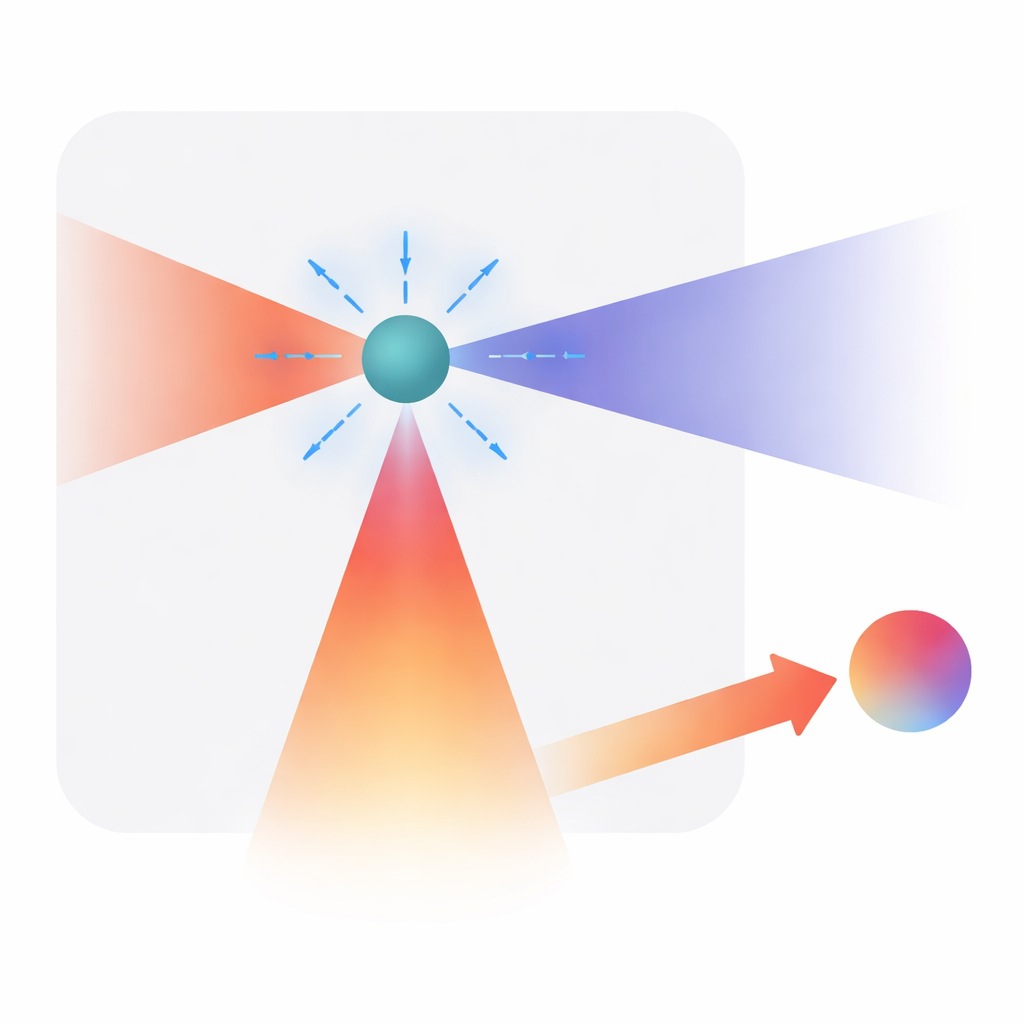
Modern "optical tweezers" use a tightly focused laser beam to hold and steer nanoparticles and biological targets inside a chamber, even in near-vacuum conditions. This contact-free control is essential for experiments in quantum physics, nanotechnology and life sciences. However, focusing intense light into such a tiny spot packs in a lot of energy. The trapped object absorbs part of that light, warms up, and can become unstable or even suffer heat damage. The team behind this work set out to tame that heating directly in the trap itself, using another laser to pull heat out of the particle while it remains levitated.
How light can cool instead of heat
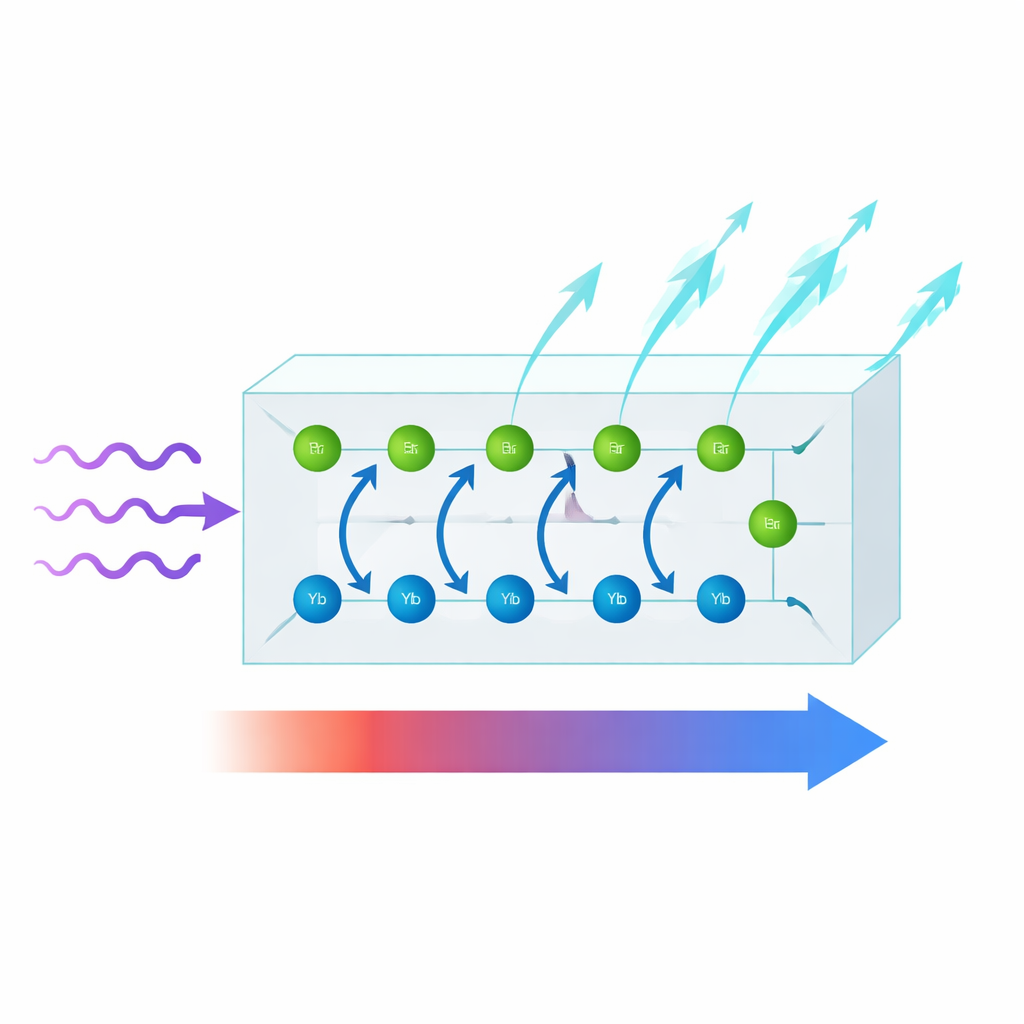
The cooling method relies on a process called anti-Stokes emission, in which a material absorbs relatively low-energy light and then re-emits slightly higher-energy light. The extra energy needed for the emitted photons comes from tiny vibrations in the material’s crystal lattice—its internal heat. When many such events occur, the particle effectively loses thermal energy and cools down. To make this work efficiently, the researchers engineered nanocrystals of sodium yttrium fluoride that contain two kinds of rare-earth ions, ytterbium (Yb) and erbium (Er). One laser at a wavelength of 1030 nanometers acts as the trapping beam, holding a single nanoparticle in place inside a vacuum chamber. A second laser at 1064 nanometers drives the cooling process by exciting the Yb ions, which then pass energy to higher-lying states of the Er ions.
Two partners sharing the cooling work
By co-doping the nanoparticle with both Yb and Er, the researchers create multiple radiative pathways along which absorbed light can be converted into shorter-wavelength emission that removes heat. Yb ions act as efficient absorbers for the 1064-nanometer light, while Er ions provide an additional, more strongly cooling transition at even shorter wavelengths. Energy flows from Yb to Er inside the crystal, opening a second cooling cycle that boosts overall performance compared with Yb alone. The team measured the light emitted from specific Er and Yb energy bands and used established optical thermometry techniques to infer the particle’s internal temperature without touching it.
Keeping samples warm enough but not too hot
Experiments show that the combined action of trapping and cooling lasers leads to very different outcomes depending on gas pressure, laser power and the particle’s starting temperature. At normal air pressure, frequent collisions with gas molecules pin the particle’s temperature near the environment, masking any cooling. In low-pressure conditions, however, the trapped nanoparticle can heat strongly under the trapping beam alone, reaching temperatures around 500 kelvin (more than 200 degrees above room temperature). With the cooling laser turned on, the same particle can be brought back down by over 120 kelvin, landing close to room temperature. The cooling works best when the nanoparticle starts hot and when the Er concentration is tuned to about 2 percent; too little Er wastes potential cooling channels, while too much encourages energy-sharing processes that convert light back into heat.
A sweet spot for gentle trapping
Crucially, the researchers find that when the initial nanoparticle temperature is already near room temperature, the cooling pathway does not drive it below the freezing point. That behavior is especially important for biological applications, where both overheating and overcooling can harm cells, proteins or other fragile structures held in optical tweezers. This co-doped nanoparticle design therefore acts like a built-in thermal stabilizer: it can pull very hot trapped particles down toward a safe range, but naturally avoids over-chilling them. The work provides experimental proof that carefully engineered rare-earth nanocrystals can solve a key problem in optical trapping, paving the way for more accurate force measurements and less damaging manipulation of single nano-objects and biomolecules.
Citation: Guo, X., Xiao, Y., Wang, S. et al. Laser cooling of ytterbium-erbium Co-doped nanoparticle with optical tweezers in vacuum. Commun Phys 9, 107 (2026). https://doi.org/10.1038/s42005-026-02541-7
Keywords: optical tweezers, laser cooling, nanoparticles, rare-earth doping, biophysics