Clear Sky Science · en
Information bounds production in replicator systems
How Simple Molecules Can Use “Information”
Life depends on using clues from a changing environment, but we usually imagine this requires complex cells with genes and sensory machinery. This paper asks a deeper question: can bare-bones chemical replicators—simple molecules that copy themselves—also "use" information from their surroundings in a meaningful way? By studying tiny replicating systems in flow reactors, the authors show that even very simple chemical networks can, in effect, bet on future environmental conditions and gain a productivity advantage from doing so.
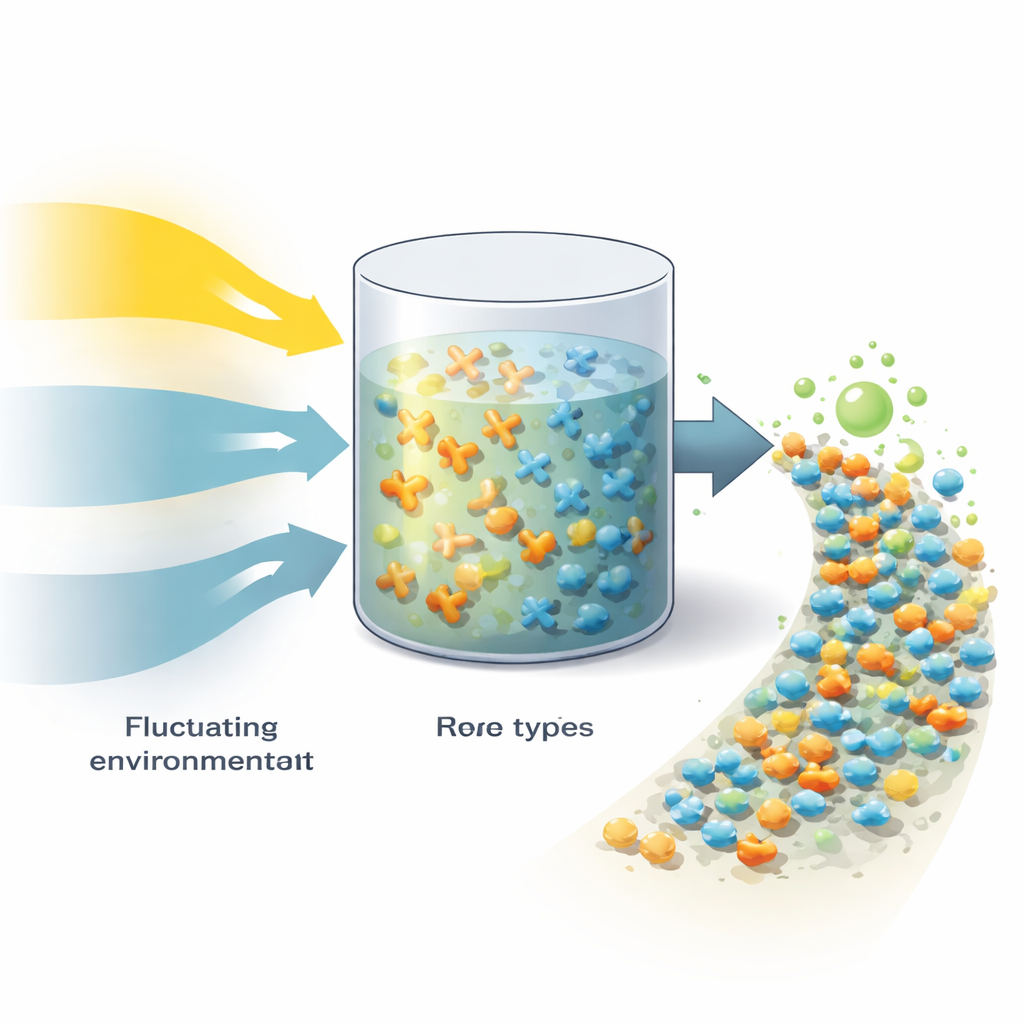
A Chemical World That Never Stands Still
The study begins with a stripped-down picture of a small pond or a lab reactor where different kinds of self-copying molecules compete for a shared resource. The environment around them changes in time, for instance cycling between strong and weak light. During “active” phases, fresh resource flows in, molecules replicate, and some are washed out of the reactor. During “inactive” phases, the flow stops and the molecules can reshuffle their mass among different types through slow exchange reactions. The key quantity the authors track is productivity: how much replicator material leaves the reactor per unit time, which can be seen as a simple stand-in for evolutionary success.
Breaking Productivity Into Pieces of Information
Using this setup, the authors derive a mathematical expression that splits the average productivity into several conceptually clear parts. One part reflects what productivity would be if the environment stayed fixed and the best possible replicator type always dominated. A second part captures the unavoidable cost of not knowing in advance which environmental condition will appear next—this is tied to how unpredictable the winner is across different environments. A third part represents the value of “side information” that helps anticipate the next environment, and a final part measures how well the actual mixture of replicator types at the start of each active phase matches the theoretically optimal mixture for exploiting that information. This last piece is the only one that depends on the system’s internal strategy.
Strategies, Memory, and a Surprising Head Start
In the model, a strategy is simply the pattern of initial proportions of each replicator type before an active phase begins. Intriguingly, the strategy that maximizes long-term productivity does not always favor the fastest-growing type. When an environment sometimes favors a slower replicator, the optimal strategy gives that slow type a "head start"—a larger initial share—so that it has enough time to rise to high productivity before the environment changes again. The authors also show that the productivity gains that come from using side information obey clean, universal bounds: the benefit is directly proportional to a standard information-theoretic quantity measuring how much the side information reduces uncertainty about which replicator will win.
From Abstract Theory to Real Molecular Replicators
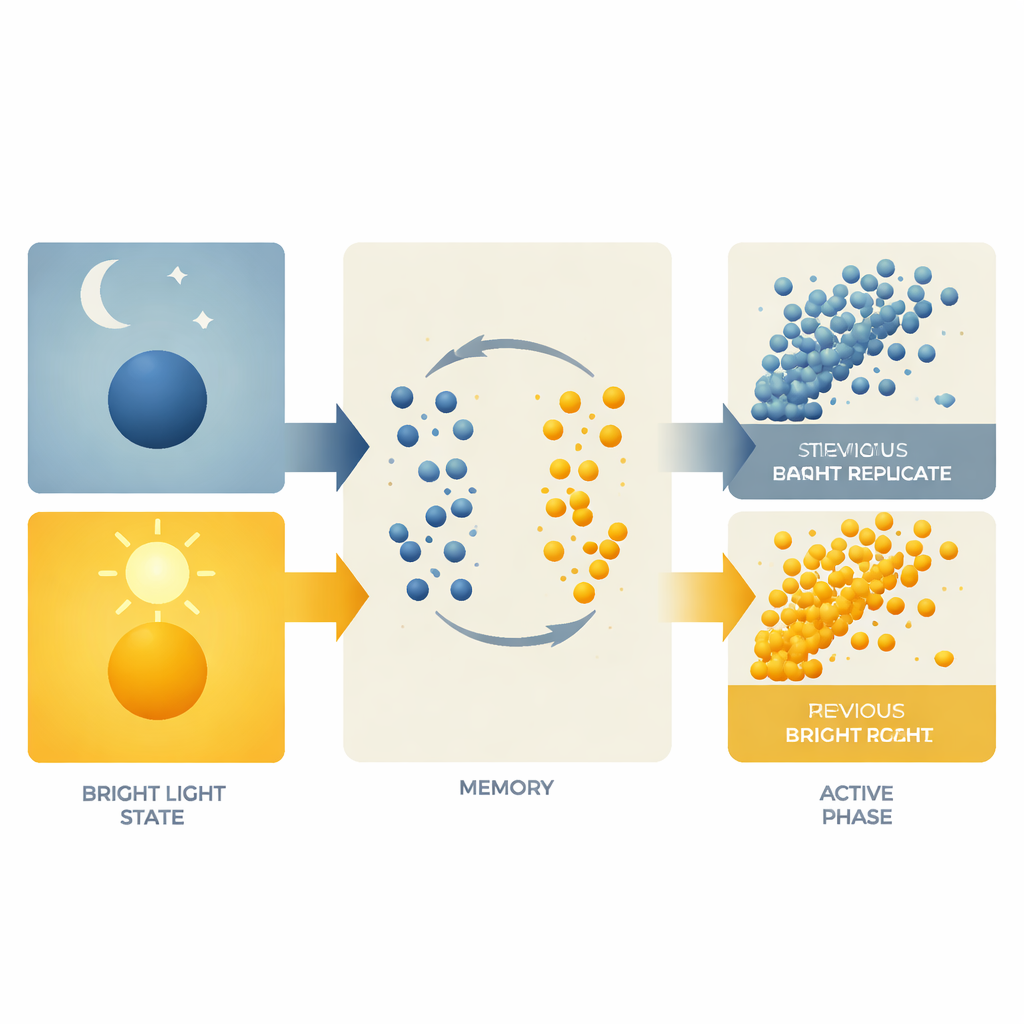
To connect theory with experiment, the authors apply their framework to a real chemical system developed by other researchers: two synthetic molecular replicators that grow under light. One type does better in weak light, the other in strong light, and they can slowly exchange material between them in the dark. The environment alternates between lit “active” phases and dark “inactive” phases, with the pattern of weak and strong light showing temporal correlations (for instance, bright days tending to follow bright days). In this system, the dark intervals act as a built-in memory: slow exchange during inactivity adjusts the ratio of the two replicators based on what the previous light condition was, thereby encoding information about the recent past into the initial state of the next active phase. Depending on how fast this exchange runs and how biased it is toward one replicator, the system can either exploit or squander that memory.
Why This Matters for the Origins of Life
The authors conclude that simple replicator networks can, in a precise and measurable sense, use functional information: statistical correlations with the environment that improve a clear performance measure, here productivity. They show how environmental uncertainty, side information, and imperfect strategies each contribute to gains or losses in output, and they propose concrete experiments with light-driven molecular replicators to detect these effects. For a layperson, the key message is that meaningful information processing might not require genomes, cells, or brains. Instead, it can emerge naturally whenever even very simple chemical systems are repeatedly exposed to changing conditions and allowed to reorganize themselves between bouts of growth.
Citation: Piñero, J., Sowinski, D.R., Ghoshal, G. et al. Information bounds production in replicator systems. Commun Phys 9, 120 (2026). https://doi.org/10.1038/s42005-026-02527-5
Keywords: molecular replicators, fluctuating environments, functional information, origin of life, flow reactors