Clear Sky Science · en
Reconfigurable free-space mode generation and detection enabled by an active photonic integrated circuit coupled to a passive mode-selective interface
Turning Complex Light into a Useful Tool
Modern technologies—from high-speed internet to quantum communication—are increasingly limited not by how much light we can generate, but by how cleverly we can shape and read it. This paper presents a new kind of optical chip that can rapidly rearrange how it handles intricate patterns of light traveling through open air. For a lay reader, the appeal lies in what this enables: more data through the same link, sharper sensors, and communication systems that can adapt on the fly to fog, turbulence, or even moving platforms like satellites and drones.
Why Shaping Light Patterns Matters
A light beam is not just a simple spot; it can carry rich structure in its brightness and phase across space. Different structures, or “modes,” can be made mathematically independent of each other, allowing many channels to share the same color of light without interference. For decades, researchers have built optical devices that separate or create such modes, but most are fixed: they are designed for one specific set of patterns and cannot be easily changed. When the environment changes—as in turbulent air over a city—those fixed devices no longer match the incoming light, and performance drops. A truly flexible mode sorter that can be reprogrammed in real time would let communication and sensing systems adapt to their surroundings and keep working efficiently.
Marrying Free-Space Optics with a Tiny Chip
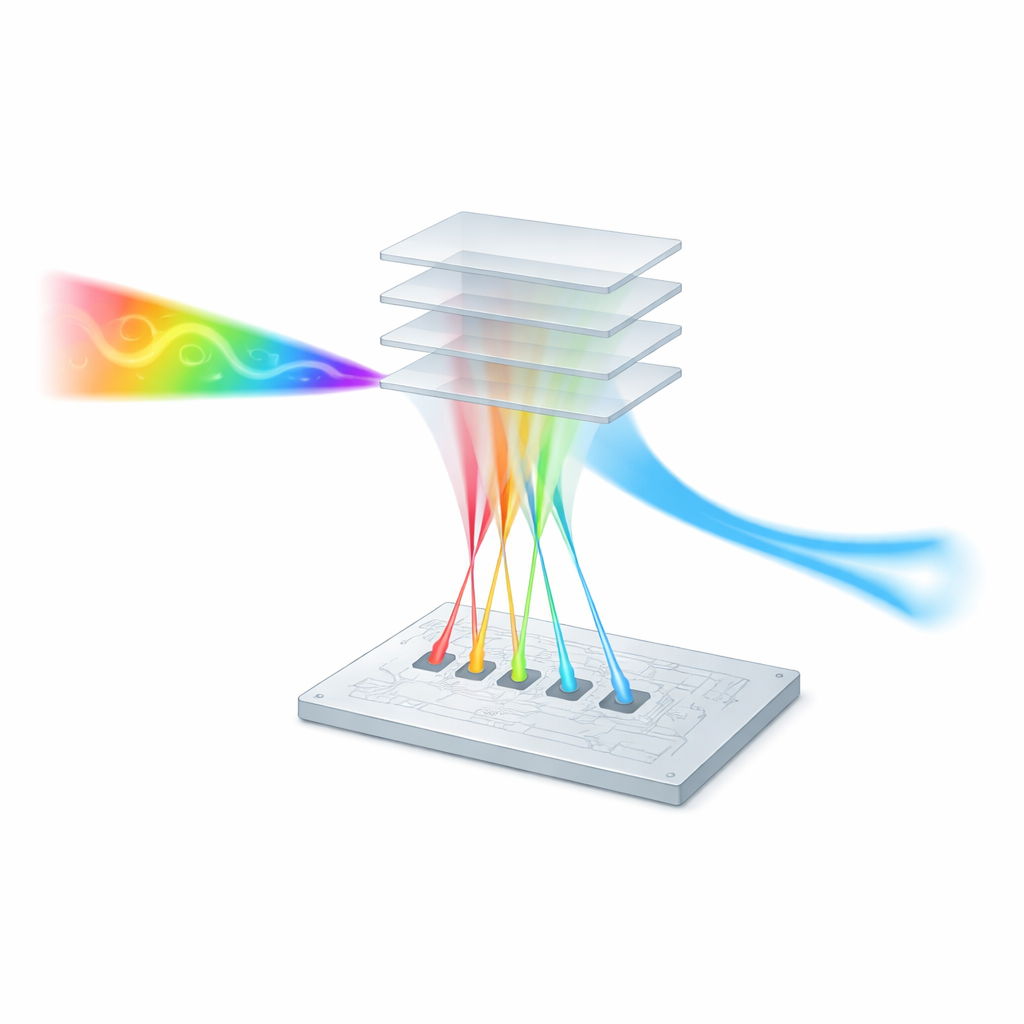
The researchers combine two powerful ideas: a passive “optical mode-selective interface” that works in free space, and an active photonic integrated circuit on a silicon chip. The free-space part is a stack of six thin phase-shaping elements known as a multiple-plane light converter. Together, they gently reshape incoming beams so that each desired light pattern is transformed into a small near-Gaussian spot landing on one of 15 tiny surface couplers on the chip. In effect, this front-end transforms a complicated two-dimensional pattern of light into a set of 15 clean input channels, defining a 15-dimensional space of possible modes. Inside the chip, a mesh of interferometers—waveguide loops whose behavior is tuned by tiny heaters—can then mix these channels with precise control over their relative brightness and phase.
A Light Mixer that Can Be Reprogrammed
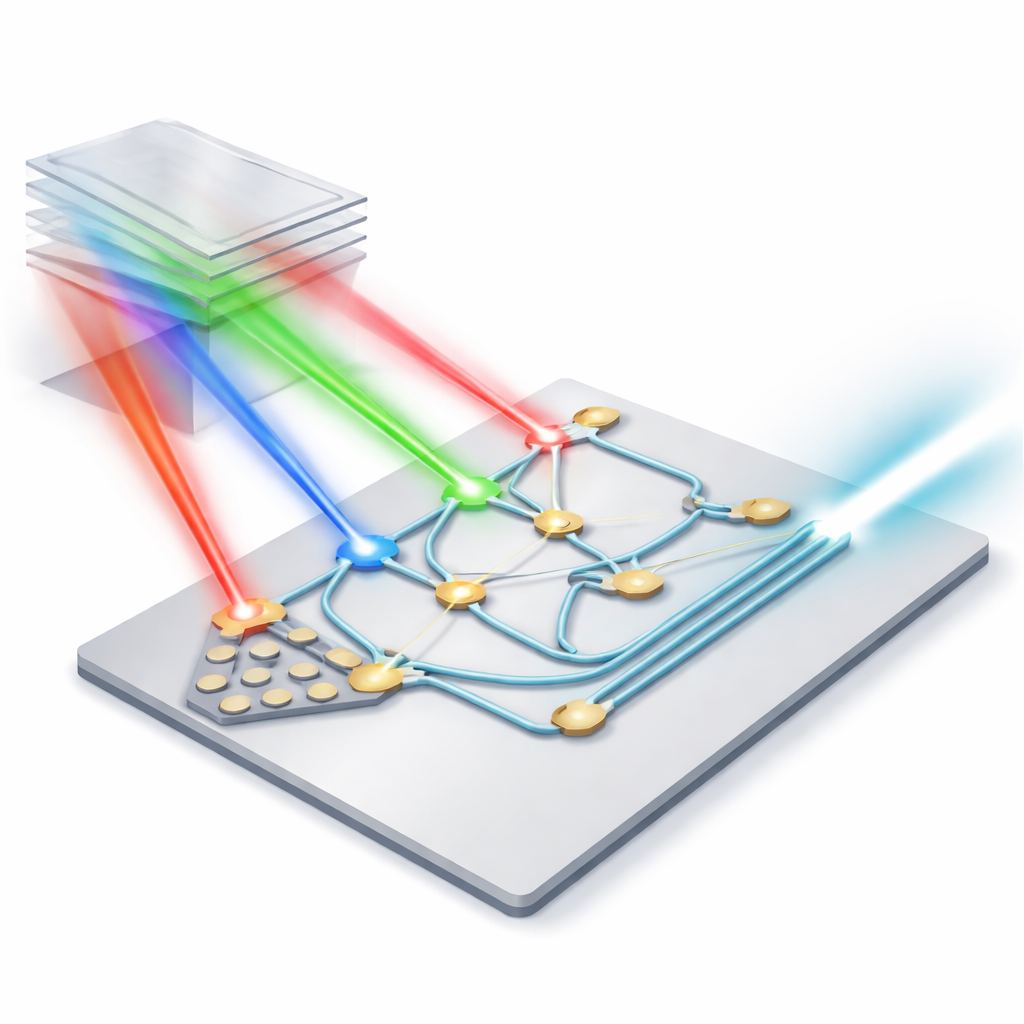
Because the chip controls how the 15 inputs are combined, it can be electronically reconfigured to pick out almost any pattern that can be described as a mixture of the basic modes set by the interface. In one direction of operation, the device acts as a sorter: if a chosen mode hits the system, the chip directs its power to a single “signal” port while steering other, orthogonal modes to separate outputs. In the opposite direction, feeding light into that signal port allows the chip and interface together to generate a tailored beam in free space. The team demonstrates this flexibility by handling four different complete sets of 15 modes each, including well-known structured beams and more exotic patterns deliberately spread across all inputs. They report low interference between modes (about –22 dB on average) and show that the system can be reprogrammed at nearly 20,000 times per second, limited mainly by how fast the heaters can warm up and cool down.
Beating the Limits of Pixelated Arrays
Conventional optical phased arrays—grids of emitters or detectors on chips—face strict spacing rules set by the Nyquist sampling principle: to faithfully represent fine spatial detail, one needs many closely packed elements. This quickly leads to two problems: wasted light in unwanted directions (grating lobes) and crosstalk between neighboring waveguides when they are placed too close together. The new approach sidesteps these issues by using the mode-selective interface to map each whole light pattern onto just one chip coupler. That means far fewer on-chip elements are needed—more than a fourfold reduction compared with a straightforward pixel grid for similar performance—and those elements can be spaced widely enough to avoid both excess loss and unwanted coupling.
Implications for Future Communication and Sensing
From a lay perspective, this work shows how to turn an unruly, complex beam of light into a set of clean, rapidly reconfigurable channels without redesigning the hardware each time. The combination of a fixed but efficient free-space interface and a programmable optical chip creates a general engine for shaping and analyzing light patterns. The authors argue that, with fabricated rather than prototype components, overall losses could be pushed down to just a few decibels, and speeds could rise from tens of kilohertz to megahertz or even gigahertz using faster modulators. Such a system could underpin adaptive links between ground stations and satellites, robust free-space data connections in turbulent air, and agile optical sensors that tailor their beams to complex environments—all by reshaping light itself inside a chip.
Citation: Boldin, A., Daly, U.J., Milanizadeh, M. et al. Reconfigurable free-space mode generation and detection enabled by an active photonic integrated circuit coupled to a passive mode-selective interface. Commun Phys 9, 133 (2026). https://doi.org/10.1038/s42005-026-02522-w
Keywords: photonic integrated circuits, free-space optical communication, mode multiplexing, structured light, adaptive optics