Clear Sky Science · en
Unified mechanism of charge-density-wave and high-Tc superconductivity protected from oxygen vacancies in bilayer nickelates
Why this new superconductor matters
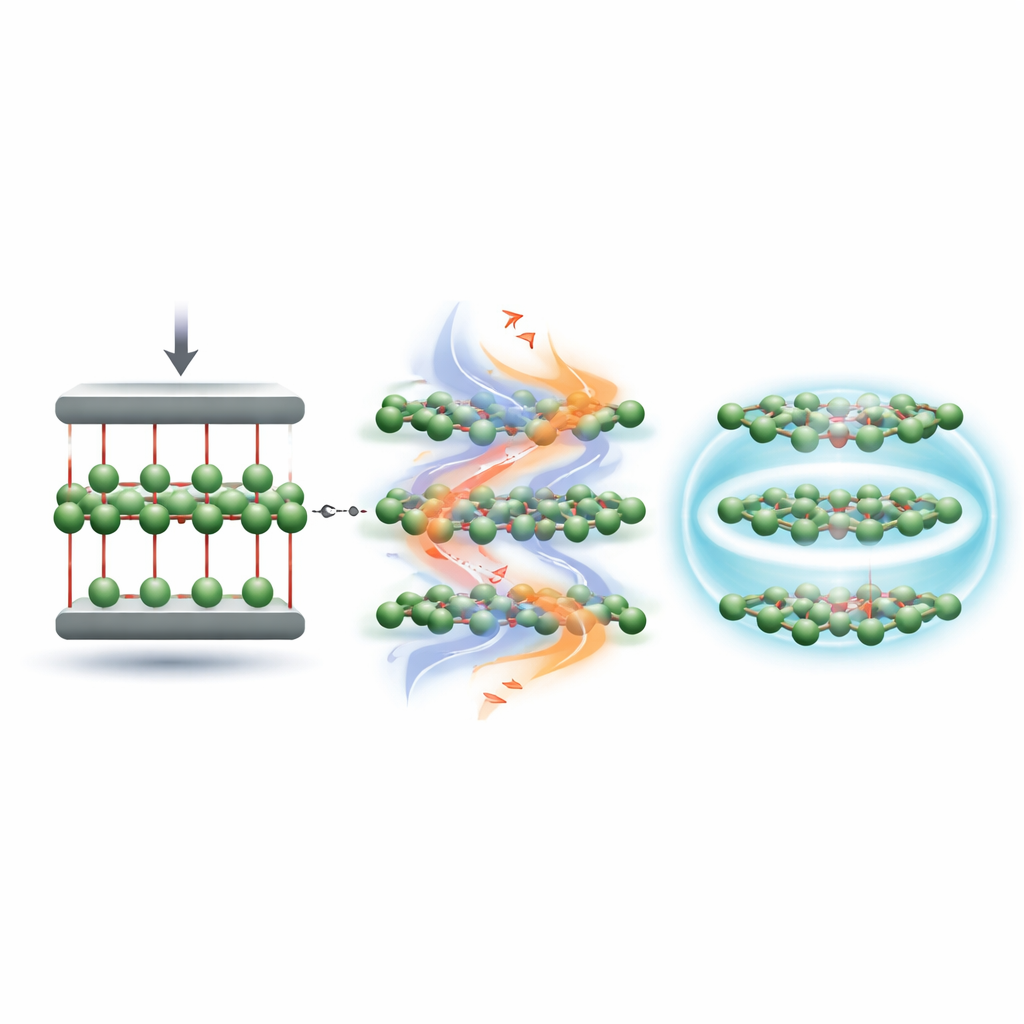
Superconductors that work at relatively high temperatures promise more efficient power grids, powerful magnets, and new electronic devices. A recently discovered material, a bilayer nickelate called La3Ni2O7, becomes superconducting at unusually high temperatures when squeezed under pressure or grown as thin films. Experiments also show that, before it turns superconducting, the electrons in this material arrange themselves into finely patterned charge and spin stripes. This paper explains how those patterns arise from the underlying electron motion and how they actually help, rather than hinder, the formation of superconductivity—even when the crystal contains many microscopic defects.
Striped patterns in a nickel-oxide sandwich
La3Ni2O7 is built from two closely spaced nickel-oxide layers stacked like a sandwich. Electrons move within each layer and also hop between them. Experiments have revealed two kinds of order in this material at ordinary (non-superconducting) temperatures. In a charge-density wave, electrons bunch up and thin out in a repeating pattern, forming a kind of standing wave of electric charge. In a spin-density wave, the tiny magnetic moments of electrons line up in stripes that alternate in direction. Intriguingly, in La3Ni2O7 these charge and spin stripes appear together and at similar temperatures, hinting that they share a common cause and may be tied to the later appearance of superconductivity.
How subtle electron interference makes stripes
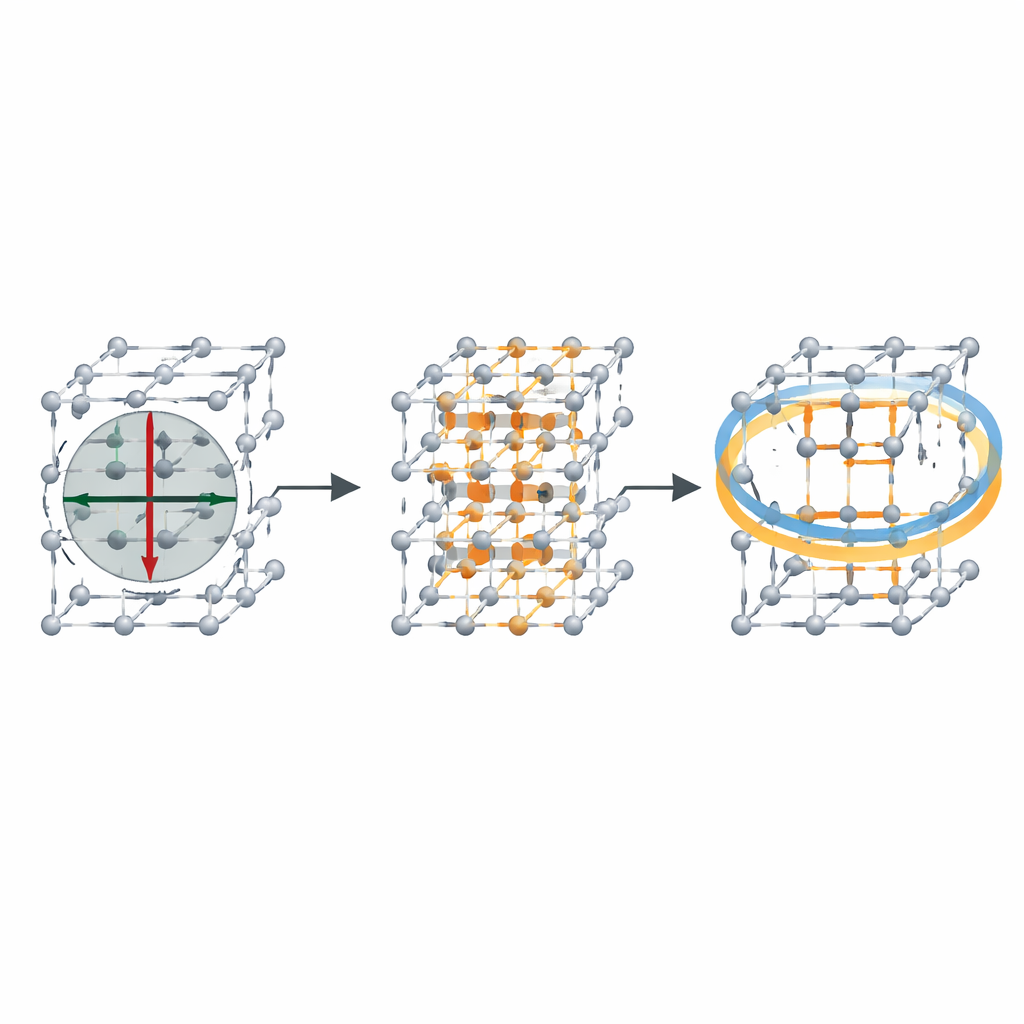
Simple theories, which treat electrons as mostly independent, struggle to produce strong charge patterns in this material. The authors tackle this by using a more advanced framework that keeps track of how electrons disturb one another in a collective way. They focus on a particular set of electron states built from a nickel orbital called dz2, which forms a small, nearly circular pocket of allowed energies. When electrons in this pocket are scattered back and forth along two perpendicular directions, the associated spin fluctuations can interfere with each other. This “paramagnon interference” naturally generates charge modulations at a diagonal wave pattern that matches the experimentally seen charge stripes. In the model, charge and spin waves strengthen together, explaining why their transition temperatures track each other so closely.
From stripes to strong pairing
The same collective fluctuations that create charge and spin stripes can also glue electrons into the pairs needed for superconductivity. The authors compute how both types of fluctuations contribute to the effective attraction between electrons on the different Fermi-surface pockets of the material. They find that when the charge pattern is strong, it boosts several possible superconducting states, and in particular favors an s-wave state in which the energy gap is largest on the dz2-derived pocket and smaller on the others. Although the mathematical description is intricate, the physical picture is simple: intertwined charge and spin waves in the bilayer nickel sheets provide a powerful pairing mechanism that can support high transition temperatures.
Why oxygen defects do not easily kill superconductivity
Real crystals of La3Ni2O7 are never perfect. They often contain missing oxygen atoms between the two nickel layers, which locally break the vertical bonds that help shape the electron states. Using a theory of impurity scattering, the authors test how such defects affect different possible superconducting states. They show that the s-wave state supported by the combined charge and spin fluctuations is unexpectedly robust: even when many inner oxygen atoms are missing, the calculated superconducting strength remains high, because these defects mainly disturb one subset of electron orbits without strongly mixing those that carry the largest energy gap. In contrast, a d-wave state, where the gap changes sign more frequently in space, would be rapidly weakened by the same defects.
Takeaway: a cooperative route to tough superconductivity
In summary, this work proposes a unified story for La3Ni2O7. The same electron interactions that drive strong spin fluctuations also, through interference, generate charge stripes in and between the two nickel layers. Those intertwined fluctuations in turn promote a particular kind of s-wave superconductivity that is both strong and unusually tolerant of oxygen vacancies. For a lay reader, the key message is that seemingly complex stripe patterns and atomic defects do not merely compete with superconductivity in this material—they help reveal and even stabilize a robust high-temperature superconducting state.
Citation: Inoue, D., Yamakawa, Y., Onari, S. et al. Unified mechanism of charge-density-wave and high-Tc superconductivity protected from oxygen vacancies in bilayer nickelates. Commun Phys 9, 115 (2026). https://doi.org/10.1038/s42005-026-02511-z
Keywords: nickelate superconductors, charge density waves, spin fluctuations, oxygen vacancies, high temperature superconductivity