Clear Sky Science · en
The detection of marine microseismic activity with the CUORE tonne-scale cryogenic experiment
Waves Beneath Our Feet
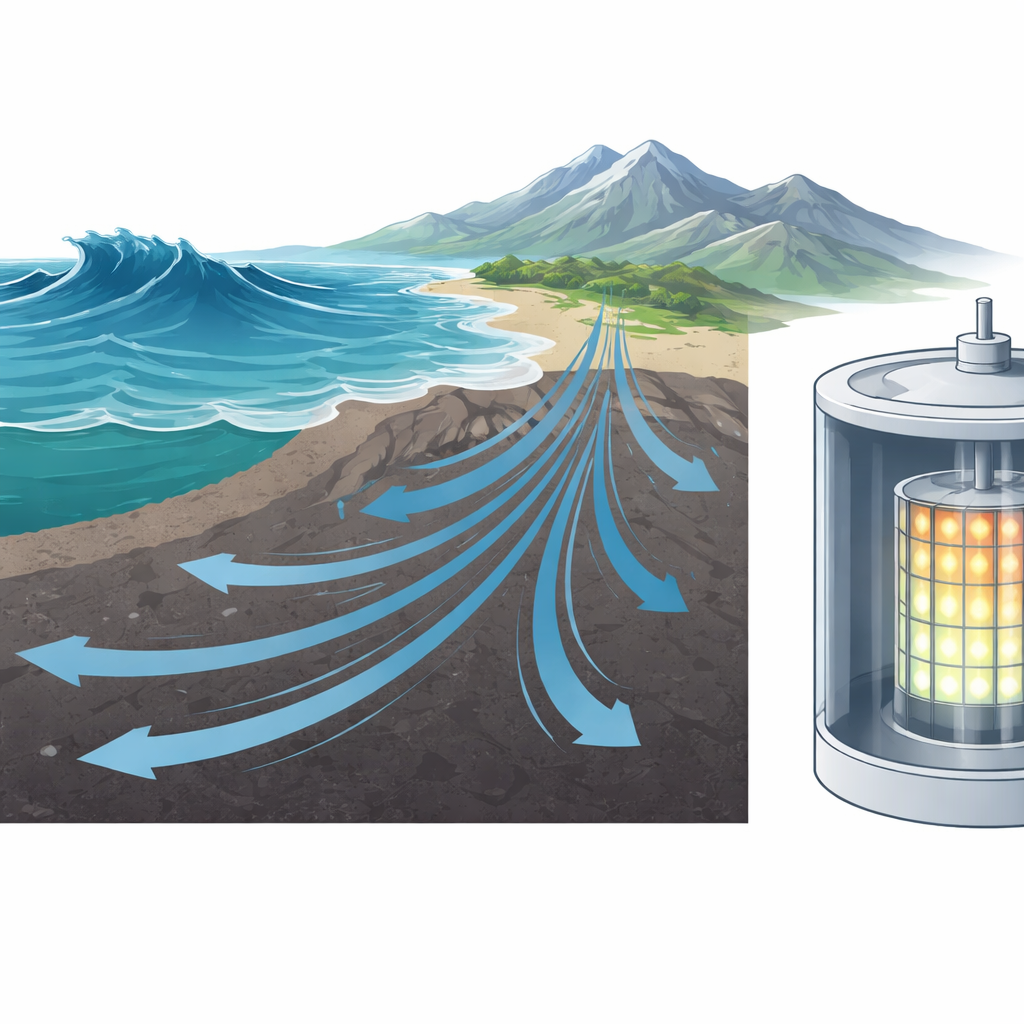
Deep under an Italian mountain, one of the world’s most sensitive experiments is listening for a whisper of new physics: a rare nuclear process called neutrinoless double beta decay. To reach this goal, the CUORE experiment cools nearly a thousand crystals to a few thousandths of a degree above absolute zero. At such extremes, even tiny disturbances matter. This paper reveals that gentle rocking of the Mediterranean Sea—hundreds of kilometers away—quietly shakes this underground detector, slightly blurring its vision, and shows how new noise-cancelling methods can win back some of that lost clarity.
Why Tiny Shakes Matter for Big Questions
CUORE uses “ultra-cold thermometers” called low-temperature calorimeters: when a particle deposits energy in a crystal, the crystal warms by a minuscule amount, and sensitive sensors convert that warmth into an electrical pulse. Because CUORE is hunting for incredibly rare events, it must distinguish real pulses from noise with exquisite precision. Any extra vibration—whether from the machinery that keeps it cold, human activity, or natural ground motion—adds unwanted wiggles to the signal. This work focuses on one particularly elusive culprit: marine microseisms, faint but persistent ground vibrations generated when ocean waves interact and push on the seafloor, then travel far inland.
From Sea Storms to Mountain Caverns
To trace the path from sea to sensor, the team combined three streams of data. First, they used satellite-based marine information from the Copernicus program, which tracks the height and strength of waves in the Adriatic and Tyrrhenian Seas. Second, seismometers installed in Italy’s underground Gran Sasso laboratory recorded how much the rock itself was shaking. Third, CUORE’s own detectors provided a measure of how noisy their temperature readings were. By lining up these records over several Mediterranean storms and over four years of operation, the researchers showed a clear chain: when sea waves grow during storms, ground motion underground increases, and CUORE’s noise and energy resolution get noticeably worse.
A Yearly Rhythm in the Detector’s Performance
Because the Mediterranean is stormier in winter than in summer, the sea’s restless rhythm leaves a seasonal fingerprint on CUORE. The authors found that in winter, when waves are higher and microseismic vibrations stronger, the detector’s ability to resolve energy becomes poorer and its minimum detectable energy rises. This directly affects two key performance measures: the “low-energy exposure” (how much detector mass can reliably see very small signals) and the sharpness of a reference gamma-ray line near the energy region where the sought-after decay would appear. Between summer and winter, the amount of detector mass meeting the strict low-energy requirement can drop by about one third to nearly one half, and the sharpness of the energy peak near the signal region can worsen enough to reduce CUORE’s sensitivity to neutrinoless double beta decay by more than 4 percent.
Listening to the Noise to Remove It
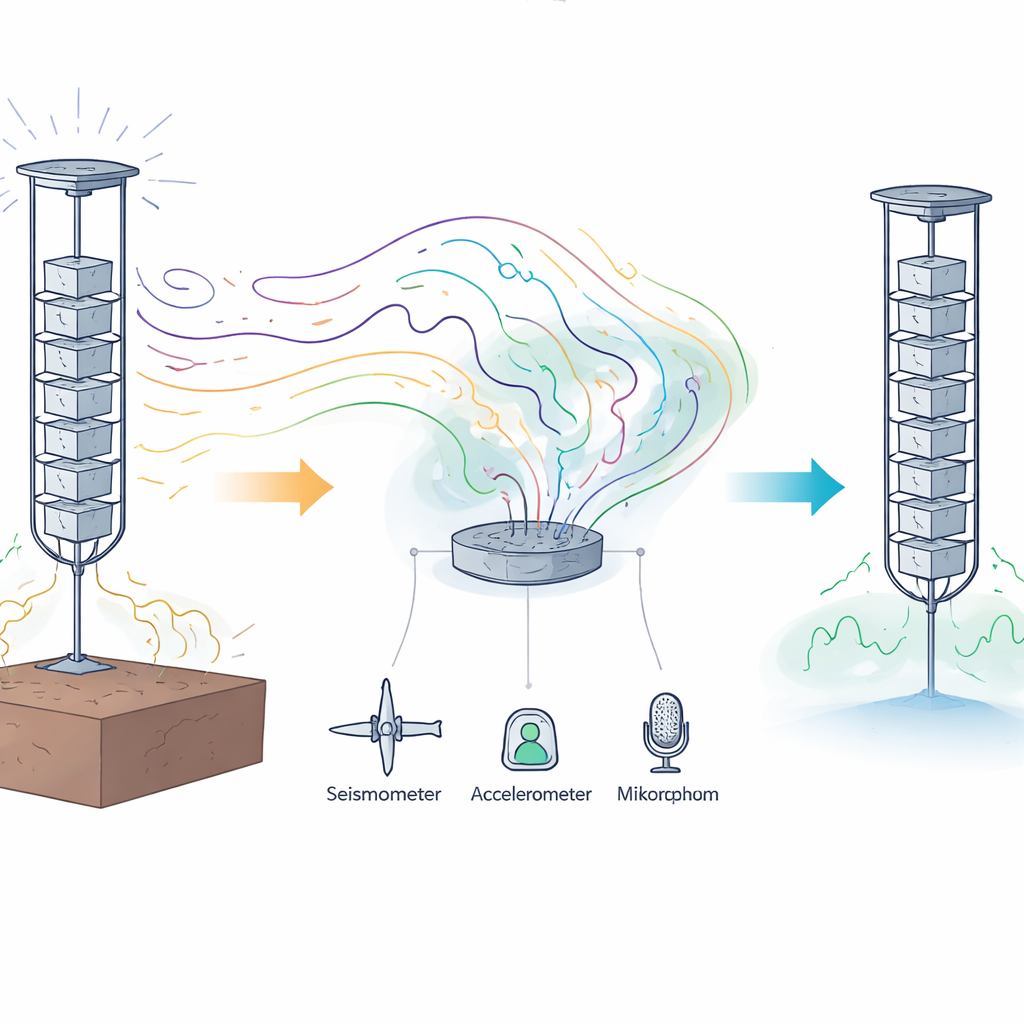
Rather than simply enduring this environmental background, the team turned it into a tool. Around the experiment, they installed additional sensors: seismometers, accelerometers, and microphones. These devices record how the experimental infrastructure responds to vibrations across a wide range of frequencies. The researchers developed a denoising algorithm that learns, from stretches of data containing only noise, how the vibrations picked up by these auxiliary sensors translate into noise in each calorimeter. It then predicts the noise waveform and subtracts it from the real detector signal. Applied across the full detector array over a test period, this method reduced the overall noise power by about three quarters and improved the intrinsic stability of most channels, lowering their effective detection thresholds.
Sharpening the View of Rare Events
For a non-specialist, the core message is that CUORE is now so sensitive that distant storms at sea measurably disturb its search for new physics. The study shows that these tiny tremors not only limit how clearly the experiment can see, but also change that clarity with the seasons, slightly weakening the chances of spotting an ultra-rare decay. At the same time, the work demonstrates that smart use of extra sensors and advanced noise-cancellation can substantially quiet these effects. These insights will guide the design of future, even more sensitive experiments that aim to uncover the nature of neutrinos, dark matter, and other rare phenomena—proving that understanding and taming environmental noise is as important as building bigger and colder detectors.
Citation: Adams, D.Q., Alduino, C., Alfonso, K. et al. The detection of marine microseismic activity with the CUORE tonne-scale cryogenic experiment. Commun Phys 9, 121 (2026). https://doi.org/10.1038/s42005-025-02484-5
Keywords: neutrinoless double beta decay, cryogenic detectors, seismic noise, CUORE experiment, Mediterranean Sea waves