Clear Sky Science · en
Postselection-free experimental observation of the measurement-induced phase transition in circuits with universal gates
Watching Quantum Information Change Its Mind
Modern quantum computers promise huge leaps in computing power, but they are extraordinarily sensitive to measurement and noise. This paper explores a strange kind of “phase change” in how quantum information spreads and then suddenly collapses when you watch it too often. The authors not only describe this transition in theory but also show how to observe it cleanly on today’s hardware, without the heroic data filtering that has held back previous experiments.
Two Competing Behaviors in the Quantum World
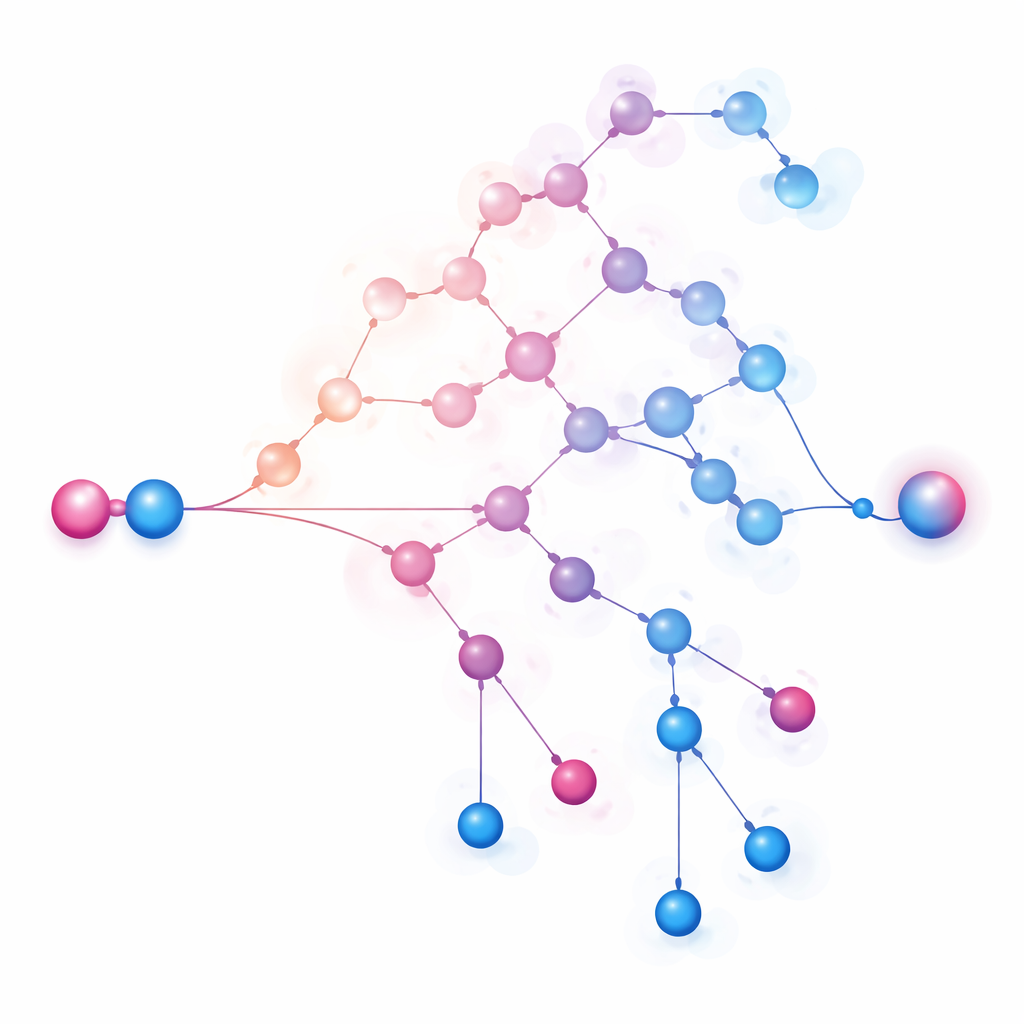
When many qubits evolve together, they typically become highly entangled: information about any one qubit is smeared out across the whole device. But if you repeatedly measure qubits while they evolve, those measurements tend to collapse the quantum state and erase entanglement. Recent theory predicts a tug-of-war between these two tendencies. At low measurement rates, the system ends up in an “entangling phase,” where information is spread nonlocally. Above a certain point, it flips into a “disentangling phase,” where measurements dominate and the system’s state becomes almost perfectly known. This sharp change in behavior is called a measurement-induced phase transition.
Why Postselection Was a Roadblock
Detecting this transition in the lab has been notoriously difficult. The most direct signatures involve nonlinear quantities such as entanglement entropy or purity, which depend on the full quantum state, not just simple averages of measurement outcomes. To estimate those properties, one usually has to “postselect” on runs of the experiment that share a specific string of mid-circuit measurement results. Because those results are random, the number of required runs blows up exponentially with system size. Experiments have either accepted this costly overhead, stayed with very small systems, or limited themselves to special sets of gates that are easier to simulate on a classical computer.
Tree-Shaped Circuits as a Clever Shortcut
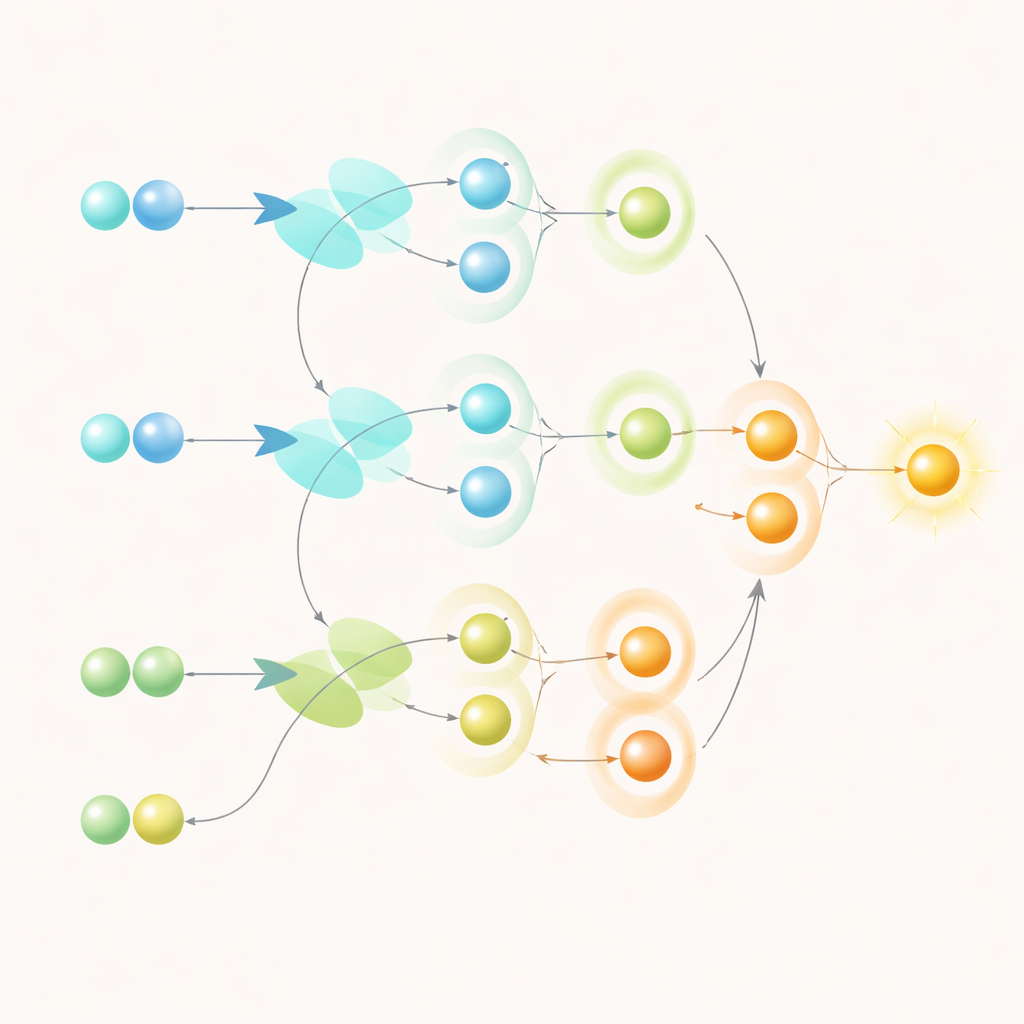
The authors escape this bottleneck by changing the layout of the quantum circuit. Instead of arranging qubits on a line or grid, they use a tree structure: starting from a single “root” qubit (initially entangled with a probe), they repeatedly add fresh qubits and entangle them in a branching pattern. After each entangling step, they perform gentle, or “weak,” measurements on the qubits. The strength of these measurements can be tuned continuously from very weak (hardly disturbing the state) to effectively projective (strong, fully collapsing measurements). Crucially, the tree’s recursive structure allows them to process all the recorded measurement outcomes with a classical algorithm whose cost grows only linearly with the number of qubits, instead of exponentially.
Following a Single Qubit Through the Forest
Rather than reconstructing the full many-qubit state, the authors track how much uncertainty remains about one special qubit that starts out entangled with the rest. In the tree picture, this can be phrased as how well one can predict the initial state of the root qubit just from the record of all weak measurements inside the circuit. If prediction remains imperfect even for very deep trees, the system is in the entangling phase. If, beyond some measurement strength, the root’s state can essentially be reconstructed, the system has entered the disentangling, or “purified,” phase. The team defines a simple numerical quantity that captures this predictability and shows that it behaves just like a standard order parameter in more familiar phase transitions, turning from nonzero to effectively zero at a critical measurement strength.
From Theory to a Working Quantum Device
The researchers implement their tree-circuit protocol on Quantinuum’s H1-1 trapped-ion quantum computer, using up to four layers of the tree. They choose generic, randomly drawn single-qubit gates—so the dynamics are not artificially simplified—and weak measurements implemented with the machine’s native interactions. With a modest number of random circuits and repeated shots, they estimate the order parameter for different tree depths and measurement strengths. Their data closely follow detailed theoretical predictions and large-scale classical simulations, all without any error mitigation, demonstrating that the transition can be cleanly resolved in present-day noisy devices.
What This Means for Future Quantum Technologies
To a non-specialist, the key message is that there are two distinct regimes of how information behaves in monitored quantum systems: one where it stays spread out and hard to access, and another where continual measurement makes it crisp and local. This work shows that the boundary between those regimes—the measurement-induced phase transition—can be observed experimentally without excessive data filtering or restricted gate sets, provided one uses a tree-like circuit architecture and the right decoding strategy. That makes tree-based models powerful testbeds for understanding how measurement, noise, and information flow will shape the performance and design of tomorrow’s quantum technologies.
Citation: Feng, X., Côté, J., Kourtis, S. et al. Postselection-free experimental observation of the measurement-induced phase transition in circuits with universal gates. Commun Phys 9, 110 (2026). https://doi.org/10.1038/s42005-025-02443-0
Keywords: measurement-induced phase transition, quantum circuits, entanglement, trapped-ion quantum computer, quantum error correction