Clear Sky Science · en
RAFT enables controlled radical ring-opening polymerisation of cyclic ketene acetals for degradable nanoparticles
Why this research matters for everyday life
Plastics are everywhere in modern life, from cosmetics and food packaging to drug delivery systems in medicine. The problem is that most of them linger in the environment for decades or longer. This study explores a new way to make tiny plastic-like particles that are precisely built yet fully break down into small, simple molecules. That combination—high performance while in use, followed by complete disappearance when no longer needed—is exactly what future sustainable materials will require.
Building smarter break-apart plastics
The work focuses on a special family of molecules that can join together into chains while quietly inserting fragile links that nature can later cut. These starting molecules, called cyclic ketene acetals, form polyester-like materials that enzymes can degrade. Until now, chemists faced a trade-off: they could either make these chains in a simple, uncontrolled way that gave fully biodegradable products but messy structures, or they could mix them with conventional ingredients to gain precision at the cost of only partial breakdown. This paper shows how to avoid that compromise by using only the degradable building blocks, yet still steering the chain-building process with high precision.
A gentler steering wheel for chain growth
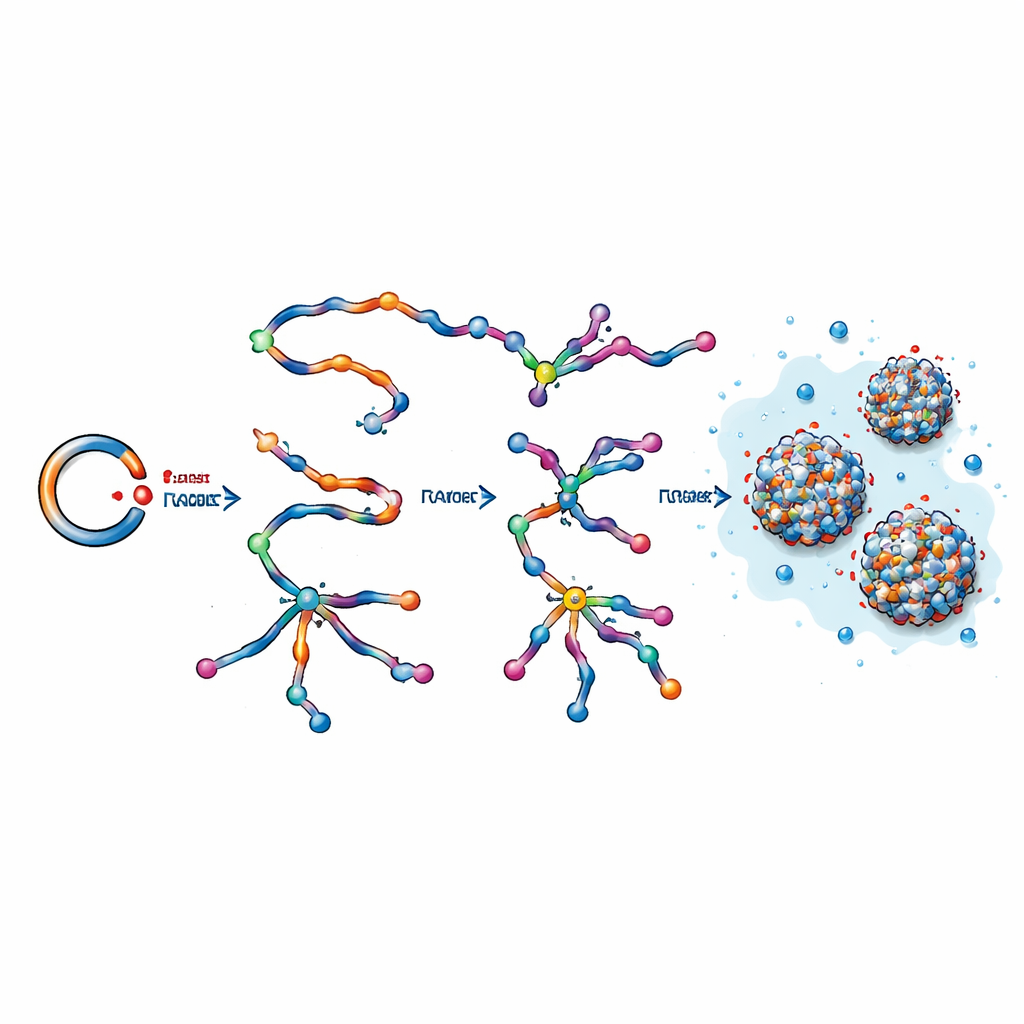
The authors adapt a technique known as RAFT, a kind of built-in traffic control for growing polymer chains. In a typical radical process, highly reactive chain ends behave like impatient drivers, starting and stopping unpredictably and creating a jumble of chain lengths and branches. RAFT introduces a helper molecule that temporarily parks these active ends and then releases them again, keeping growth orderly. The study identifies a particular helper that works under mild conditions and does not require metal catalysts, which is important for future biomedical and cosmetic uses. By carefully tuning how much of this helper and how much initiator they add, the team shows that they can predetermine the average chain length, keep the spread of sizes narrow, and preserve the special chemical handle at the chain end needed for later upgrades.
Designing the internal architecture
Because the underlying chemistry still uses very reactive chain ends, some branching—side arms coming off the main chain—is unavoidable. Rather than fighting this, the researchers measure and map it. They find that the density of branches grows in a predictable, almost linear way as the chains extend. That means branching, which strongly influences how thick a material feels or how it packs into particles, can itself be treated as a design parameter. The team uses advanced solution measurements and nuclear magnetic resonance methods to confirm both the presence of the helper fragment on the chains and the progression from short side arms to longer ones as the reaction proceeds. In short, they turn what was previously a nuisance side effect into a controlled feature of the material’s architecture.
From precision chains to tiny carriers
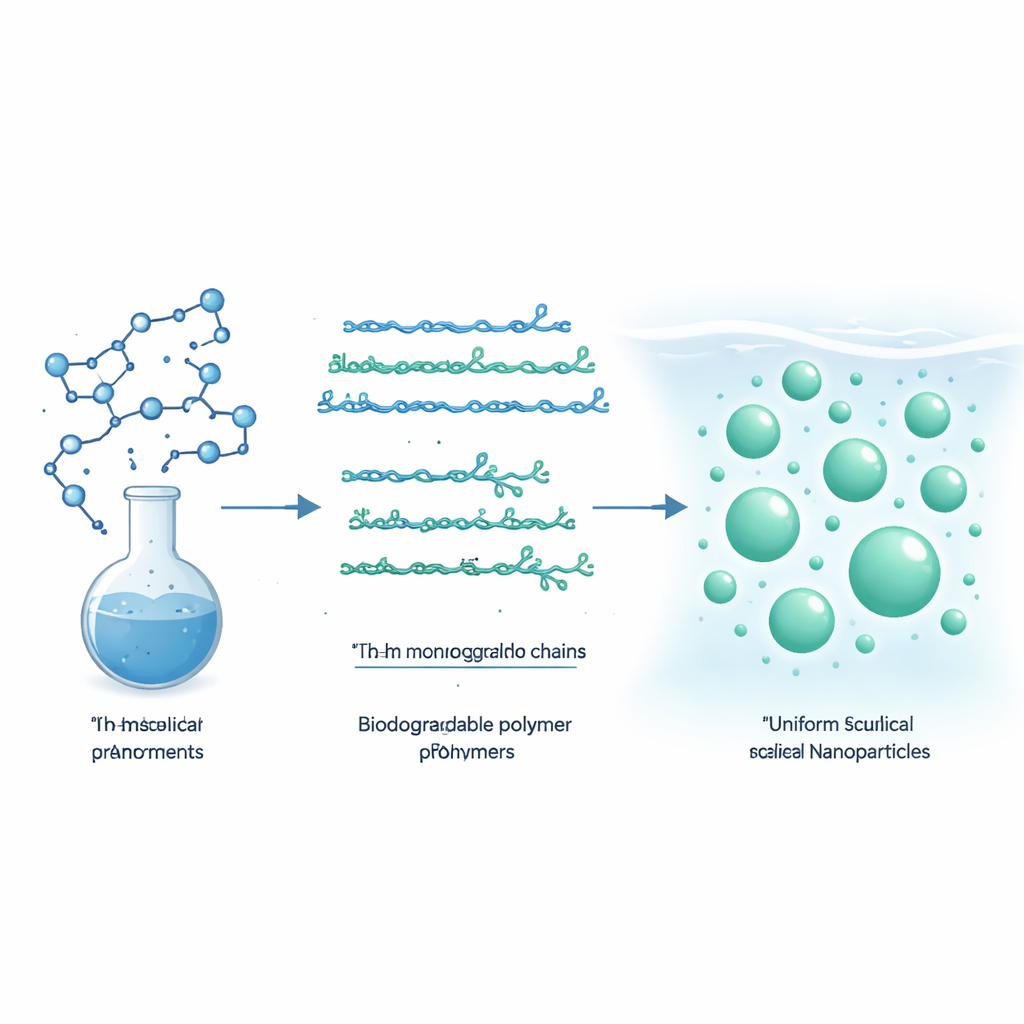
With well-behaved chains in hand, the authors take a crucial next step: building block copolymers, where one degradable block is joined to another with slightly different behavior. They extend their first block made from one monomer into either a second block of the same type or a block made from a related ring. Dropping solutions of these block-like molecules into water makes them spontaneously assemble into uniform spherical nanoparticles. These particles, around 200 billionths of a meter across, are ideal candidates for carrying dyes or drugs inside the body. When the team loads them with a fluorescent dye and adds a natural enzyme that cuts ester bonds, the dye signal fades as the particles fall apart, confirming that the entire structure ultimately breaks down.
Tuning how fast things fall apart
An intriguing twist is that changing the second block lets the researchers nudge how quickly the particles degrade. One block type forms tiny semi-ordered regions that slow the cutting action of enzymes, leading to slightly longer-lived particles compared with those built from two identical blocks. Even though the difference is modest, it demonstrates that lifetime and release rate can be adjusted simply by swapping or redesigning blocks, all while keeping the overall system fully degradable. This kind of control opens the door to tailoring nanoparticles for specific roles, such as delivering drugs over a chosen time window or acting as temporary sensors that vanish after doing their job.
What this means for future materials
To a non-specialist, the key message is that the authors have shown how to make “smart” plastics that are both carefully engineered and completely biodegradable, without mixing in permanent components. Their method offers control at many levels: chain length, internal branching, block structure, particle size, and even degradation speed. Because it relies on mild conditions and metal-free helpers, it is well suited for applications in medicine, personal care, and environmentally sensitive products. This approach brings us closer to a future in which high-performance polymer-based technologies can be designed to work precisely when and where we need them—and then quietly and safely disappear.
Citation: Mehner, F., Bukane, A.R., Keddie, D.J. et al. RAFT enables controlled radical ring-opening polymerisation of cyclic ketene acetals for degradable nanoparticles. Commun Chem 9, 156 (2026). https://doi.org/10.1038/s42004-026-01997-6
Keywords: biodegradable polymers, polymer nanoparticles, ring-opening polymerization, controlled radical polymerization, drug delivery materials