Clear Sky Science · en
Hydrogen evolution electrocatalysts in high-fold degenerate topological semimetals with chiral structures
Why better hydrogen matters
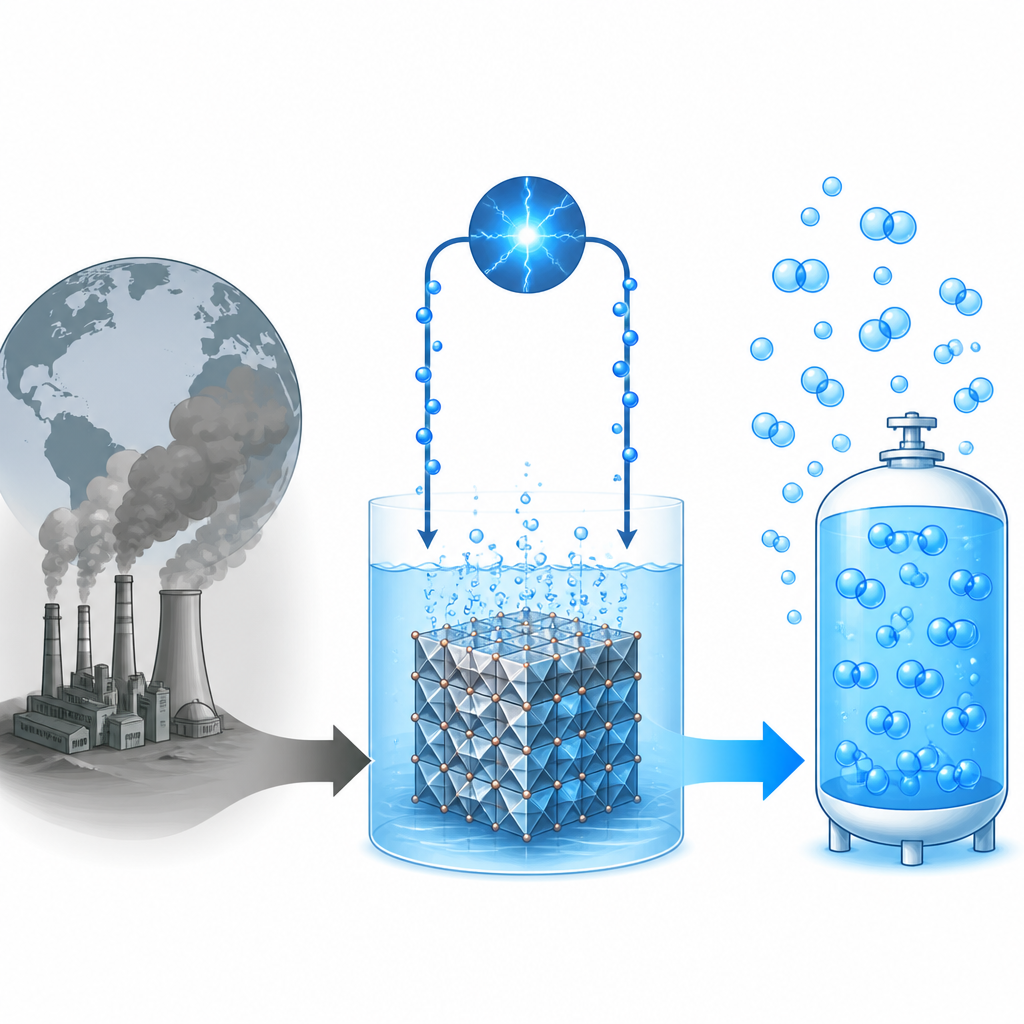
Hydrogen fuel is often hailed as a clean alternative to fossil fuels, but making hydrogen efficiently is still a challenge. Splitting water into hydrogen and oxygen takes a lot of electricity, so scientists are searching for catalyst materials that can help do the job faster and with less energy. This study explores a new family of exotic crystalline metals that can outperform platinum, the current gold standard for driving the hydrogen producing half of water splitting, and even points to cheaper options that could make green hydrogen more practical at large scale.
Special crystals with a twist
The materials at the heart of this work are called topological semimetals, a class of crystals whose electrons move in unusual ways on their surfaces. Some of these crystals have chiral structures, meaning their atomic arrangement is twisted in a left handed or right handed sense rather like a screw. In such crystals, the surface electrons follow protected pathways that are hard to disrupt, allowing them to move quickly and steadily. The researchers focused on a subgroup known as high fold degenerate topological semimetals, where several electronic energy levels meet at a point, creating a broad energy window for these special surface states. Earlier work hinted that these materials could be excellent helpers for hydrogen production from water, and this study set out to systematically test that idea.
Screening a library of candidate catalysts
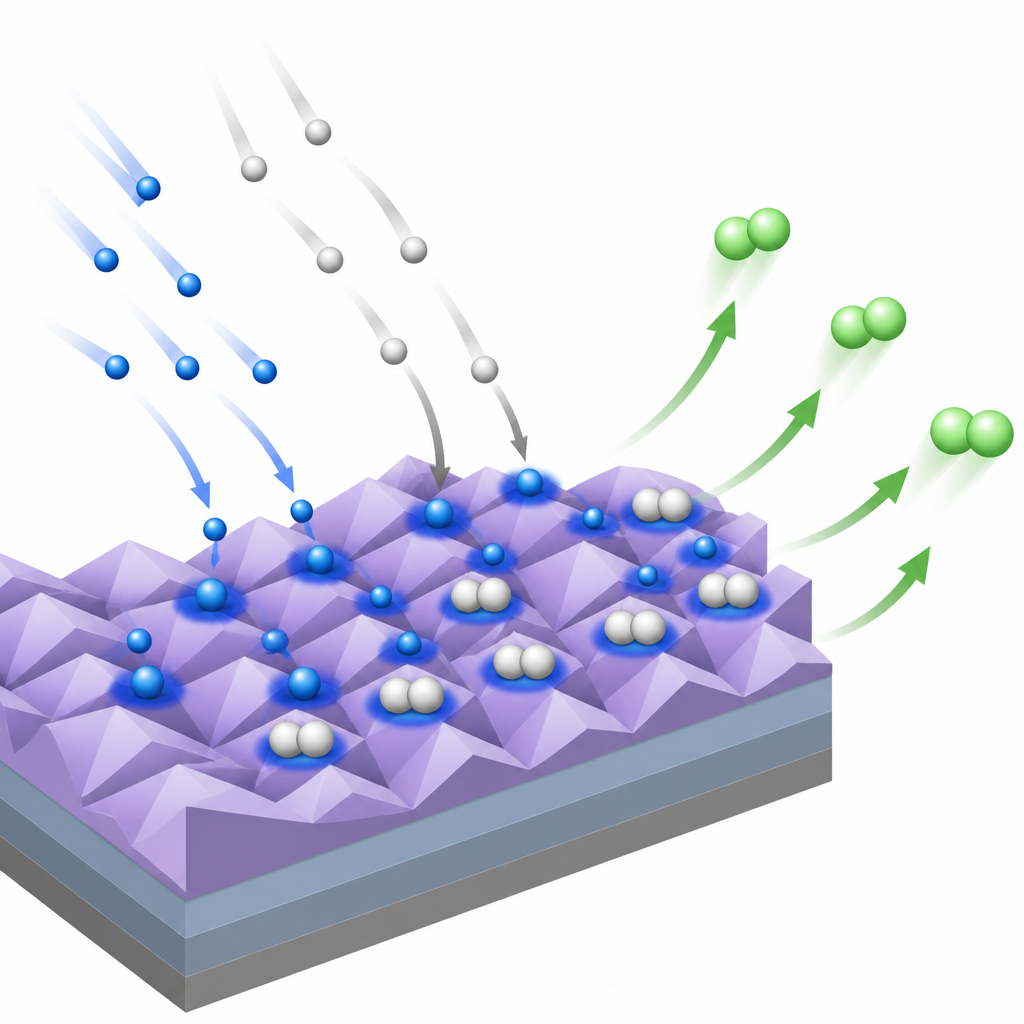
Using computer simulations based on quantum mechanics, the team examined 47 such crystals drawn from a larger database they had previously built. All share the same basic symmetry as a well studied material called CoSi, but differ in which elements occupy the atomic sites. The key quantity they calculated is the Gibbs free energy of hydrogen adsorption, which measures how strongly a hydrogen atom sticks to the catalyst surface. For a good hydrogen evolution catalyst, this value should be close to zero, meaning hydrogen binds strongly enough to form but not so strongly that it cannot leave as gas. By building detailed models of different crystal surfaces and testing many possible binding sites for hydrogen, the authors identified the most favorable adsorption spot for each material and then compared their performance to platinum.
Sixteen standouts and a few stars
The screening revealed 16 top performing catalysts whose calculated hydrogen binding strength is even closer to ideal than that of platinum. Among them, three compounds PtGa, PtPbTe, and Pd3Pb2S2 emerged as especially promising representatives of different structural types. Many of the best performers contain precious metals such as platinum and palladium, whose d orbitals play a strong role in binding hydrogen at specific surface atoms. However, the study also identified five effective catalysts that do not rely on expensive elements, including CoSi, CoGe, TcSi, NiSi, and NiPS. This mix of precious metal based and cheaper options suggests that the same design rules could guide both high performance and low cost solutions.
How unusual surface electrons boost the reaction
Beyond listing good candidates, the authors wanted to understand why these materials work so well. They compared different surfaces of the same crystal, some that host topological surface states and others that do not. In the case of CoSi, for example, one surface shows long, arc like pathways of surface electrons, while another surface lacks these features. Calculations show that hydrogen binds closer to the ideal strength on the surface with these special electron paths than on the surface without them. Similar analysis of Pt and Pd based crystals indicates that when the topological surface states are mainly formed from the orbitals of these metals, they supply highly mobile electrons that readily flow to adsorbed hydrogen, making it easier for hydrogen molecules to form and depart.
What this means for future clean fuel
In simple terms, this work shows that carefully engineered crystals with twisted, topological surfaces can act as very efficient helpers for making hydrogen from water, sometimes even edging out platinum. By proving that surfaces with special electron pathways consistently outperform those without, the study offers a clear strategy for designing better catalysts: turn known metal catalysts into topological semimetals so their surfaces can deliver electrons more effectively. This approach not only expands the list of promising hydrogen evolution materials, including some that avoid costly precious metals, but also hints that similar principles could guide the design of catalysts for other important reactions involved in clean energy and carbon management.
Citation: Wang, Y., Yu, H., Xu, Q. et al. Hydrogen evolution electrocatalysts in high-fold degenerate topological semimetals with chiral structures. Commun Chem 9, 184 (2026). https://doi.org/10.1038/s42004-026-01985-w
Keywords: hydrogen evolution, electrocatalysts, topological semimetals, chiral crystals, water splitting