Clear Sky Science · en
Stereoelectronic and hydrogen-bonding effects on hydroxyproline conformation
Why a tiny twist in collagen matters
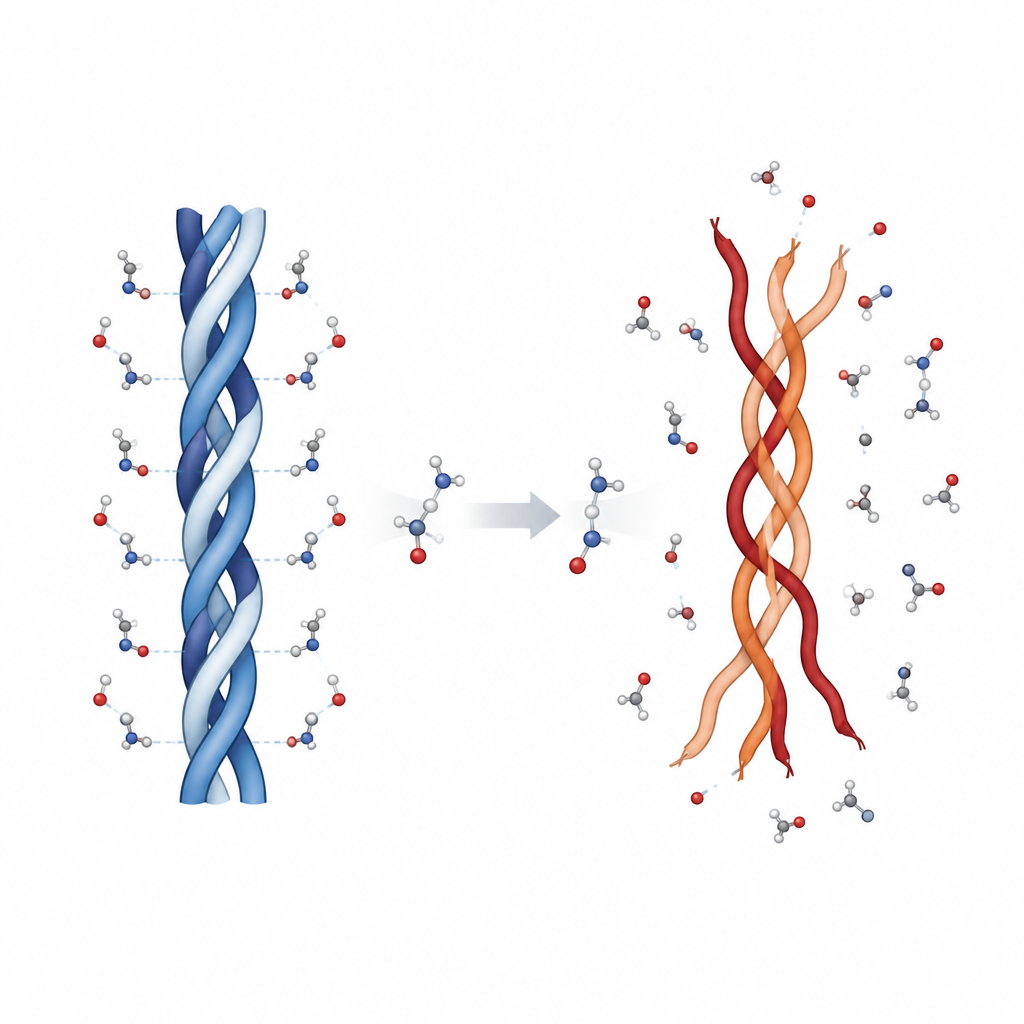
Collagen is the protein that gives our skin firmness, our tendons strength, and our bones resilience. Its power comes from long, rope-like molecules that twist together into sturdy triple helices. This study asks a surprisingly simple question with big consequences: how can flipping the three-dimensional arrangement of just one small group on one amino acid so dramatically weaken collagen’s famous strength?
A closer look at collagen’s special building block
Within collagen’s repeating chain of amino acids, one uncommon building block, called hydroxyproline, is crucial for keeping the triple helix tightly wound. Nature almost always uses one version, named 4R-hydroxyproline, and when this is replaced by its mirror-like cousin, 4S-hydroxyproline, the triple helix can fall apart, even at room temperature. Earlier work mainly blamed subtle electronic preferences inside the molecule for this difference, but this paper tests whether that explanation is really enough, or whether other forces, such as hydrogen bonds, play a larger and more direct role.
Model molecules in a collagen-like setting
To isolate the local behavior of hydroxyproline, the researchers did not work with full collagen fibers. Instead, they studied two small, well-defined versions of the amino acid, each carrying either the 4R or 4S form, in a solvent that mimics collagen’s relatively dry, crowded surroundings. Using infrared and two-dimensional infrared spectroscopy, which sense how chemical bonds vibrate, together with quantum chemistry calculations, they mapped out how these molecules twist, bend, and interact. These methods reveal which shapes are preferred and how nearby groups attract or repel each other at the scale of individual bonds.
When weak electronic effects are not the whole story
The team confirmed that subtle electronic forces do nudge the molecules toward certain shapes. In both versions, a weak interaction known as an n to pi star effect slightly favors an arrangement in which neighboring carbonyl groups line up in a particular way. However, in solution this influence was modest, leading to only a small excess of the favored shape. This outcome contrasts with earlier assumptions that such effects alone could explain why one hydroxyproline variant stabilizes collagen while the other does not, suggesting that scientists needed to look beyond electronics to the way atoms share hydrogen atoms.
Hydrogen bonds decide who folds and who mingles
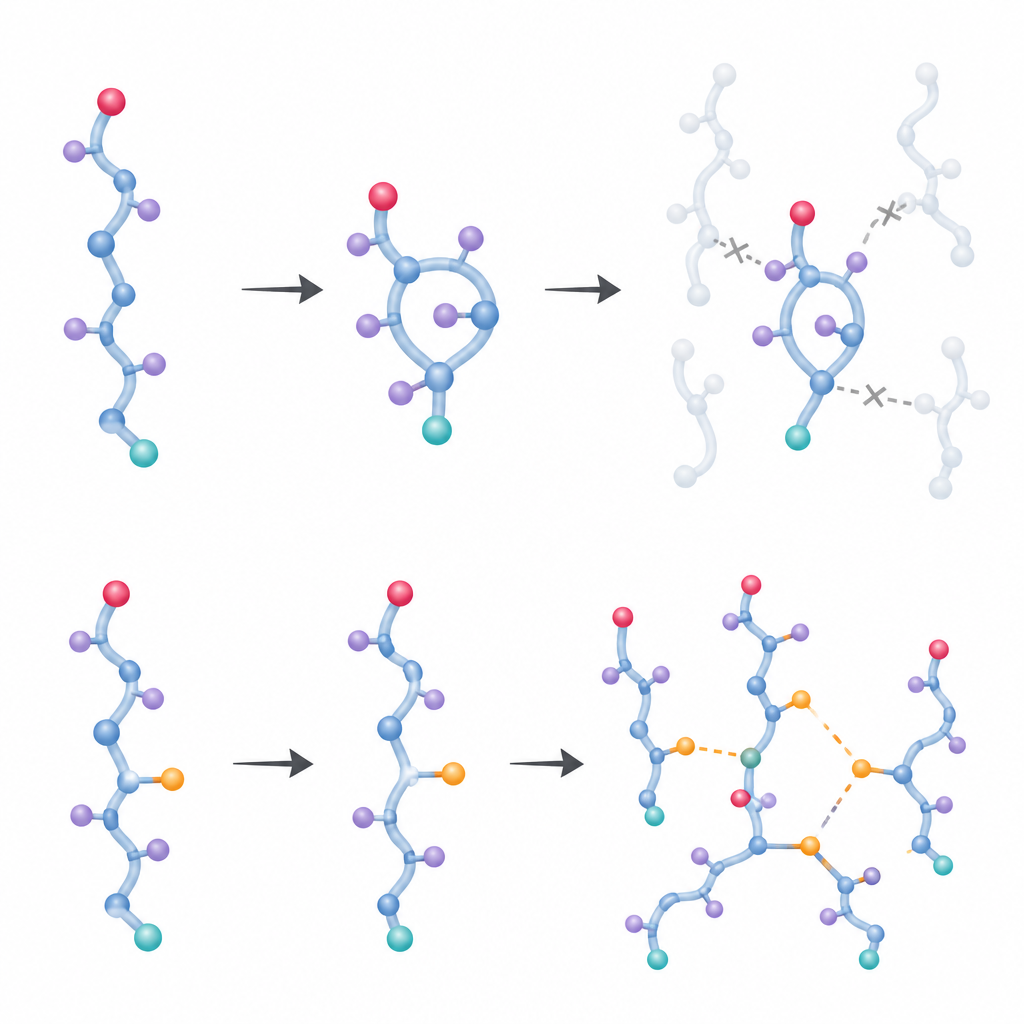
The most striking difference between the two variants lay in how they formed hydrogen bonds. In the 4S version, the hydroxyl group can reach back and form a strong internal hydrogen bond within the same molecule, locking it into a particular ring shape and orientation. In the 4R version, that same group points outward instead, making it difficult to form such an internal link. As a result, 4R molecules tended to seek partners outside themselves, forming hydrogen bonds with neighboring molecules and gradually clustering together. Measurements of vibrational peaks tied to hydrogen-bonded and free hydroxyl groups showed that 4R molecules increasingly aggregated with concentration, while 4S molecules remained mostly stabilized from within.
What this means for collagen strength
To a lay observer, the key message is that the stability of collagen’s triple helix does not arise from exotic quantum effects alone but from a competition between subtle electronics and straightforward hydrogen bonding. The natural 4R form of hydroxyproline prefers to expose its hydroxyl group to the surroundings, encouraging contacts with water and nearby chains that help organize and assemble collagen. The 4S form, in contrast, hides this group in an internal bond and alters how the local structure bends, which undermines the larger helix. By dissecting these behaviors at the level of a single residue, the study shows that where a simple hydrogen bond points can decide whether the body’s main structural protein holds firm or starts to unravel.
Citation: Matsumura, F., Gómez Argudo, P., Bonn, M. et al. Stereoelectronic and hydrogen-bonding effects on hydroxyproline conformation. Commun Chem 9, 179 (2026). https://doi.org/10.1038/s42004-026-01984-x
Keywords: collagen, hydroxyproline, hydrogen bonding, protein stability, infrared spectroscopy