Clear Sky Science · en
Synthesis of tetrahydroisoquinoline-fused polycyclic heterocyclic skeletons via Vilsmeier-reagent promoted decarbonylative annulation
Why new chemical building blocks matter
Many medicines and natural compounds share a common ring-shaped backbone known as a tetrahydroisoquinoline scaffold. These shapes help drugs fit snugly into their biological targets, much like a key fitting a lock. However, building more elaborate versions of these structures in the lab often requires hot, harsh, and complex reactions. This study introduces a gentler, metal-free way to snap together densely fused ring systems that could feed the discovery of future cancer treatments and other therapies.
Turning simple pieces into complex ring systems
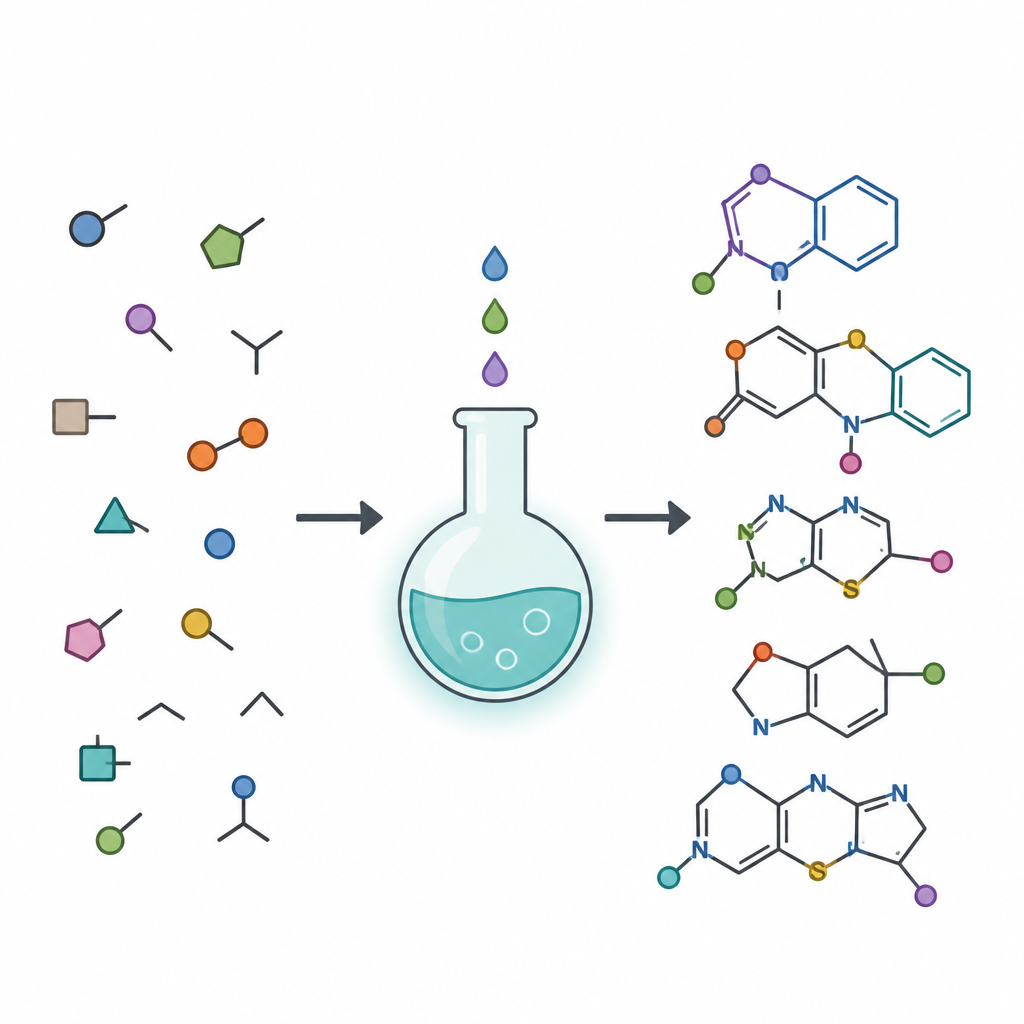
The researchers focused on a family of molecules where a tetrahydroisoquinoline unit is fused to one or more additional rings. Such architectures appear in antibiotics, anti-cancer agents, and compounds that act on the brain. Despite their importance, chemists have had only a few practical routes to assemble the more complex six- and seven-membered fused rings of this type. Existing methods can be slow, require high temperatures, rely on expensive metal catalysts, or only work with a narrow range of starting materials. These limitations make it harder to explore chemical space around promising drug leads.
A gentle, one-step ring-forming reaction
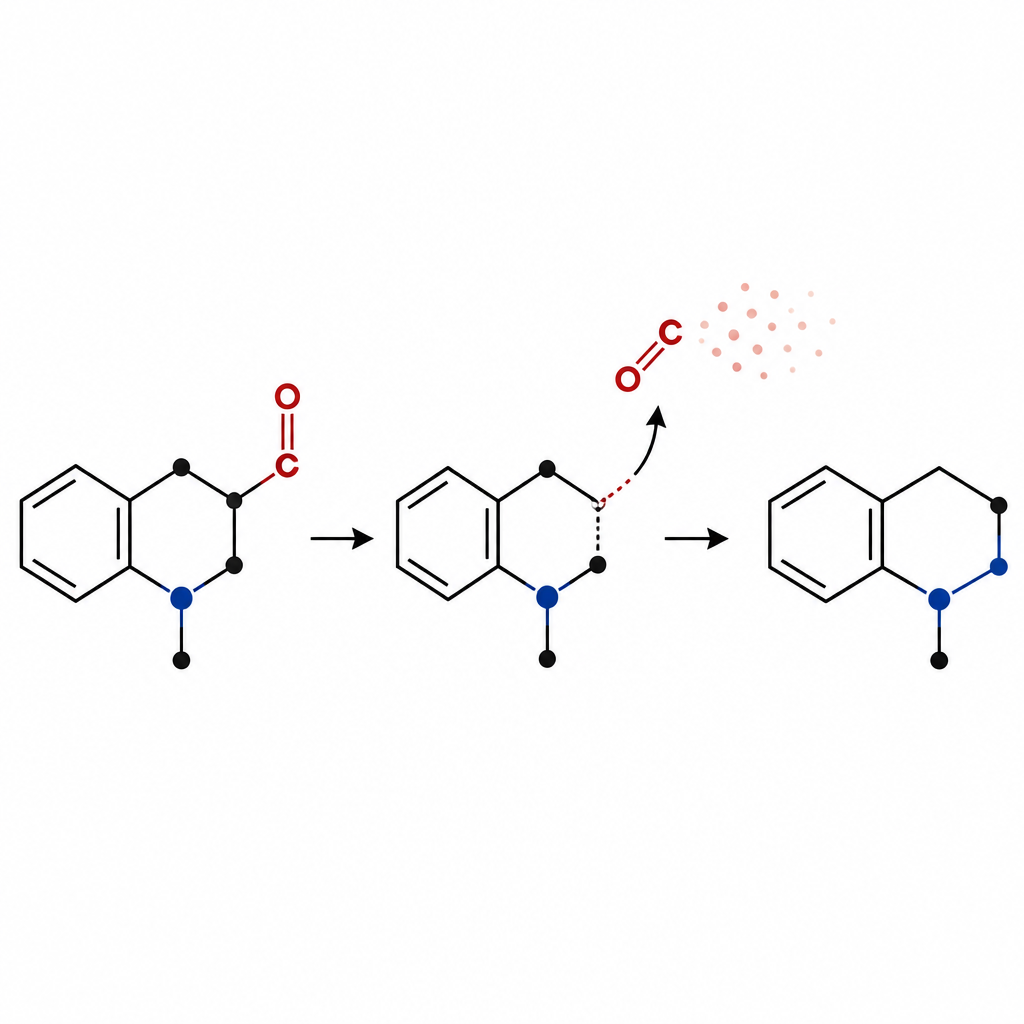
In this work, the team devised a one-step reaction that joins parts of a starting molecule into a new ring while clipping off a small carbon-based fragment as gas. The key helper is the Vilsmeier reagent, a well-known laboratory chemical usually used for a different type of transformation. By combining this reagent with tetrahydroisoquinoline carboxylic acids in a common solvent at temperatures around room level, the scientists triggered a “decarbonylative annulation” process. In plain terms, the reaction removes a carbon-containing group and, at the same time, closes a new ring, creating a tightly fused, three-dimensional structure in a single operation.
A broad menu of starting materials
After finding the best conditions, the researchers tested how many different starting molecules would work. They altered both the tetrahydroisoquinoline portion and the attached ring fragments, swapping in groups that donate or withdraw electrons, as well as changing ring sizes and shapes. The reaction tolerated methyl, methoxy, halogen, ester, and other common groups, and it even worked when the aromatic ring was replaced by a sulfur-containing ring. In many cases, the desired products formed in moderate to high yields. The same strategy could be adapted to build not only seven-membered fused rings, but also six-membered versions by exchanging an indole unit for a phenol unit in the starting material. This broad scope suggests that chemists can quickly generate libraries of related structures for biological testing.
Peeking under the hood of the reaction
To understand how the process unfolds, the team carried out control experiments and used advanced tools to glimpse short-lived intermediates. They showed that the carboxyl group in the starting material is expelled as carbon monoxide gas, and that a reactive intermediate then folds back on itself to close the new ring. The researchers confirmed the structures of key products using X-ray crystallography, which provides a detailed three-dimensional map of the atoms. Together, these studies revealed that the path taken by the reaction differs from more familiar metal-driven or light-driven ways of removing carbon-based groups, highlighting a new mode of reactivity for the Vilsmeier reagent.
First signs of activity against cancer cells
To test whether these newly built ring systems might be useful as drug starting points, the authors screened selected compounds against human cancer cell lines. Several of the fused structures, especially those containing a simple sulfur-bearing ring, strongly slowed the growth of breast cancer cells in dishes, with some also affecting cervical and colon cancer cells at low micromolar concentrations. Early structure–activity comparisons hinted that small changes to the ring system can either preserve or greatly reduce this effect, offering clues for future optimization. While far from ready as medicines, these molecules give researchers fresh shapes to refine in the search for more effective anticancer agents.
A new shortcut to complex drug-like shapes
Overall, this study introduces a straightforward, room-temperature way to turn readily available starting materials into intricate, fused tetrahydroisoquinoline frameworks without using metal catalysts. The reaction’s tolerance for many different add-on groups, together with its ability to form both six- and seven-membered fused rings, opens up a flexible route to novel, drug-like structures. The early signs of anticancer activity suggest that these new building blocks could serve as useful starting points for designing and fine-tuning future therapies.
Citation: Yan, M., Mukatay, U., Shen, H. et al. Synthesis of tetrahydroisoquinoline-fused polycyclic heterocyclic skeletons via Vilsmeier-reagent promoted decarbonylative annulation. Commun Chem 9, 185 (2026). https://doi.org/10.1038/s42004-026-01982-z
Keywords: tetrahydroisoquinoline, heterocyclic synthesis, decarbonylative annulation, metal-free chemistry, anticancer compounds