Clear Sky Science · en
Orthogonal recognition of miRNA and lncRNA enables high-fidelity cancer diagnostics
Why two tiny molecules matter for cancer tests
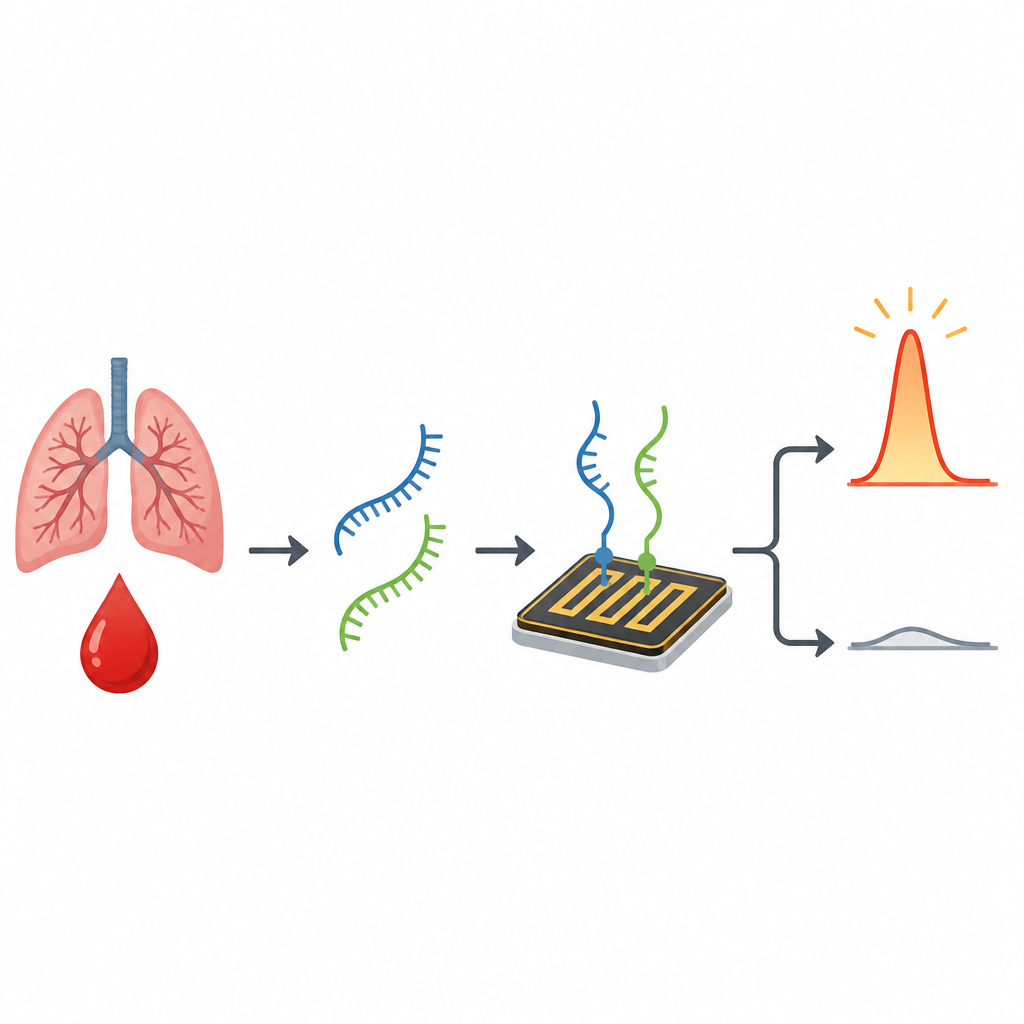
Cancer doctors increasingly look for telltale molecules in blood or other body fluids to spot disease early, but single warning signs can be noisy and misleading. This study shows how listening for a pair of small RNA signals together, instead of one alone, can make lab tests for lung cancer more accurate and reliable.
From single clues to combination checks
Many modern cancer tests track microRNAs and long non coding RNAs, short genetic messages that help control how cells behave. Two of these, called miR 21 and MALAT1, often rise in lung and other cancers, but each can also increase during normal processes or inflammation. If a test looks only at one of them, a harmless flare up in the body can mimic cancer and lead to false alarms. The researchers set out to design a sensing platform that would respond only when both molecules show up together at high levels, a pattern that more closely matches true tumors.
Building an RNA powered logic gate
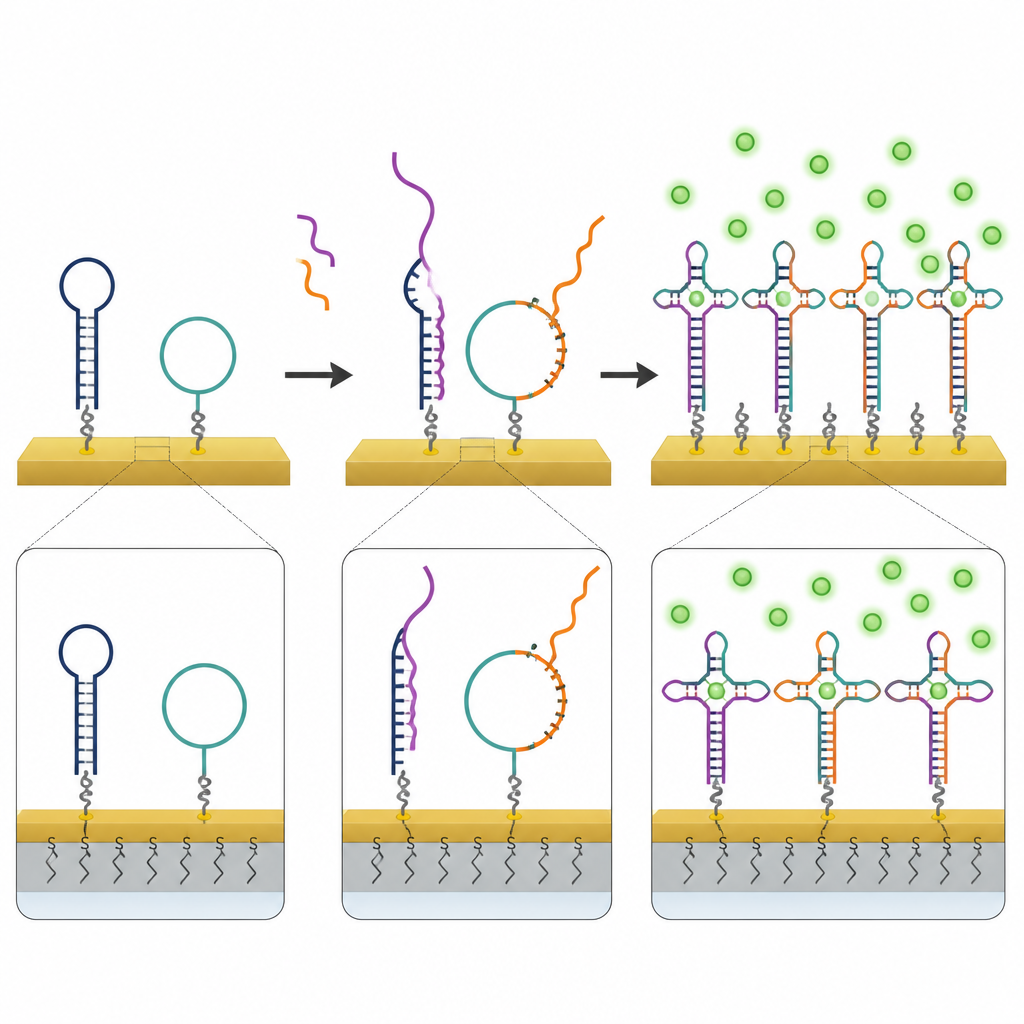
The team created a molecular circuit that behaves like a simple electronic AND gate, producing a signal only when both inputs are present. One part of the design is a hairpin shaped DNA probe that recognizes miR 21. When miR 21 is around, it binds to this hairpin and causes it to open, releasing a short DNA primer. A second DNA piece, called a padlock probe, is tailored to latch onto MALAT1 and close into a ring only when MALAT1 is there. Both the free primer and the closed ring are needed to start a rolling copying reaction that extends long strands of DNA on the surface of an electrode.
Turning DNA chains into readable signals
These extended DNA chains are engineered to contain repeated G rich segments that fold into special four armed shapes. When a small iron containing molecule binds to these shapes, they act like tiny enzyme mimics that speed up a chemical reaction involving hydrogen peroxide. This reaction changes color in a standard lab dye test and also alters the flow of electrons at the electrode surface, which can be read out as an electrical current. The result is a strong, easily measured signal that appears only when both miR 21 and MALAT1 have triggered the copying step, while other RNAs or single targets alone leave the system quiet.
Putting the sensor to the test with real cells
After confirming the chemistry, the scientists challenged the platform with lung cancer cell lines and normal lung cells. Normal cells produced low current signals, while all examined lung cancer cells gave clearly higher readings, with no overlap between the groups. The sensor could also tell apart tumor types that share high miR 21 but differ in MALAT1, highlighting the advantage of checking both markers together. In samples mimicking inflammation, single marker tests misread the elevated RNAs as cancer like, but the dual RNA test stayed mostly silent. In clinical lung cancer and pleural effusion samples, the dual marker method outperformed either single marker alone, showing higher power to separate patient and healthy groups.
What this means for future cancer diagnosis
To a non specialist, the key message is that this work turns two imperfect signals into one more trustworthy answer. By requiring both RNA markers to be high before sounding an alarm, and by amplifying their combined presence into a strong electrical and color change, the platform cuts down on false positives while still catching very low levels of cancer related molecules. With further streamlining and large scale testing, similar multi marker logic based sensors could move into compact devices that help doctors screen for lung cancer and other diseases earlier and more precisely.
Citation: Guo, Y., Zhang, J., Jiang, L. et al. Orthogonal recognition of miRNA and lncRNA enables high-fidelity cancer diagnostics. Commun Chem 9, 180 (2026). https://doi.org/10.1038/s42004-026-01978-9
Keywords: lung cancer detection, microRNA biomarker, MALAT1, electrochemical biosensor, rolling circle amplification