Clear Sky Science · en
Allosteric regulation of enzymatic catalysis by molecular crowding
Why crowding inside cells matters
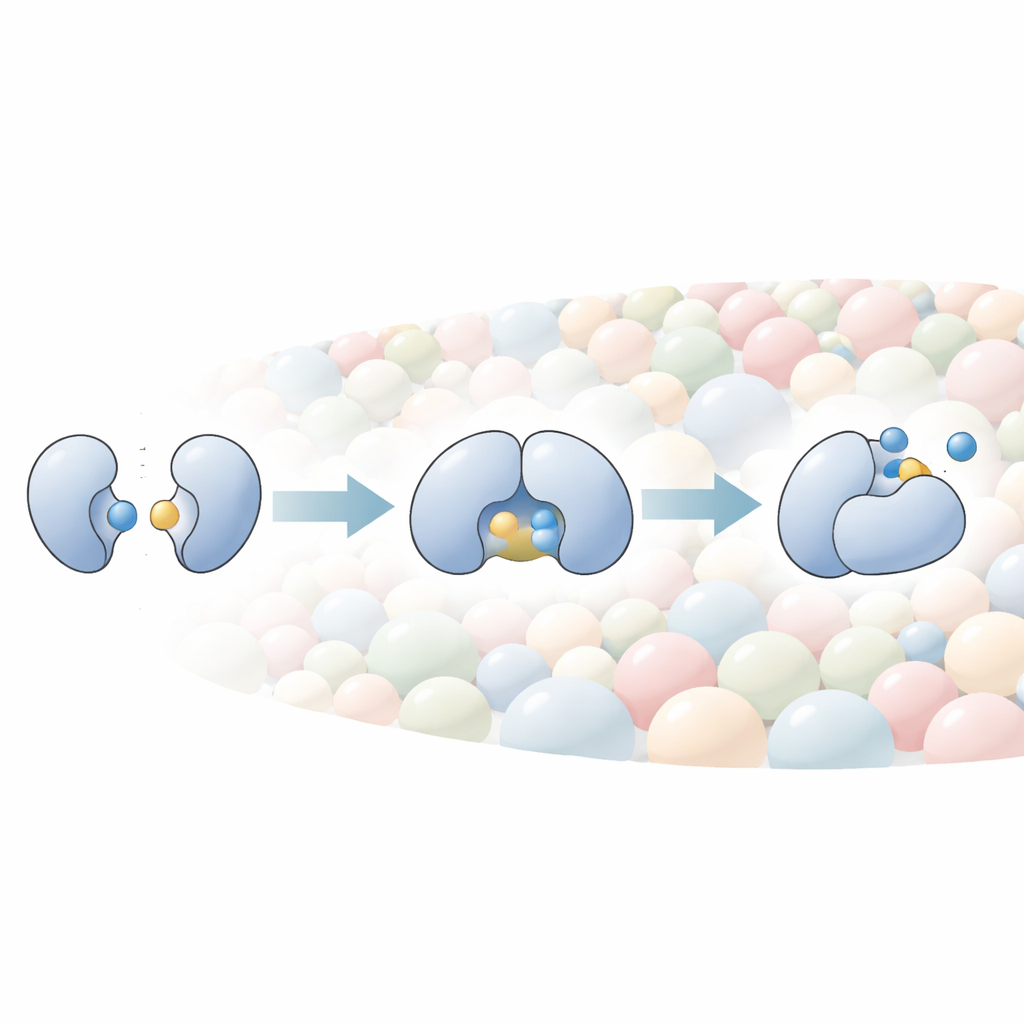
Inside every living cell, proteins and other molecules are packed together so tightly that nearly a third of the volume is filled. Enzymes—the tiny machines that drive chemistry in cells—must work in this bustling environment, not in the dilute solutions often used in test tubes. This article explores how that crowding can either speed up or slow down an enzyme’s work, and explains a general rule that helps predict which way things will go.
Life in a molecular traffic jam
The authors begin by describing how crowded the cell interior really is. Beyond the usual mix of metabolites, there are large proteins, nucleic acids, sugars, and complexes that jostle each other constantly. Cells can even create highly concentrated droplets, known as condensates, to locally tune reaction rates. Experiments over the years have shown confusing results: in some cases crowding makes enzymes more active, in others it inhibits them, and sometimes the effect changes with concentration. This diversity hinted that crowding was doing more than simply blocking space.
A model enzyme that opens and closes
To unravel this puzzle, the researchers focus on adenylate kinase (AdK), a well-studied enzyme that shuttles phosphate groups between energy-carrying molecules. AdK behaves like a clamshell with a rigid core and two mobile lids. In solution without any reactants, it flips between an open form and a closed form, with the open form more common. When the right substrates bind, they stabilize the closed form, allowing the reaction to occur; afterwards the enzyme must reopen to release products and start over. Because its activity is tightly linked to these large opening and closing motions, AdK is an ideal test case for understanding how crowding reshapes an enzyme’s internal motions.
Simulating the full working cycle in a crowd
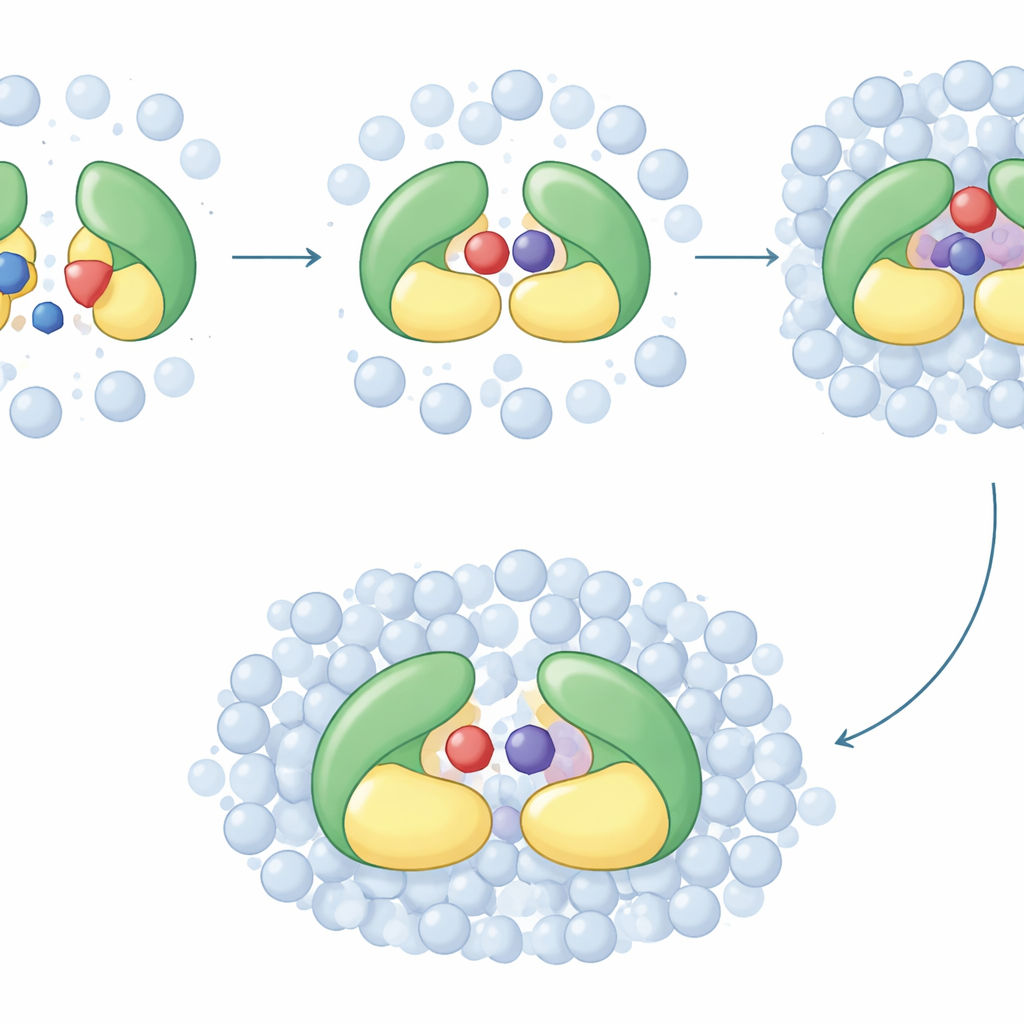
Instead of tracking every atom, the team used a coarse-grained computer model that represents each amino acid as a single particle but still preserves the enzyme’s overall shape and flexibility. They built a “dynamic energy landscape” that lets AdK move between open and closed states, bind substrates, perform the chemical step, and release products. To mimic molecular crowding, they added many inert spherical particles that interact with the enzyme mainly by taking up space. By changing how much of the simulated volume these particles occupy, they could dial in different levels of crowding and follow complete catalytic cycles over long simulated times.
When crowding helps and when it hurts
The simulations reveal a simple but powerful pattern. Crowding tends to favor compact shapes, so it stabilizes the closed form of AdK and speeds up the transition from open to closed. If, for a particular version of the enzyme, the slowest step is getting the substrates into place and achieving the closed, active form, then crowding helps: it nudges the enzyme toward closed states and speeds up overall activity. But if the slowest step is reopening and letting products go, the same crowding becomes a hindrance, because the overly stabilized closed form makes product release more difficult. By creating theoretical AdK variants biased toward more open or more closed behavior, the authors show that the very same crowders can either enhance or suppress activity, depending on which step limits the cycle.
Beyond hard packing: softer interactions and real cells
The study also tests more realistic scenarios. Using larger crowders softens the effect, because big particles exclude volume less harshly. Adding gentle attractive forces between crowders and the enzyme—mimicking proteins or nucleic acids in real cells—can partially counterbalance the packing effect and, in some cases, even boost activity for enzymes that otherwise struggle to release products. These explorations highlight that cellular crowding is not just about physical blockage but also about subtle, nonspecific interactions that shape how enzymes move and function.
What this means for understanding enzymes in cells
Overall, the work shows that molecular crowding acts like a distant control knob on enzyme activity by shifting how easily an enzyme can switch between open and closed forms. Whether this control speeds up or slows down catalysis depends on which step in the cycle is the bottleneck: forming the active complex or letting go of products. This framework helps make sense of many seemingly contradictory experimental results and offers guidance for engineering enzymes that work efficiently in the dense interior of cells or inside synthetic crowded environments.
Citation: Ren, W., Lu, J., Huang, H. et al. Allosteric regulation of enzymatic catalysis by molecular crowding. Commun Chem 9, 172 (2026). https://doi.org/10.1038/s42004-026-01977-w
Keywords: molecular crowding, enzyme dynamics, adenylate kinase, cellular environment, allosteric regulation