Clear Sky Science · en
Redox chemistry of early Earth and the origin of life
How Earth’s Early Chemistry May Have Sparked Life
Long before forests, oceans full of fish, or even bacteria existed, our planet was a restless ball of rock, water, and gas. During this remote Hadean time, Earth’s surface was shaped by volcanoes, asteroid impacts, and a churning interior. This article explores how simple chemical reactions that move electrons—called redox reactions—likely transformed raw planetary ingredients into the first building blocks of life. By tracing how air, water, and rock interacted, the authors show that several once-competing ideas about life’s beginnings may actually fit together.
Building a Planet Ready for Life
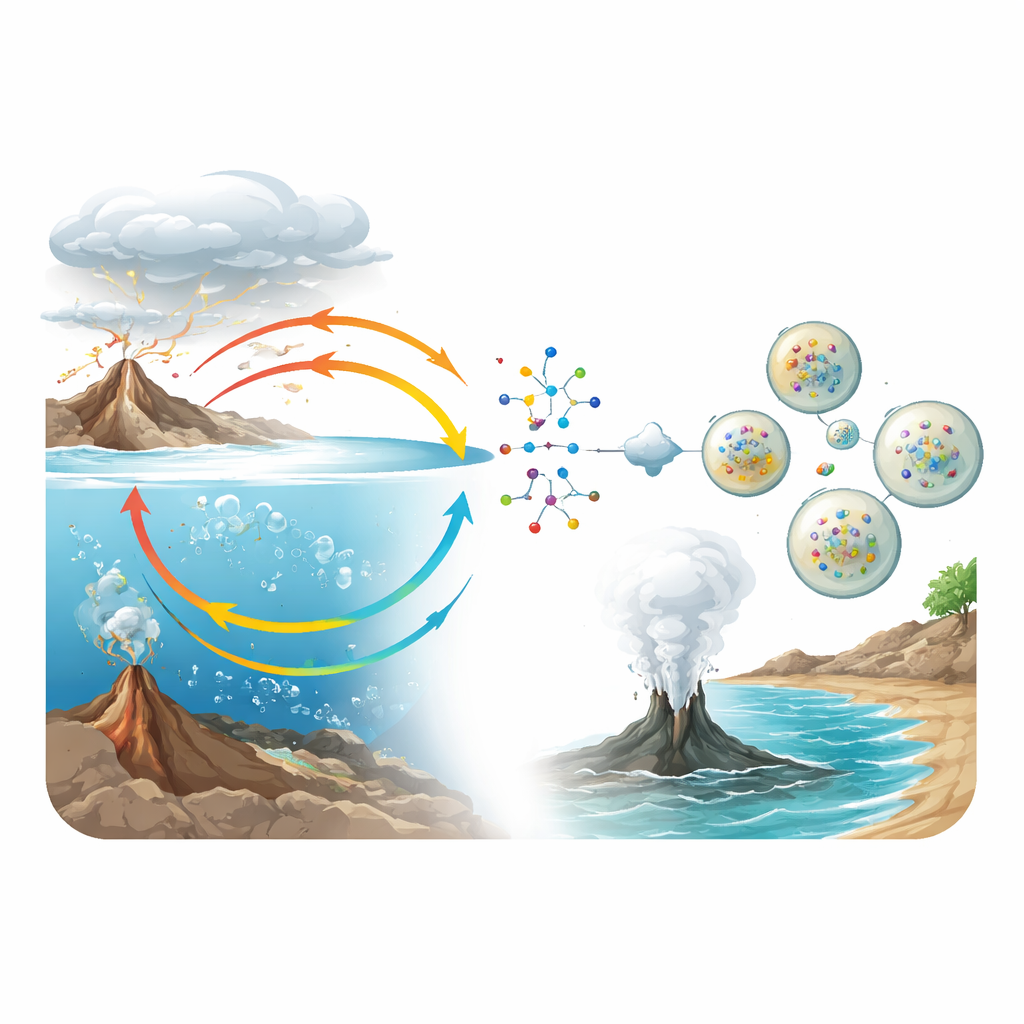
The story starts with how Earth itself took shape. After a series of giant impacts, including the collision that formed the Moon, Earth’s outer layer cooled from a global "magma ocean" into solid crust. As this crust thickened and broke into moving plates, volcanoes and deep faults began recycling material between the surface and the interior. This early form of plate tectonics helped control long-term cycles of carbon and other elements, keeping surface temperatures within a range where liquid water could exist. Rain reacting with fresh rock slowly drew carbon dioxide from the air into minerals, while volcanoes returned it to the atmosphere, creating a primitive climate thermostat that made Earth more habitable over time.
Air, Water, and Rock as a Chemical Engine
Above this changing surface, the young atmosphere was mostly carbon dioxide, nitrogen, and water vapor, with occasional bursts of more reactive gases like methane and ammonia from impacts and volcanism. Lightning, intense ultraviolet sunlight, and shocks from meteorite strikes energized these gases. In this restless sky, key molecules such as hydrogen cyanide and formamide could form—substances that are known starting points for amino acids, sugars, and the bases of RNA. Meanwhile, in the oceans and crust, iron- and sulfur-bearing minerals participated in redox cycles that turned otherwise inert molecules like carbon dioxide and nitrogen into more useful forms, including simple fuels and nutrients. Together, the atmosphere, oceans, and rocks acted as a connected chemical factory.
Oceans, Hot Springs, and the “Water Problem”
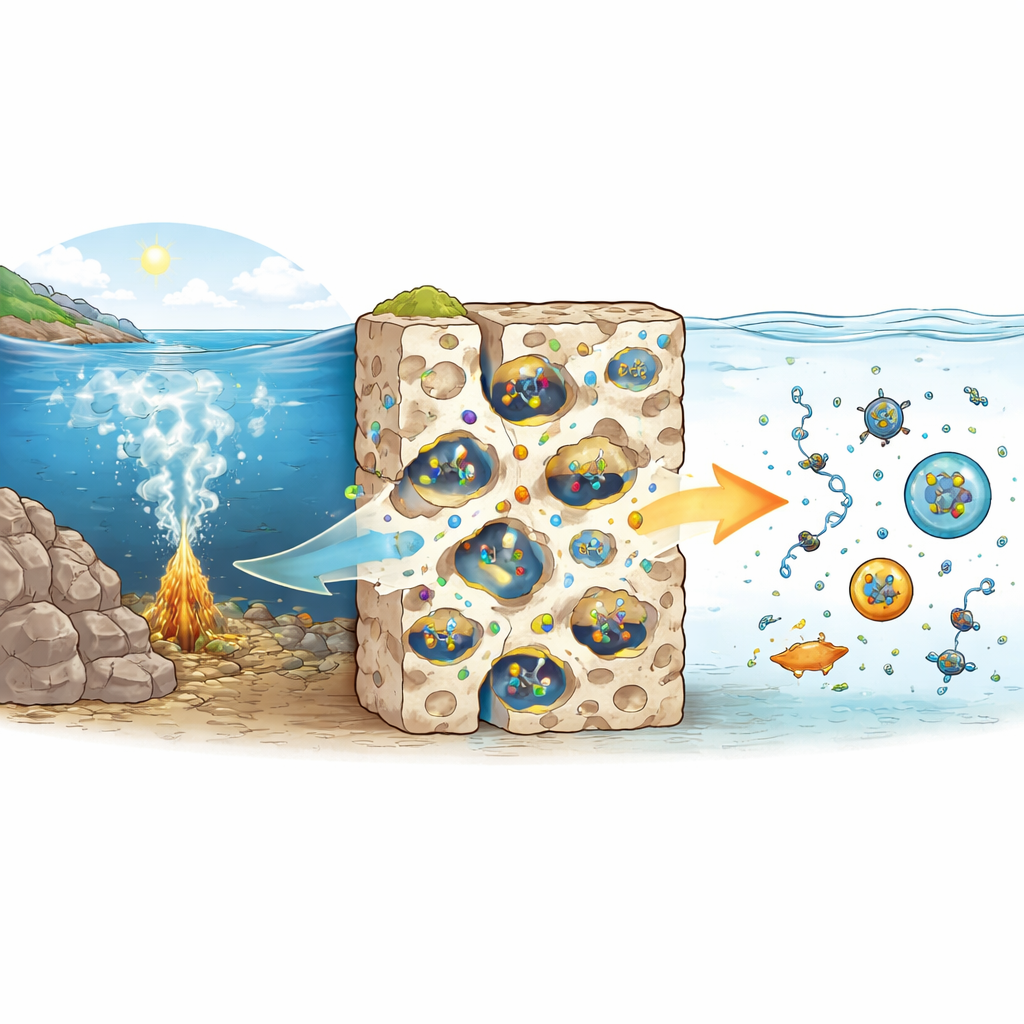
Much attention has focused on deep-sea hydrothermal vents as potential cradles of life. In Hadean times, these vents likely pumped hot, alkaline fluids rich in hydrogen into cooler, more acidic seawater. The resulting gradients in temperature, acidity, and redox state across porous mineral walls could power the conversion of carbon dioxide into small organic molecules and short carbon chains. However, water also tends to break large molecules apart, raising the so‑called water paradox: how could long chains like proteins or RNA form in an environment that constantly pulls them back into pieces? The authors argue that other settings—such as volcanic hot springs, shallow ponds, and crater lakes—offered natural wet–dry and hot–cold cycles. On mineral surfaces in these subaerial environments, concentrating and repeatedly drying mixtures of amino acids and nucleotides could drive them to link into longer chains despite water’s tendency to undo them.
From Metabolism to Genes, or the Other Way Around?
Scientists have long debated whether life began as a network of simple reactions that later learned to copy genetic information (“metabolism first”), or as self-replicating molecules like RNA that later built supporting chemistry (“genes first”). This review points out that early mineral-driven redox cycles resemble stripped-down versions of modern metabolic pathways that cells still use to fix carbon dioxide. Reactions powered by iron, sulfur, and hydrogen in vents and hot springs could make central compounds such as acetate and small organic acids—the same types of molecules that today feed into life’s core energy pathways. These reactions are often energetically favorable under plausible Hadean conditions. At the same time, atmospheric chemistry and surface ponds could build nucleotides and short RNA-like strands, especially where water repeatedly evaporated and condensed.
Many Birthplaces, One Outcome
Bringing these strands together, the authors suggest that life did not arise at a single magic spot, but from the interplay of many environments. The atmosphere, deep oceans, and land-based waters each specialized in making certain ingredients, which were then shuffled around by rain, rivers, aerosols, and ocean circulation. Over time, minerals and natural gradients channeled these ingredients into self-sustaining chemical networks, and simple membranes formed protocell-like compartments. In this picture, early organisms could include both “autotrophs” that made their own food from carbon dioxide and “heterotrophs” that consumed existing organics, emerging side by side. To a lay reader, the key message is that life’s origin likely depended less on a single miracle reaction and more on Earth’s entire redox-driven planet acting as a vast, interconnected chemical reactor.
Citation: Moldogazieva, N.T., Terentiev, A.A., Mokhosoev, I.M. et al. Redox chemistry of early Earth and the origin of life. Commun Chem 9, 143 (2026). https://doi.org/10.1038/s42004-026-01969-w
Keywords: origin of life, early Earth, hydrothermal vents, prebiotic chemistry, redox reactions