Clear Sky Science · en
Distribution of extraterrestrial nucleobases, other N-heterocycles, and their precursors in a sample from asteroid Bennu
Rocks That Carry the Seeds of Life
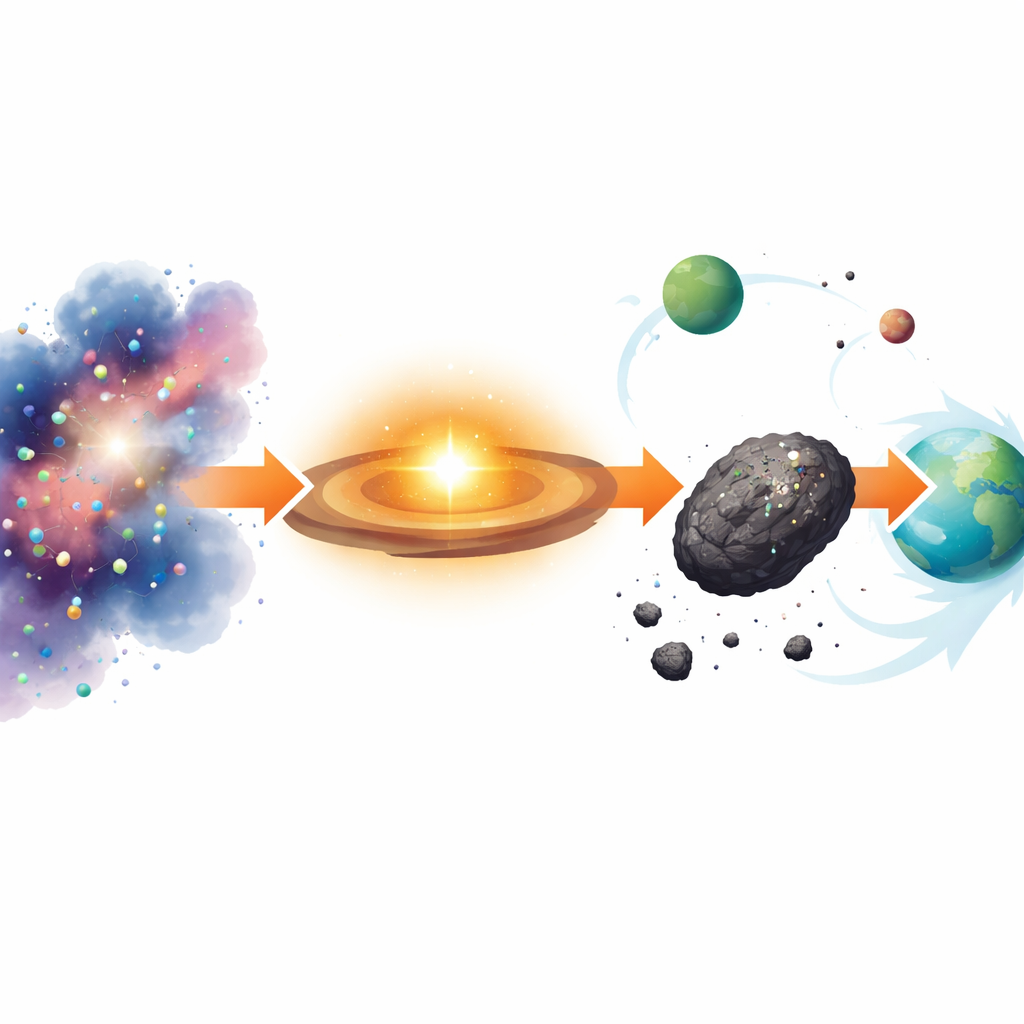
Long before Earth became a living world, space was already busy cooking up many of life’s chemical ingredients. This study looks at dust from the asteroid Bennu, recently returned to Earth by NASA’s OSIRIS-REx mission, and asks a simple but profound question: what kinds of “letters of life” are hiding inside this primitive rock? By carefully extracting and counting delicate ring-shaped molecules that form the heart of DNA and RNA, the researchers show that complex, life-related chemistry can unfold on an airless asteroid, without any biology at all.
What Was Found Inside Bennu’s Dust
The team analyzed a carefully homogenized portion of Bennu’s dark, fine-grained material and focused on nitrogen-containing ring molecules called N-heterocycles. These include nucleobases—the small components that, on Earth, pair up to write genetic code—as well as related families of rings. Remarkably, they detected all five of the canonical nucleobases used in DNA and RNA (adenine, guanine, cytosine, thymine, and uracil), along with several close cousins that are rare or absent in living organisms. They also found high levels of other nitrogen-rich rings such as imidazoles, triazines, and vitamin B3–like compounds, painting a picture of rich, varied chemistry that took place long before these samples reached our planet.
Gentle Versus Harsh Chemical “Mining”
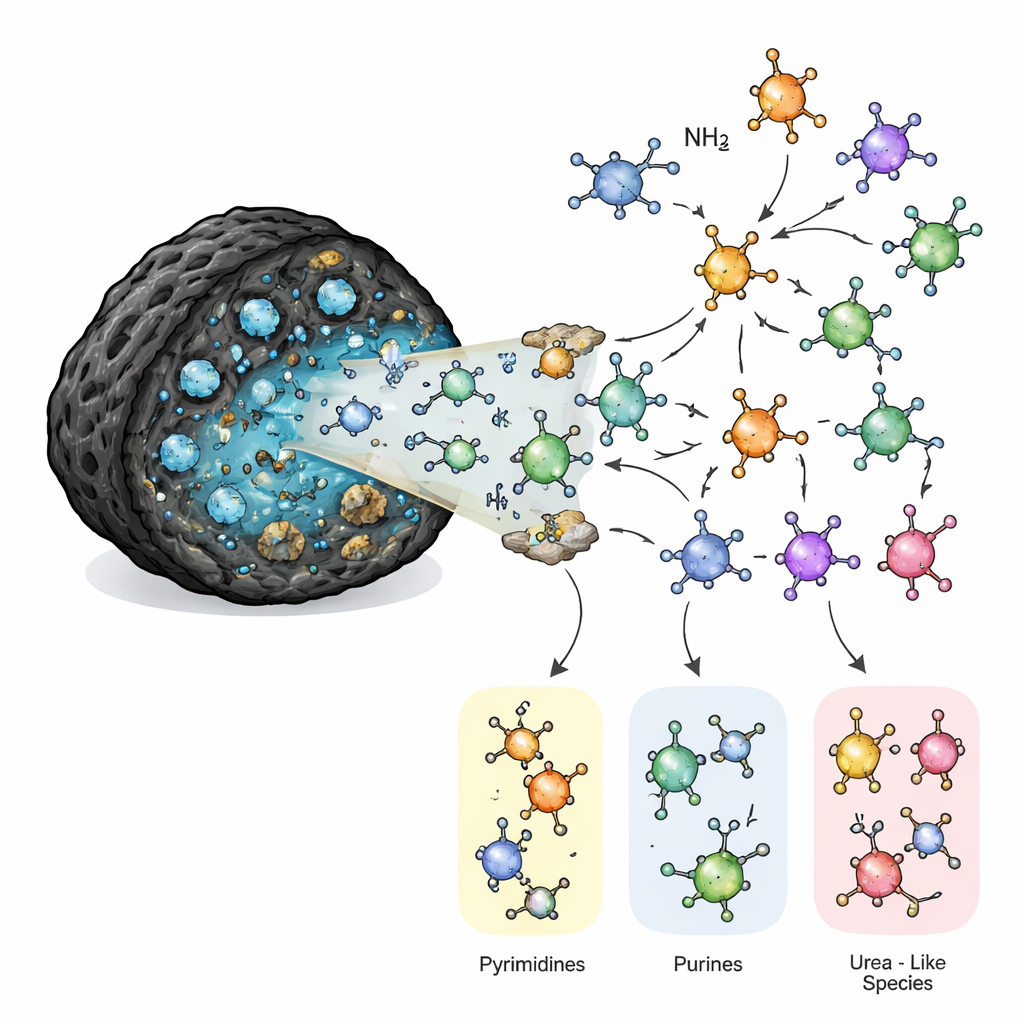
To understand how these molecules are stored in the rock, the researchers extracted organics from the same powdered sample with two different strengths of hydrochloric acid—one mild (2%) and one strong (20%). The gentle treatment liberated nucleobases and other rings that were loosely held or easily dissolved, while the harsher treatment broke open more resistant structures and mineral attachments. Both steps revealed the full set of standard nucleobases, but the strong acid released far more purines (adenine and guanine) and a broader variety of exotic isomers. This pattern suggests that some bases were free and mobile in Bennu’s ancient water-rich pores, while others were locked into macromolecules or clinging tightly to minerals such as clays and carbonates.
A Chemical Fingerprint of a Cold, Ammonia-Rich World
A key finding is that Bennu’s material is unusually rich in one class of bases, the pyrimidines (uracil, thymine, cytosine), compared with the purines. This “purine-to-pyrimidine” ratio acts like a chemical fingerprint of the environment in which these molecules formed. When the Bennu results are compared with those from meteorites and samples from asteroid Ryugu, a pattern emerges: Bennu and the Orgueil meteorite, which likely formed from ammonia-rich ices, show strong pyrimidine enrichment, while the famous Murchison meteorite, known to contain abundant hydrogen cyanide, is loaded with purines. Bennu’s dust also contains very large amounts of urea and related molecules, which laboratory experiments show can act as key starting materials for building pyrimidines and other nitrogen rings under cold, icy conditions.
Water, Heat, and Time Reshape the Chemistry
The distribution of non-nucleobase rings adds further clues about Bennu’s history. Chains of related triazine compounds—melamine, ammeline, ammelide, and cyanuric acid—appear in a sequence that matches what is produced when melamine is slowly hydrolyzed in warm, ammonia-rich water. In Bennu, the “end product” cyanuric acid dominates, implying that its parent body experienced extensive aqueous alteration over long periods. In contrast, the Murchison meteorite still contains mostly melamine, hinting at a milder or shorter-lived watery episode. Similarly, Bennu’s sample is rich in the acid form of vitamin B3–like molecules but lacks their more fragile amide versions, again consistent with prolonged exposure to water that quietly reshaped the original organic inventory.
Life’s Alphabet Without the Book
Strikingly, while Bennu harbors both nucleobases and sugars such as ribose, the team could not detect nucleosides—the next step where a base is chemically attached to a sugar to form a true building block of DNA or RNA. Laboratory work suggests that forming nucleosides under the cool, slowly evaporating conditions expected inside Bennu is inefficient, and the required high-energy reagents seen in some prebiotic experiments have not been found in such rocks. In plain terms, Bennu shows that nature can assemble many of life’s letters, and even arrange them into complementary “pairs,” but does not automatically bind them into the words and sentences of genetics. The study therefore strengthens the idea that asteroids delivered a diverse stockpile of raw molecular parts to the early Earth, while our planet’s own environments supplied the extra energy, catalysts, and complexity needed to cross the final threshold into biology.
Citation: Oba, Y., Koga, T., Takano, Y. et al. Distribution of extraterrestrial nucleobases, other N-heterocycles, and their precursors in a sample from asteroid Bennu. Commun Chem 9, 132 (2026). https://doi.org/10.1038/s42004-026-01966-z
Keywords: asteroid Bennu, nucleobases, prebiotic chemistry, carbonaceous meteorites, origins of life