Clear Sky Science · en
Optimizing photon conversion routes in cinnamate derivatives
Why this light-trick matters
Sunlight can be both life-giving and damaging. Nature has evolved tiny light-absorbing structures that turn harmful ultraviolet (UV) rays into harmless heat in a fraction of a trillionth of a second. This article explores how chemists can deliberately redesign one such natural scaffold – the cinnamate backbone found in many plants and sunscreens – so it funnels light energy into heat as efficiently as the molecule that kickstarts human vision. Understanding and tuning this ultrafast “light-to-heat” trick could lead to better UV filters, safer sunscreens, and smart materials that respond to light on demand.
Building better light-absorbing bricks
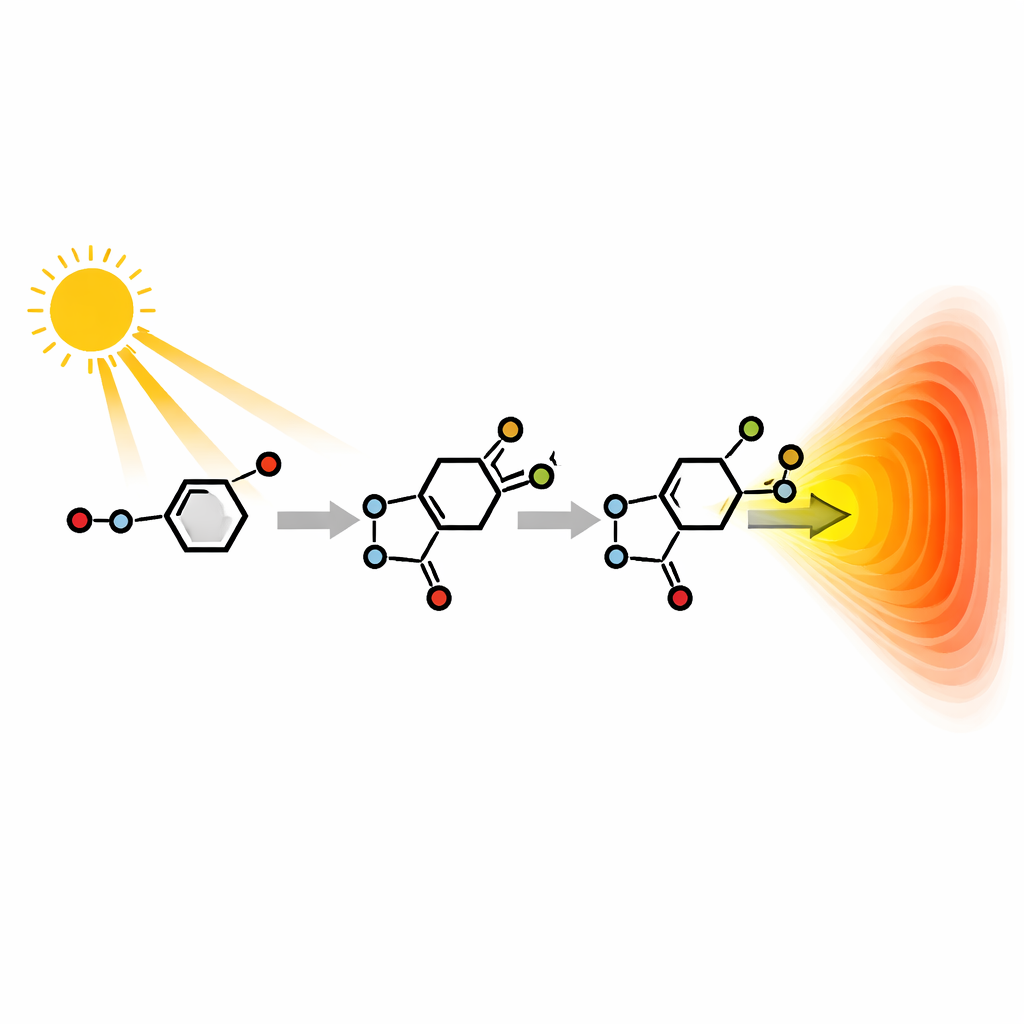
The researchers focus on a small family of molecules derived from methyl cinnamate, a compound common in plants. These molecules share a central double bond that can flip its geometry when hit by light, a motion known as photoisomerization. In nature, a similar flip in the retinal molecule is the very first step of vision and happens extraordinarily fast. Here, the team asks: can we redesign cinnamate molecules so that, instead of holding on to light energy or shining it back out, they dump it into heat almost as quickly as retinal does? To test this, they systematically add small chemical groups that change how crowded and how electron-rich the molecule is around its central double bond.
Three siblings with very different tempers
The team creates and studies three closely related cinnamate “siblings.” The first has extra groups placed close to the double bond, which were expected to twist the molecule and speed up its relaxation after absorbing light. Surprisingly, this version hangs onto its energy for tens to hundreds of picoseconds – a relative eternity on the molecular timescale – before fully relaxing. In the second sibling, an additional group is placed on the opposite side of the ring. This subtly improves how electrons are shared across the molecule and, crucially, makes it much easier for the excited molecule to reach a special crossing point where it can fall back to its ground state and release energy as heat. As a result, its excited-state lifetime shrinks by more than an order of magnitude.
Pre-twisting the spring
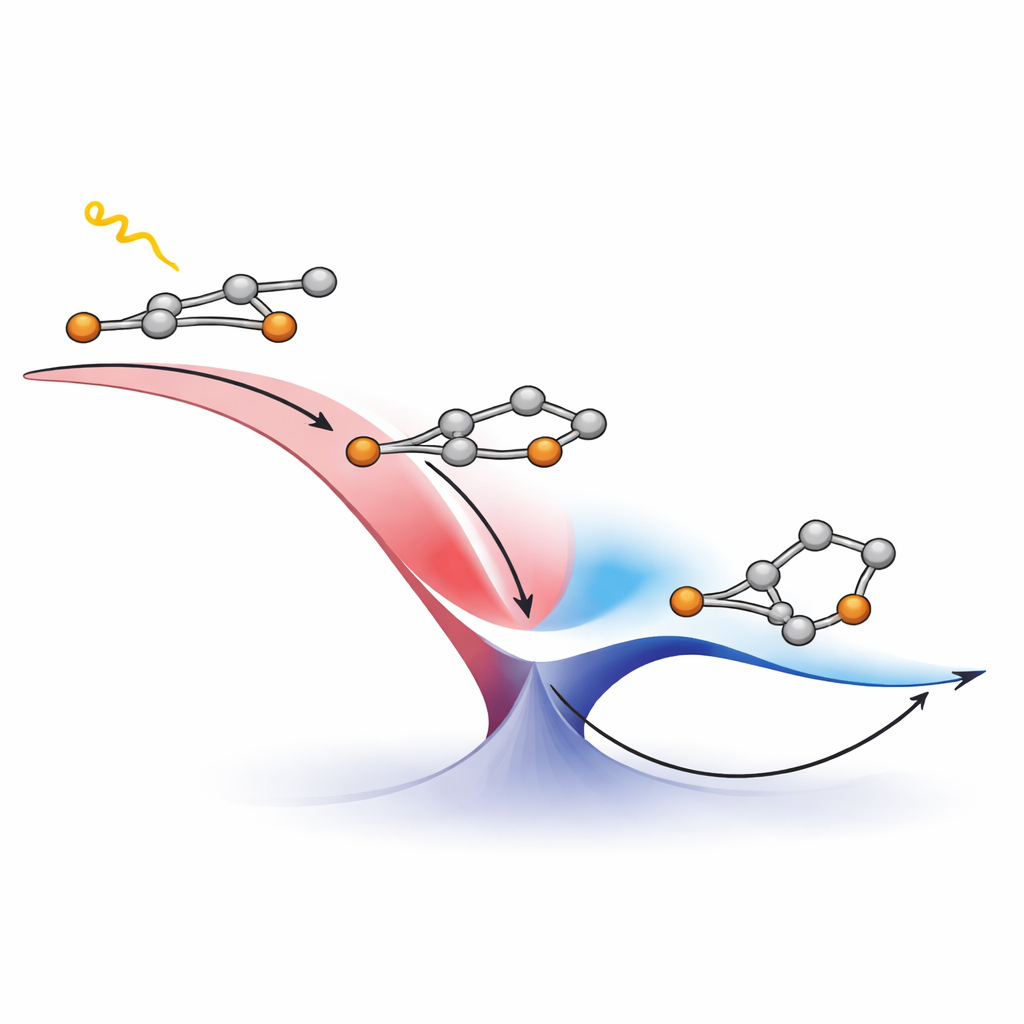
The third sibling adds one more small group directly on the central double bond. This extra steric crowding forces the molecule to be twisted even before it absorbs light, like a spring that is already partly wound. When a UV photon is absorbed, the molecule no longer settles into a comfortable excited-state valley; instead, it rolls almost directly downhill toward a “conical intersection” – the point where the excited and ground energy surfaces touch. At this intersection, energy is shed extremely rapidly as heat. Measurements show that this third derivative relaxes nearly as fast as cis-11-retinal in the eye, pushing the conversion of light to heat into the ultrafast femtosecond regime.
Watching molecules move in real time
To see these processes in action, the researchers use ultrafast laser techniques in both solution and gas phase. Femtosecond transient absorption and photoelectron measurements let them follow how the excited molecules change over time after a short UV pulse. In parallel, high-level quantum chemical calculations map out the energy landscapes these molecules travel on – highlighting where valleys, hills, and crossing points lie. The combined picture shows that small structural changes can switch between slow “trapping” in shallow excited-state wells and direct, almost barrier-free pathways back to the ground state via sharply focused conical intersections that act as efficient funnels for energy disposal.
From plant chemistry to smarter sunscreens
In everyday terms, this work shows that by cleverly choosing where to place tiny chemical “handles” on a simple light-absorbing backbone, scientists can tune how quickly and cleanly it converts UV light into heat. One design leads to energy being briefly stored, another routes it rapidly but with a small delay, and a third delivers almost instantaneous dumping of energy, rivaling nature’s benchmark in vision. These insights offer a recipe for engineering new molecules that protect against UV light more efficiently, act as fast and reliable light-driven switches, or safely convert light into heat in a controlled way – all by reshaping the invisible energy landscape that governs how molecules move after they absorb a photon.
Citation: Hymas, M., Dalton, J., Romanov, I. et al. Optimizing photon conversion routes in cinnamate derivatives. Commun Chem 9, 163 (2026). https://doi.org/10.1038/s42004-026-01963-2
Keywords: photoisomerization, cinnamate derivatives, ultrafast spectroscopy, UV photoprotection, photon-to-heat conversion