Clear Sky Science · en
Modulation of sonochemical reactions by cavitation driven thermal degradation of aqueous salts solutions
Cleaning Water and Making Fuel with Sound
Ordinary salt water can behave in extraordinary ways when blasted with powerful sound waves. This study explores how high-intensity ultrasound turns tiny bubbles in salty water into fleeting "microreactors" that can either help clean up pollutants or generate hydrogen gas, a potential clean fuel. By choosing the right dissolved salt, the authors show that we can steer these bubble-driven reactions toward more useful chemical outcomes, opening new paths for greener water treatment and energy production.
How Sound Turns Bubbles into Tiny Reactors
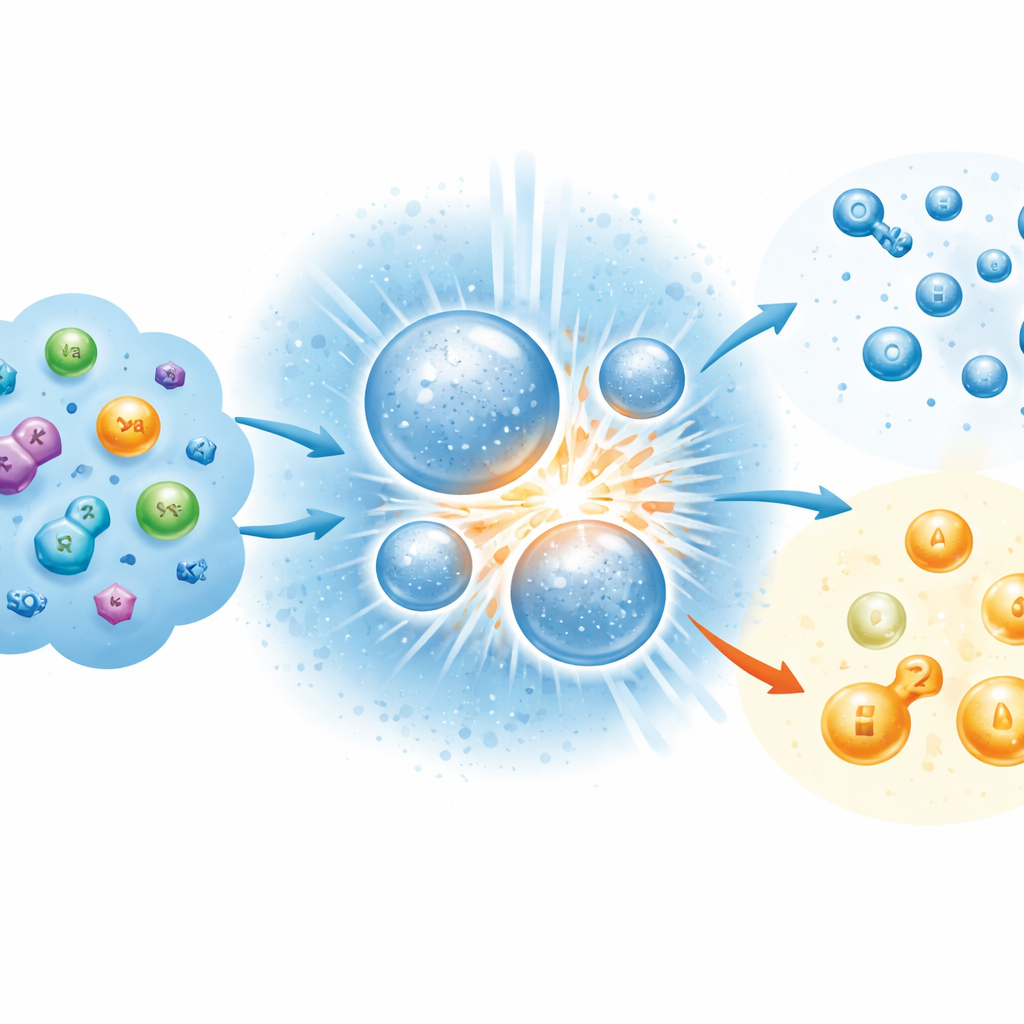
When strong ultrasound passes through a liquid, it creates countless microscopic bubbles that grow and suddenly collapse, a process known as acoustic cavitation. Each collapsing bubble briefly reaches extreme temperatures and pressures, like a tiny, short-lived hotspot. In pure water, this violent collapse rips water molecules apart, forming highly reactive short-lived species that can oxidize or reduce other chemicals. These reactions lie at the heart of "sonochemistry"—using sound to drive chemistry—but in plain water they are hard to control and often too inefficient for large-scale environmental or energy applications.
Salts That Turn Sound into Hydrogen
The researchers first examined concentrated solutions of a tartrate salt (potassium sodium tartrate). Under low-frequency ultrasound, they found that these solutions became strongly more reducing: dyes that normally break down were instead chemically "turned off" to a colorless form, and direct measurements showed a drop in the solution’s redox potential. Gas analysis revealed a striking increase in hydrogen production compared with pure water, along with carbon monoxide formed from breaking down the tartrate itself. These findings suggest that the collapsing bubbles are hot enough to thermally split the tartrate salt, releasing hydrogen gas and creating new reducing species that shift the chemistry in a fuel-producing direction.
Salts That Boost Oxidizing Power
Next, the team studied concentrated nitrate salts, such as potassium and sodium nitrate. Here, no obvious change in classic hydroxyl radicals could be detected, so the authors turned to a sensitive test that tracks how oxidizing species convert iodide into iodine. When nitrate was present, this test signaled a marked rise in oxidizing power at both low and high ultrasound frequencies. The results match a picture in which nitrates thermally decompose in or near the hot bubbles, releasing oxygen that reacts with hydrogen atoms from water splitting. This chain of events favors the formation of oxidizing products such as hydrogen peroxide, effectively recycling some of the bubble chemistry to make the solution a stronger chemical cleaner.
Flame-Quenching Phosphates That Fine-Tune Radicals
The most subtle behavior appeared with acidic phosphate salts, some of which are widely used in fire extinguishers. In concentrated phosphate solutions, ultrasound degraded several organic dyes—methylene blue, methyl orange, and bromophenol blue—more efficiently than in pure water and even outperformed a standard piezoelectric zinc oxide catalyst under comparable conditions. Fluorescent probes indicated complex, concentration-dependent changes in the apparent level of hydroxyl radicals, and light emitted from the collapsing bubbles hinted at the formation of phosphate-based radical species. Drawing on known flame-suppression chemistry, the authors propose that these phosphates absorb energy as they decompose and at the same time "catch and transform" the radicals formed from water. Rather than simply quenching the reactions, the phosphate-derived radicals appear to redirect them, generating a mixture of oxidative species that are especially good at breaking down dyes.
Designing Sound-Driven Chemistry for the Real World
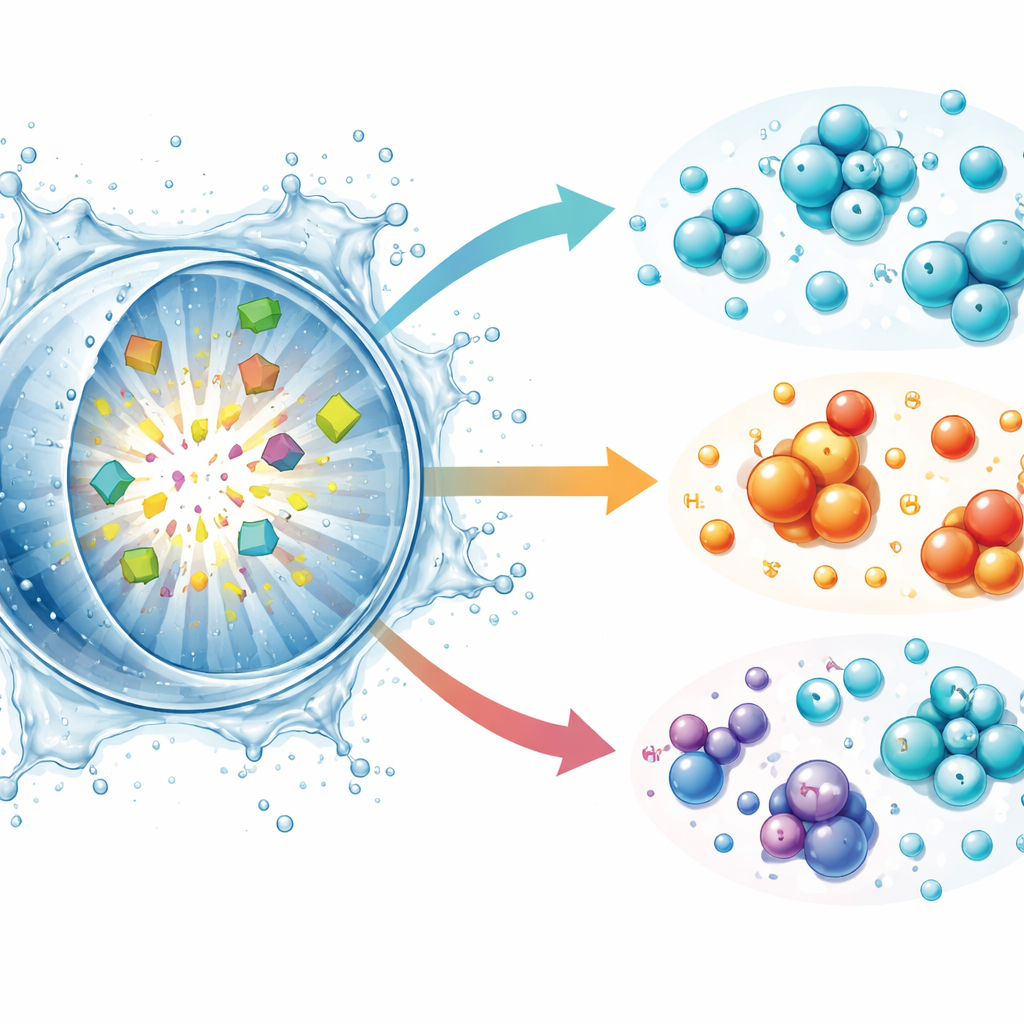
Taken together, the experiments show that the key player is not the special electrical behavior of piezoelectric salts, but their ability to decompose under the intense, brief heating inside or around collapsing bubbles. The salts’ breakdown products then shape the balance between oxidizing and reducing chemistry in the surrounding liquid. By tuning the salt type, its concentration, and the ultrasound frequency, the authors outline a new strategy for controlling sonochemical reactions in uniform solutions. In practical terms, carefully chosen salts could help turn ultrasound into a more predictable tool for cleaning polluted water or producing hydrogen, using nothing more exotic than sound, salt, and water.
Citation: Troia, A., Gallone, M., Vighetto, V. et al. Modulation of sonochemical reactions by cavitation driven thermal degradation of aqueous salts solutions. Commun Chem 9, 160 (2026). https://doi.org/10.1038/s42004-026-01961-4
Keywords: ultrasound cavitation, reactive oxygen species, hydrogen generation, advanced water treatment, sonochemistry